
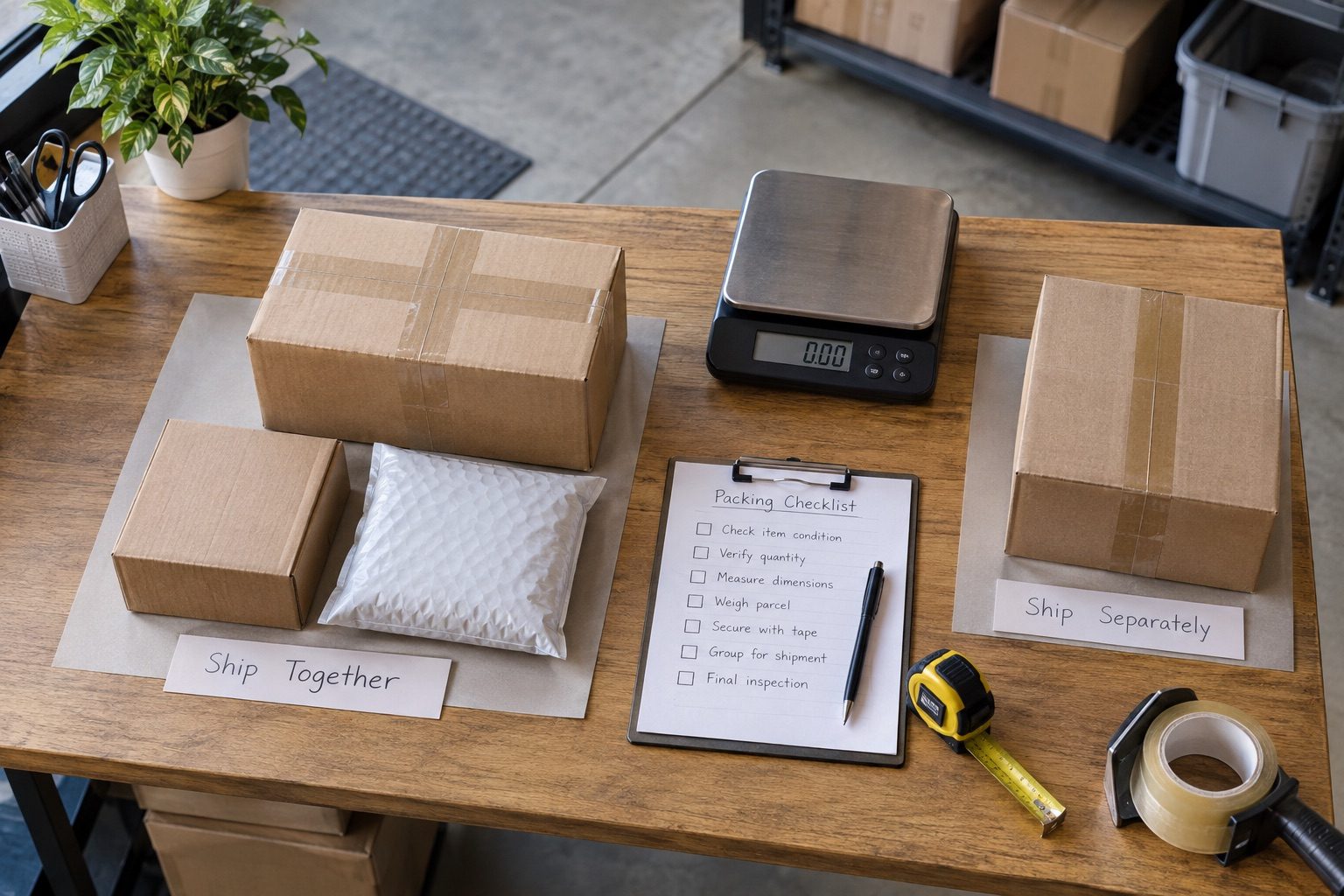
Decide whether Pinduoduo parcels for Guyana should be consolidated, repacked, separated or held by comparing product restrictions, return windows, chargeable weight and customs evidence.
If you are buying from several Pinduoduo sellers for delivery to Guyana, do not request consolidation automatically. First compare the cartons, product restrictions, return deadlines and chargeable weight. Some parcels should travel together; others are safer or cheaper to send separately.
This guide is for a personal buyer who has selected products and now needs to decide how the orders should leave China. It does not promise a fixed freight price, delivery time or customs result. Its outcome is a written dispatch decision: combine, repack, separate or stop before export.
For the basic two-leg process—from a Pinduoduo seller to a China address and then overseas—read the Pinduoduo international shipping guide. This page focuses on the decisions made after several domestic parcels are involved.
Start with a parcel map, not a freight quote
Create one row for every seller parcel before asking for international shipping:
| Parcel | Product | Quantity | Return deadline | Battery, liquid or other restriction | Seller weight/size | Decision |
|---|---|---|---|---|---|---|
| A | Describe the actual item | Hold / combine / separate |
Use specific descriptions such as “cotton T-shirts” or “plastic kitchen organisers.” “Accessories,” “samples” or “daily goods” is too vague for route screening and customs preparation.
The parcel map prevents three common mistakes: forgetting which seller sent an item, closing the domestic return window while waiting for another order, and combining a normal item with a product that changes the available shipping route.
Decide whether each parcel is ready to leave China
Before consolidation, match the received item to the order evidence. Check the visible model, colour, size, quantity and obvious exterior damage. Keep the product page, order record, payment evidence and seller conversation until the shipment has cleared.
A warehouse photo is useful evidence, but it is not a laboratory test, authenticity certificate or guarantee of hidden quality. If material composition, electrical safety or another regulated characteristic matters, obtain appropriate supplier evidence or professional testing before export.
If the wrong variant arrived and the seller return period remains open, a China-side return may be more practical than discovering the problem in Guyana. The China warehouse receiving guide explains what arrival recording and basic checks can—and cannot—establish.
Use four questions to choose consolidation or separate dispatch
1. Are the products compatible?
Ordinary dry clothing, non-fragile household items and similar unrestricted goods may be reasonable consolidation candidates. Batteries, liquids, powders, magnets, aerosols, branded goods with uncertain authorisation, fragile pieces and unusually long items may require a different route or may not be accepted at all.
Do not hide a restricted item inside a mixed carton. Ask for route eligibility using the exact product, composition, battery specification, quantity and packaging before authorising dispatch.
2. Will repacking reduce chargeable weight?
International carriers may charge the greater of actual weight and volumetric weight. The volume divisor depends on the carrier and service, so a universal formula should not be used as a final quotation.
Request the following for each incoming parcel and for the proposed final carton:
- actual weight;
- external length, width and height;
- packaging that can be removed safely;
- protective material that must remain;
- quoted route and its volumetric-weight rule.
Removing an oversized retail box can reduce volume, but inadequate protection can increase damage risk. A compact soft-goods parcel and a fragile item do not need the same repacking decision. Use the international shipping cost guide to understand how dimensions and service choice affect a quote.
3. Does waiting create a return or storage problem?
Consolidation is useful only when the remaining orders are likely to arrive before important return or inspection deadlines. Record the domestic tracking number and arrival date for every parcel. If one seller delays repeatedly, compare the cost of waiting with the cost of sending the ready items separately.
Eligible ordinary goods may qualify for up to 180 days of free storage under YDA Express conditions. This is not an unconditional promise for every product or parcel, and it should not replace a return-deadline decision.
4. Could the quantity look commercial?
Several different personal items and dozens of identical units create different customs questions. Consolidation can make separately purchased goods appear as one larger import. The correct response is not to split parcels to conceal the quantity; it is to describe the goods accurately and ask whether the shipment should follow a personal or commercial import process.
Prepare the Guyana clearance file before dispatch
The Guyana Revenue Authority describes personal effects as non-commercial items in barrels, boxes, packages or parcels sent by air or sea through a recognised shipping agency. Its procedure also shows that identification, a customs declaration, inspection and any assessed duties or taxes may be involved. Classification can change the declaration route even for a lower-value shipment.
That means “personal parcel” is not the same as “automatically tax-free,” and a marketplace checkout total is not a final landed cost. Before authorising shipment, prepare:
- consignee’s full legal name, delivery address, telephone number and valid identification details requested by the carrier or broker;
- Pinduoduo order pages and payment records;
- a product list with plain-English descriptions, quantities and actual purchase values;
- seller invoices or other transaction evidence where available;
- the final packing list and international waybill details;
- permits or supporting documents if the product category requires them.
Policy check: 28 September 2026. Confirm the current process and product-specific requirements with the Guyana Revenue Authority personal-effects guidance or the appointed carrier/broker before dispatch.
Build a landed-cost range instead of guessing one number
Use a worksheet with separate lines for:
- product payments;
- China domestic delivery;
- purchasing assistance, if used;
- warehouse handling or optional checks;
- repacking and protective materials;
- international freight based on the final chargeable weight;
- insurance, if selected;
- duties, taxes, brokerage and destination handling when applicable;
- local delivery in Guyana.
Do not declare a lower value to make the estimate look attractive. Guyana Customs can request valuation support and may reassess a value it considers unreliable. Keep the worksheet as a range until the final carton, route and customs treatment are known.
A practical dispatch decision
Choose combine and repack when the goods are compatible, return questions are resolved and the final carton reduces unnecessary volume without weakening protection.
Choose ship separately when products require different routes, one item is fragile or oversized, or waiting would close an important return window. Separate dispatch should reflect genuine handling needs, not an attempt to avoid customs scrutiny.
Choose hold when product identity, battery details, quantity, value evidence or consignee documents are incomplete.
Choose stop before export when the product cannot use an available route, required permission cannot be confirmed, the received item materially differs from the order or the landed-cost range no longer makes sense.
What YDA Express can support
YDA Express may assist with China purchasing, seller communication, warehouse receiving, available photos or agreed basic checks, eligible storage, consolidation, repacking and comparison of available international shipping options. Route availability must be confirmed from the exact product and destination details.
YDA Express does not determine the final HS classification, issue Guyana import permits, guarantee product quality, set the final tax assessment or guarantee customs release and delivery time. The consignee or importer remains responsible for accurate information and applicable import requirements.
Send the parcel map, product links, quantities and any battery or liquid details when requesting a route review. That information is more useful than asking only, “How much is shipping to Guyana?”
📲 Download the YDA Express App
Use the YDA Express App to place China purchasing orders, view product check photos, manage packages, and arrange consolidation and international forwarding.