
Learn how international shipping costs are calculated based on weight, dimensions, distance, and carrier. Practical tips for getting better rates, including consolidation and choosing the right service.
How Are International Shipping Costs Calculated? A Practical Guide for Everyday Shippers
You’re finally ready to send that care package to your cousin in Canada, or maybe you’ve just sold a vintage lamp to a buyer in the UK. You pack it up, head to the shipping counter—and the quote makes your jaw drop.
Why does it cost $80 to ship a box that weighs only 5 pounds?
The answer lies in how 【international shipping costs】
are actually calculated. It’s rarely just about weight. In fact, the scale often takes a backseat to something called dimensional weight.
If you’ve ever been baffled by freight charges, this guide will walk you through every major factor so you can estimate costs more accurately and avoid nasty surprises.
⸻
The Two Weights That Matter: Actual vs. Volumetric
Most people assume that if a package is light, shipping will be cheap.
That’s only half true.
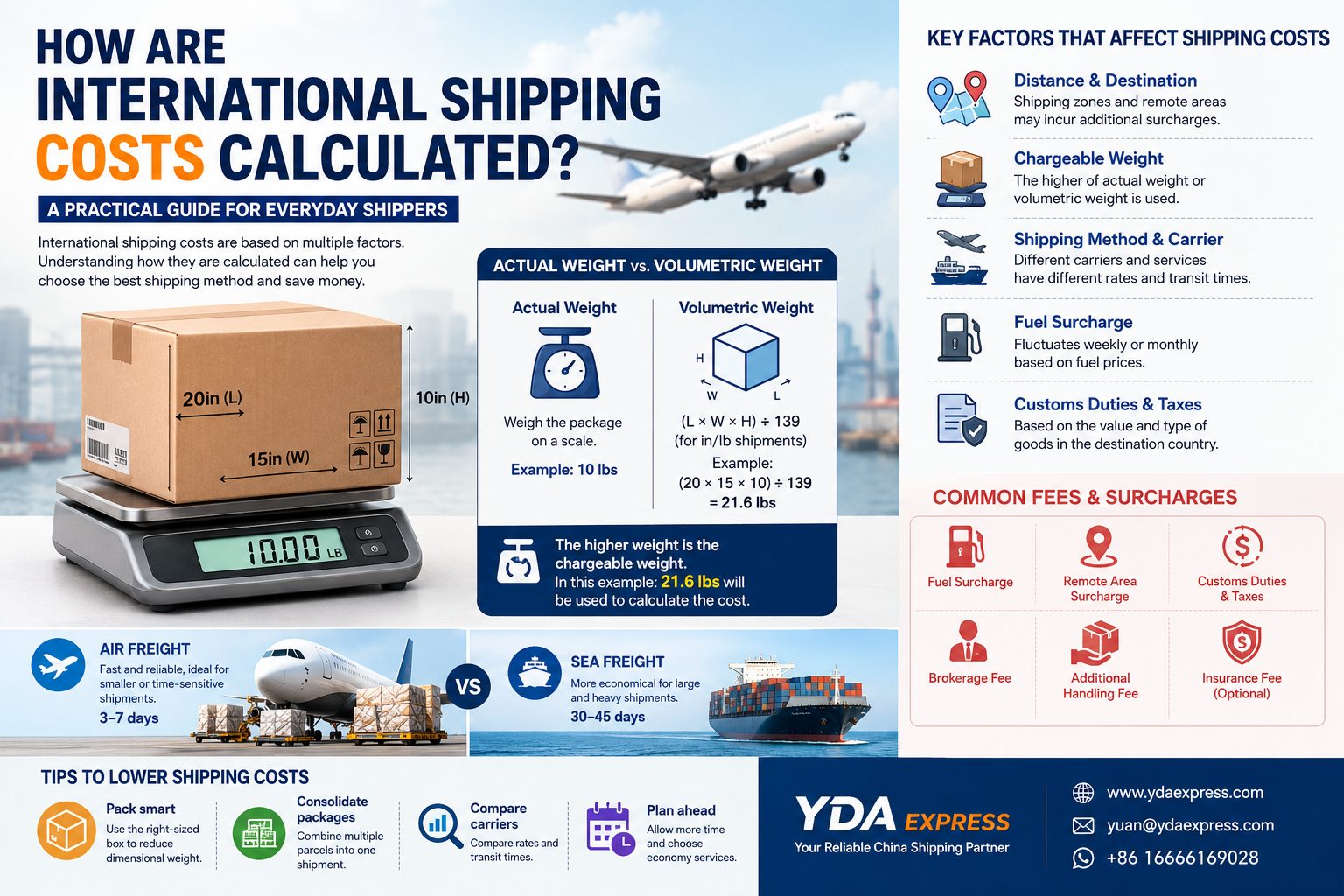
Carriers like FedEx, UPS, and DHL use a pricing method that compares two numbers: actual weight and volumetric (or dimensional) weight.
Whichever is higher becomes the chargeable weight—and it’s the key to understanding most air freight and express bills.
Actual weight is straightforward: put the box on a scale.
Volumetric weight accounts for how much space the package takes up in a plane or truck.
The formula is simple on paper:
length × width × height divided by a dimensional factor.
For international express shipments, that divisor is usually 139 for inches/pounds or 5000 for centimeters/kilograms.
So if you have a box that’s 20 × 15 × 10 inches, you’d calculate:
(20 × 15 × 10) ÷ 139 = 21.6 lbs
If the actual weight is only 10 lbs, you’ll be charged for 21.6 lbs.
That lightweight but bulky winter coat, stuffed into a big box, might cost as much to ship as a set of dumbbells.
This is why experienced shippers learn to pack tightly and use the right-sized boxes.
At YDA Express, we often see customers save 30–40% on shipping by using our 【Package Consolidation Service】
to combine multiple small packages into one optimized shipment.
Removing excess packaging and air pockets can dramatically reduce dimensional weight, helping customers pay only for the space they actually need.
allows you to collect all parcels first before shipping them internationally, making consolidation much more cost-effective.
⸻
How Distance and Destination Shape the Price
Shipping from Shanghai to Sydney isn’t just about kilometres.
International carriers divide the world into zones, and the farther the destination zone from the origin, the higher the base shipping rate.
For example, sending a 【parcel from China】
to the United States (Zone 7 or 8, depending on the carrier) will usually cost more than sending it to Japan (Zone 2).
However, pricing isn’t always perfectly linear.
Remote or less-serviced regions often carry additional surcharges that can make a nearby destination more expensive than a distant metropolitan area.
A real-world example:
A 2 kg package shipped via FedEx International Economy from Guangzhou to Los Angeles might cost around $30–40.
The same package delivered to rural Montana could cost an additional $10–15 because of a remote area surcharge.
Always check whether your recipient’s address qualifies as a remote delivery area before placing your order.
Most carriers provide online tools for this, but many people don’t check until they receive an unexpectedly high invoice.The Carrier Equation: Comparing Apples to Apples
Not all carriers calculate shipping charges the same way.
DHL, for instance, is known for offering a slightly more favorable dimensional divisor on certain routes, which can benefit customers shipping medium-sized packages.
UPS and FedEx generally provide similar international pricing, although fuel surcharges change frequently and can increase the final cost by 10–15%.
SF International is another popular option for shipments originating from China, especially for destinations across Asia.
If you’re comparing different logistics providers, choosing the right 【international shipping service】
can make a significant difference in both shipping costs and delivery time.
Here is a common example for a shipment from Shenzhen to London.
A 5 kg parcel measuring 30 × 30 × 30 cm may cost approximately:
- DHL Express: $55–65 (3–4 business days)
- FedEx International Priority: $60–70
- UPS Worldwide Express: $65–75
- SF International Economy: $30–40 (7–12 business days)
through YDA Express can reduce shipping costs by up to 50% while still offering reliable international delivery.
Our logistics specialists compare multiple shipping channels and recommend the most cost-effective solution based on your destination, package size, and delivery timeline.
⸻
Sea Freight: When Volume Really Matters
Once your shipment exceeds approximately 50 kg or half a cubic meter (CBM), 【Sea Freight】
often becomes more economical than air freight.
Sea freight charges are typically calculated by cubic meter (CBM) rather than package weight.
For Less-than-Container Load (LCL) shipments, freight forwarders usually charge per cubic meter, while Full Container Load (FCL) shipments are priced per container.
For example, shipping from China to the US West Coast may cost approximately $80–120 per CBM, excluding customs clearance, documentation, and destination handling fees.
Although sea freight offers significant savings for bulky shipments, it requires more patience.
Door-to-door delivery from China to New York generally takes between 30 and 45 days.
to simplify customs clearance, delivery coordination, and overall shipping management.
⸻
Hidden Fees and Surcharges You Should Know About
Many first-time international shippers only compare the base freight rate.
However, the final invoice often includes several additional charges that should not be overlooked.
Common examples include:
- Fuel surcharge
- Remote area surcharge
- Customs duties and taxes
- Brokerage fees
- Additional handling fees
If you’re unfamiliar with import regulations, working with a professional 【China logistics partner】
can help you avoid unexpected expenses and shipping delays.
For international buyers, requesting a complete landed cost estimate before shipment is always recommended.
This estimate includes freight charges, taxes, customs duties, and all applicable surcharges, allowing you to understand the real cost before shipping.
⸻
Tips to Lower Your International Shipping Costs
One of the easiest ways to reduce shipping expenses is to calculate dimensional weight before packing.
Using a slightly smaller box or removing unnecessary retail packaging can often reduce the chargeable weight by more than 20%.
If you’re purchasing products from multiple Chinese marketplaces such as 【Taobao】
shipping each parcel separately is usually much more expensive.
Instead, you can send all purchases to a 【China Warehouse】
where they are inspected, consolidated, and professionally repacked before international shipping.
Using 【Package Consolidation】
can dramatically reduce shipping costs by eliminating unnecessary packaging and minimizing dimensional weight.
I once saw a family combine fifteen individual parcels—including clothing, toys, and electronics—into one optimized shipment.
Instead of paying an estimated $320 for separate deliveries, they spent only $78 using air freight consolidation.
This example clearly demonstrates how consolidation can significantly reduce international shipping expenses.How to Get a Reliable Estimate
Before requesting an international shipping quote, prepare the following information:
- Actual weight of the package
- Package dimensions (length, width, height)
- Origin and destination addresses
- Description of the goods
- Declared value
Providing complete and accurate information allows shipping companies to recommend the most suitable 【international shipping solution】
based on your package size, delivery timeline, and budget.
Many carrier websites offer online shipping calculators, but these usually provide only estimated rates.
If you ship frequently or purchase products from China on a regular basis, consulting an experienced 【China Shipping Agent】
can often save both time and money.
Professional freight forwarders understand carrier pricing rules, customs regulations, and package optimization techniques that most individual customers are unfamiliar with.
⸻
At YDA Express, we prepare shipping quotations every day for customers around the world.
Whether you’re ordering from one supplier or dozens of different online stores, our 【China Warehouse】
allows you to receive all purchases in one location before shipment.
Our experienced team then performs 【Package Consolidation】
to remove unnecessary packaging, reduce dimensional weight, and lower overall shipping costs.
Depending on your requirements, we can recommend 【Air Freight】
or 【Sea Freight】
to provide the best balance between price and delivery speed.
Whether you’re shipping a smartphone case, business inventory, or an entire container of furniture, our team will help you choose the most cost-effective logistics solution.
⸻
The Bottom Line
International shipping costs are not as mysterious as they first appear.
The total price depends primarily on:
- Chargeable weight (actual weight vs. dimensional weight)
- Destination country and shipping zone
- Shipping carrier
- Fuel surcharges
- Customs duties and taxes
- Additional handling fees
Understanding these factors allows you to estimate shipping costs more accurately and avoid unnecessary expenses.
For people who frequently purchase products from multiple Chinese stores, 【Package Consolidation】
is one of the most effective ways to reduce international shipping costs.
Instead of paying multiple shipping fees, your purchases are combined into one optimized shipment, significantly reducing transportation expenses.
If you’re shopping from China regularly, our 【China Shopping Agent】
can also help purchase products on your behalf, inspect goods, consolidate parcels, and arrange worldwide delivery through a single platform.
If you’d like to learn more about our complete 【China Shopping & International Shipping Services】
our team is always happy to help.
You can contact YDA Express via WhatsApp, email, or visit our official website for a personalized shipping quotation.Related Articles
📖 Related Articles