
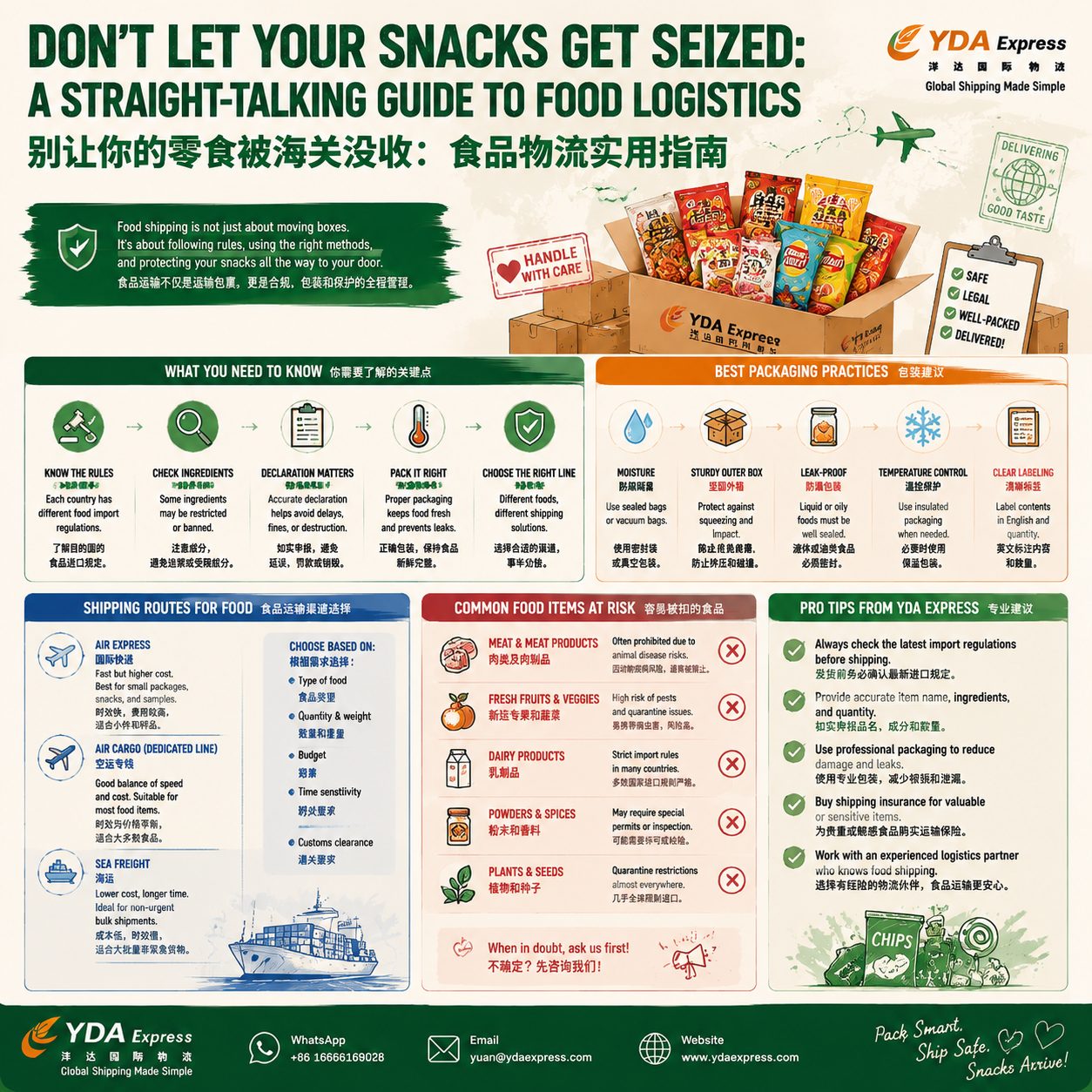
Learn how to check whether Chinese snacks, tea, sauces and other packaged foods can be shipped internationally. Review ingredients, destination restrictions, warehouse checks, packaging, customs declarations and shipping-route requirements before buying.
Chinese shopping platforms offer tea, packaged snacks, hot pot seasoning, sauces, dried foods and regional products that may be difficult to find overseas. The difficult part is determining whether a product can legally enter the destination country and whether a carrier is willing to transport it.
“Food” is not a single shipping category. Two products that look similar may be treated differently because one contains meat extract, dairy, seeds, alcohol or an ingredient subject to agricultural controls.
The safest approach is to check the product before buying it. Once restricted food reaches a China warehouse, there may be no suitable international route, and returning it may become difficult if the seller’s return period has expired.
Why food requires a product-by-product check
Food shipments may be examined for public-health, agricultural, labelling and customs compliance. The decision can depend on:
- destination country;
- full ingredient list;
- country of origin;
- processing method;
- retail or homemade packaging;
- shelf life;
- storage temperature;
- quantity;
- personal or commercial purpose;
- carrier restrictions;
- permits or prior notifications.
A factory-sealed packet of plain biscuits and a packet containing meat filling are not necessarily treated the same way. Tea bags and loose leaves may also face different requirements when plant material, seeds or medicinal claims are involved.
Do not rely on a seller’s statement that a product is “safe to ship.” A seller may only be confirming domestic delivery within China, not international transport or import eligibility.
Information to collect before placing the order
Before buying any food product, obtain:
- clear photographs of the front and back of the package;
- complete ingredient list;
- net weight;
- manufacturer and country of origin;
- production and expiry dates;
- storage requirements;
- processing method, when relevant;
- presence of meat, dairy, egg, seafood, alcohol or plant material;
- quantity you intend to send;
- destination country and postal code.
If the product page does not show the ingredient label, ask the seller for a photograph. A translated product title is not enough. “Spicy snack” does not reveal whether the seasoning contains beef extract, chicken powder or animal fat.
Customers using purchasing assistance should include the exact flavour, package size, quantity and acceptable alternatives. New YDA Express customers pay no purchasing service fee on their first order. Contact customer service before placing the order to request the offer. Existing customers may ask about available exclusive discounts or coupons.
Food categories that need extra caution
The following categories commonly require additional checking. They are not universally prohibited, but they should never be purchased for international delivery without confirming the destination rules and available route.
Meat, poultry and animal-derived ingredients
Fresh, dried, cooked and vacuum-packed meat products may be subject to strict animal-health controls. Seasoning powders, soup bases and instant noodles can also contain meat extracts even when meat is not obvious from the product name.
Check for ingredients such as beef, pork, poultry, animal fat, meat powder, broth and gelatin.
Dairy and egg products
Milk powder, cheese, cream-filled snacks and products containing egg may be controlled differently depending on origin, processing and quantity. A commercially packaged product is easier to identify than homemade food, but retail packaging does not guarantee admission.
Fresh produce, seeds and plant material
Fresh fruit, vegetables, seeds, herbs and untreated plant products may carry pests or plant diseases. Dried products can also be restricted depending on the species and processing method.
Tea should be identified accurately. Do not describe all plant-based products simply as “tea” if they contain mixed herbs, seeds or ingredients sold with medicinal claims.
Liquids, oils and sauces
Chilli oil, sauces, drinks and liquid seasoning can create both transport and packaging problems. Some routes limit liquids even when the destination country allows the food itself.
The warehouse needs the container type, volume and ingredient information before confirming a route.
Supplements and products making health claims
A product sold as ordinary food in China may be treated as a supplement, traditional medicine or regulated health product in another country. Pills, powders, concentrated extracts and products making therapeutic claims require specific review.
The restricted-item pre-shipping checklist explains why products accepted for delivery within China may still be unsuitable for international transport.
Check the destination rules, not general internet advice
There is no universal list that applies to every country. Import rules can change because of disease outbreaks, pest controls, public-health measures or regulatory updates.
Before purchasing, check the official customs, agriculture and food-safety websites of the destination. Search using the exact product type and origin country.
For the United States, food imports may involve different responsibilities under customs, food-safety and agricultural rules. Some non-commercial gifts sent from one individual to another may be treated differently from food shipped by a business, but the details of the transaction matter. Meat, poultry, fruit, vegetables and other agricultural products may have separate restrictions.
The European Union, United Kingdom, Canada, Australia and New Zealand also apply their own rules to animal products, plant materials, labelling and commercial imports. Do not copy a threshold or exemption from one country and apply it to another.
The customs policy guide for China shipments provides a general framework, but the destination authority makes the final decision.
What a China warehouse can check
A warehouse can help confirm visible information before dispatch, including:
- quantity received;
- external package condition;
- product name and flavour;
- visible ingredient label;
- production and expiry dates;
- leakage or obvious damage;
- whether the product appears factory sealed.
If the label is important, request clear photographs before approving the shipment.
A warehouse inspection cannot guarantee that the food complies with foreign law. It does not replace laboratory testing, food certification, permit review or a decision by the destination authority. It also cannot confirm ingredients that are absent from the manufacturer’s label.
YDA Express provides eligible customers with up to 180 days of free China warehouse storage. This allows packages from different sellers to arrive before shipment planning. Review the applicable terms in the free warehouse storage policy.
Food should not be stored simply because free storage is available. Check expiry dates, temperature requirements and seller return periods immediately after arrival.
Packaging food for international transport
Good packaging protects the parcel from leakage, crushing, moisture and odour transfer. It does not make a prohibited food legal.
Use packaging appropriate to the product:
- keep food in its original factory-sealed package;
- place liquids and oils in sealed secondary bags;
- use absorbent material around leak-prone containers;
- protect glass jars with individual cushioning;
- separate sharp can edges from flexible packages;
- prevent heavy cans from crushing snacks;
- fill empty space so products cannot move;
- use a strong outer carton;
- protect products from moisture.
Do not use ordinary vacuum bags to disguise a product or remove identifying labels. Customs may need to see the manufacturer, ingredients, origin and expiry information.
Temperature-sensitive food requires more than an insulated pouch. If a product must remain chilled or frozen, confirm that the complete transport chain provides the necessary temperature control. Standard parcel forwarding is generally unsuitable for food that depends on an uninterrupted cold chain.
When food should be consolidated separately
Consolidation can reduce unnecessary seller packaging and avoid sending several small parcels independently. However, food should only be combined with compatible products.
Keep food separate from:
- chemicals and cleaning products;
- strongly scented cosmetics;
- batteries or electronics that require another route;
- liquids that could contaminate dry foods;
- heavy products that may crush retail packaging;
- items intended for a different recipient;
- goods requiring different customs documents.
Different food products may also need separate treatment. A route that accepts factory-sealed tea does not automatically accept sauce, meat seasoning or herbal powder.
The package consolidation guide explains how to combine suitable purchases while avoiding incompatible products.
Choosing a shipping route for food
The fastest route is not automatically the most suitable, and the cheapest service is not necessarily authorised to carry food.
Route availability depends on:
- destination;
- exact product;
- ingredients;
- packaging type;
- parcel weight and dimensions;
- quantity;
- personal or commercial purpose;
- carrier rules;
- required documents.
Ask whether the route accepts the specific product rather than asking whether it accepts “food.” Provide photographs of the label and destination information before requesting a quote.
Avoid claims that one carrier or port receives fewer inspections. Customs inspections and admissibility decisions are outside the control of the forwarder. A lawful shipment should be prepared to withstand review regardless of the selected route.
For a broader comparison of transport methods, see the international shipping guide from China.
How to describe food on the customs declaration
Use a specific description that matches the product. Examples include:
- factory-sealed jasmine tea bags;
- packaged wheat crackers;
- bottled chilli sauce;
- instant noodles with vegetable seasoning;
- commercially packaged sugar candy.
Avoid vague terms such as:
- gift;
- snacks;
- groceries;
- food products;
- personal items;
- samples.
The declaration should also state the correct quantity and value. Free samples and seller gifts still need to be identified when included in the parcel.
Keep purchase records, ingredient photographs and invoices. Customs may request evidence of value, origin or composition.
For commercial food imports, additional responsibilities may apply to the importer, manufacturer, facility, labelling or prior notification. A parcel-forwarding company cannot replace a licensed customs broker, food importer or regulatory adviser when formal approval is required.
What happens if customs holds the package
A customs hold does not always mean the shipment has been confiscated. The authority or carrier may request:
- proof of purchase;
- ingredient information;
- manufacturer details;
- permit or certificate;
- explanation of intended use;
- tax payment;
- authorisation to remove or destroy an inadmissible item.
Respond within the stated deadline. Storage, return or destruction charges may increase while no action is taken.
Do not discard the order record or product photographs after dispatch. They may be needed to answer a customs request or submit a carrier claim.
If one product is not admissible, the authority may remove that item, return the parcel, destroy the goods or take another action allowed by local law. The outcome cannot be guaranteed in advance.
Final checklist before buying food in China
Confirm that:
- the complete ingredient list is available;
- the product is factory sealed;
- the expiry date suits the expected journey;
- no refrigeration is required;
- the destination permits the product;
- the selected route accepts the product;
- the quantity is appropriate for its stated purpose;
- required permits or notifications have been checked;
- the warehouse can identify the package;
- leak-prone products have secondary containment;
- incompatible goods will not be consolidated together;
- the customs description and value are accurate;
- the recipient is prepared to answer customs questions.
The best time to check food eligibility is before checkout. If the rules or route cannot be confirmed, do not purchase the product for international forwarding.
YDA Express can assist with purchases from supported Chinese platforms, parcel receiving, label photographs, package management, eligible free storage, consolidation and international shipping-route checks. Final import approval remains with the destination authorities.
📲 Download the YDA Express App
Use the YDA Express App to shop from China, place purchasing orders, receive product inspection photos, manage packages, consolidate shipments, and arrange worldwide delivery—all in one place.
🎁 New customers pay no purchasing service fee on their first order.