Buy Taobao clothing for Norway with better size evidence, China-side checks and returns, careful consolidation, VOEC verification, 25% VAT and product-specific textile duty planning.
Taobao clothing can offer Norwegian shoppers more styles and small-quantity choice, but the expensive mistakes are usually not at checkout. They happen when a size chart is misunderstood, fabric information is vague, a return window closes in China, or Norwegian VAT and clothing duty are ignored.
Buy measurements, not only a labelled size
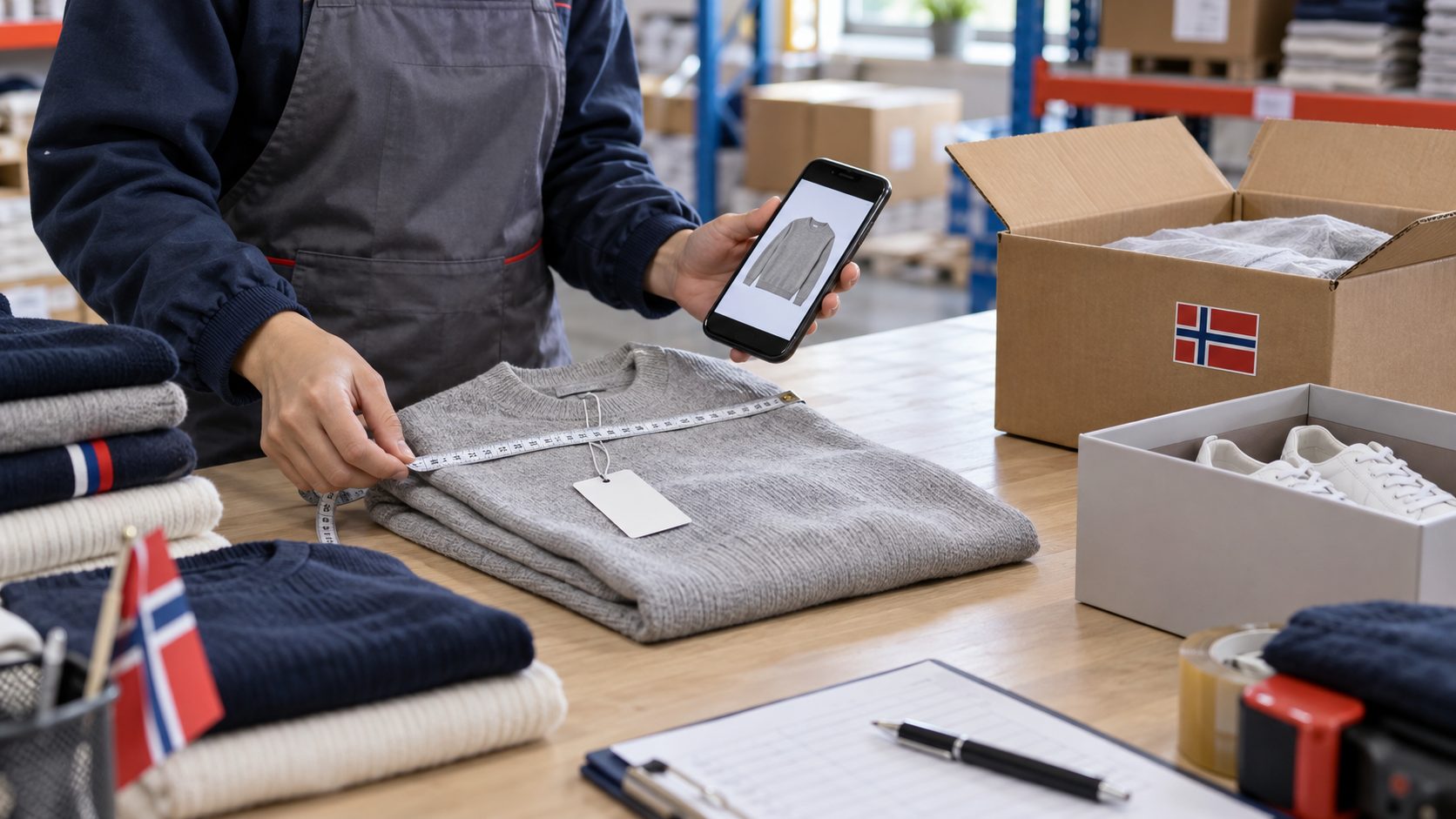
A Chinese M or XL is not a reliable conversion to a Norwegian size. Record the seller's garment measurements: chest, shoulder, sleeve, waist, hip, rise and full length. Compare them with a garment you already own, not only your body measurement.
Save the selected colour and size screenshot. Ask whether the figures are body measurements or finished-garment measurements and what tolerance applies. For shoes, confirm internal length and width. A purchasing assistant can relay questions, but the seller remains responsible for product information.
Check material and restricted details
Confirm fibre composition, lining, filling, care instructions and whether the item contains leather, fur, batteries, heating elements, liquids or brand marks. These details affect import classification, route acceptance and consumer expectations.
Warehouse photos can verify the visible size label, colour, quantity and obvious damage. If requested and available, a basic flat measurement may provide useful evidence, but it is not a professional fitting, textile test or guarantee of shrinkage and colourfastness.
Use China's return window
The best time to fix a wrong size or colour is while the item remains in China. Before ordering, check the seller's return deadline, whether original tags and packaging must remain intact, and who pays domestic return freight. International dispatch can make a low-cost garment uneconomic to return.
Coordinate arrivals under the warehouse free-storage policy. If several garments are waiting, do not remove tags or packaging needed for a seller return until the visible checks are complete.
Consolidate clothing carefully
Clothing is usually compressible, so removing unnecessary outer cartons can reduce volume. Shoes, structured hats, formal garments and fragile accessories may need their boxes or extra protection. Vacuum compression can crease or deform some materials.
The package consolidation guide explains the trade-off. Ask for measured weight and dimensions after the final packing choice. Route timing should be an estimate, not a guarantee.
VOEC, VAT and clothing duty in Norway
For eligible private purchases from a VOEC-registered shop or marketplace, each item must be below NOK 3,000 and Norwegian VAT is collected at checkout. A correctly identified VOEC shipment can avoid a second collection and carrier declaration charge on arrival. Verify the actual seller or marketplace and invoice; do not assume Taobao orders are automatically VOEC-covered.
If VOEC does not apply, Norway normally charges 25% VAT on clothing and shoes. VAT is calculated using the full basis, which can include price, shipping, insurance, customs duty and relevant fees. The carrier may charge a separate clearance fee.
Norwegian Customs states that some clothing is subject to customs duty, with the rate depending on the garment, while shoes are exempt from customs duty. Both clothing and shoes remain subject to VAT. Use the official clothes and shoes guidance and import calculator for the actual product.
The NOK 3,000 VOEC condition is per item, not a parcel-wide tax-free allowance. Food, restricted goods and excise goods are excluded. Commercial resale orders need separate import planning.
Prepare a usable item list
For every garment, record plain description, fibre composition, quantity, size, paid value and country-of-origin information when available. Keep the order and payment evidence. Do not use “clothes” as the only description for a mixed parcel and do not under-declare.
If VAT was collected under VOEC, make sure the route can transmit the required VOEC data. A warehouse cannot create VOEC eligibility after the sale.
Delivered-cost checklist
Add garment price, China domestic freight, purchasing or checking service, return risk, repacking, international freight, optional insurance, 25% VAT, possible clothing duty and carrier clearance. Shoes may avoid customs duty, but not VAT and handling costs.
YDA Express can assist with purchasing, China warehouse receiving, visible checks or photos, consolidation and international forwarding. It does not provide professional size fitting, textile certification, authenticity guarantees or Norwegian customs decisions.
Before sending Taobao clothing to Norway
- Compare actual garment measurements.
- Confirm fibre composition and special materials.
- Save the chosen size and colour.
- Check the domestic return deadline.
- Keep tags and return packaging until inspection.
- Decide which boxes can safely be removed.
- Verify VOEC on the real transaction.
- Use the correct product description and value.
- Budget 25% VAT, possible clothing duty and carrier fees.
This workflow gives the Norwegian buyer evidence before export and separates fashion choice from customs cost.
A measurement workflow that reduces size mistakes
Use one well-fitting garment from your wardrobe as the reference. Lay it flat without stretching and record the same points used in the Taobao chart. For a top, compare shoulder seam to shoulder seam, armpit width, sleeve length and back length. For trousers, compare waistband, front rise, hip, thigh and inseam. Double a flat half-chest or half-waist figure only when the seller's chart uses circumference.
Allow for layering. A winter jacket worn over a sweater needs more ease than a fitted shirt. Stretch fabric may tolerate a smaller difference, while woven fabric normally needs more room. If the seller gives only height and weight recommendations, ask for actual garment dimensions.
For shoes, foot length is not always the same as insole length. Measure both feet, use the larger one, and ask whether the seller's number refers to foot length, insole length or Chinese shoe size. Width matters for boots and structured shoes.
What a useful warehouse clothing check looks like
Before ordering, prepare a short check request that can be answered visually:
- confirm the visible size and colour labels;
- compare the number of pieces with the order;
- photograph front, back and any obvious defect;
- check whether belts, removable liners or advertised accessories are present;
- keep hangtags, hygiene seals and return packaging intact;
- if agreed, take one or two simple flat measurements.
Do not ask a basic warehouse check to judge fit, warmth, fabric grade, waterproof performance or long-term durability. Those require wearing, testing or specialist inspection.
Fabric information changes both expectations and customs data
A listing that says only “soft knit” is not enough. Ask for fibre percentages where possible. Cotton, polyester, wool, cashmere, leather, artificial fur and down filling differ in price, care and declaration. A garment advertised as wool may contain only a small wool percentage; a “down jacket” may use synthetic filling.
For animal-origin materials, fur trims or exotic leather, check import restrictions before purchase. Heated clothing, light-up shoes or jackets with power banks must also be treated as battery goods for transport.
A China-side return decision
When photos show a wrong colour, visible defect or label mismatch, compare the cost of domestic return with the item's value. Ask whether the seller will send a replacement immediately, wait for the return, or offer a partial refund. Confirm who pays domestic postage.
If the issue is a likely fit problem rather than a clearly wrong label, remember that a warehouse cannot try on the garment. A measurement check may help, but seller tolerance and measurement method can still differ. For high-value clothing, a sample order is safer than buying several sizes at once.
Packing choices by clothing type
Different items should not be packed the same way:
- T-shirts and ordinary knitwear can usually lose the seller's outer shipping bag.
- Down jackets may be compressed for transport but need time to recover; aggressive compression can damage loft.
- Suits, dresses and structured coats benefit from folding support and moisture protection.
- Shoes may need the original box or a lighter protective shoe box.
- Hats and handbags need shape protection.
- Metal accessories should be isolated from delicate fabric.
Ask the warehouse to photograph the final arrangement if shape or presentation matters. Consolidation saves repeated outer packaging, but retail boxes may be valuable for gifts or resale and should not be removed without instruction.
VOEC and clothing: two different questions
First ask whether the sale qualifies for VOEC. A private purchase from a registered shop or marketplace, with each eligible item below NOK 3,000 and VAT collected correctly, can use the simplified treatment.
Then ask whether the product itself is clothing, footwear or another textile article. Norwegian Customs states that some clothing can attract customs duty, while shoes are exempt from customs duty. A VOEC-qualified item is exempt from customs duty under the scheme, but a non-VOEC import must be assessed under the normal product rules.
This is why “the parcel contains fashion items” is not sufficient. A wool coat, cotton T-shirt, leather belt and shoes may not share the same classification or duty treatment.
Worked landed-cost example
Assume a garment costs NOK 1,200 and shipping and related costs included in the customs value are NOK 300. If the order is outside VOEC and the garment attracts a hypothetical duty, duty would first be calculated under the applicable tariff. VAT at 25% would then be calculated on the relevant base, which can include the duty. The carrier's clearance fee is separate.
Because clothing duty varies, do not copy a percentage from another garment. Use the Norwegian import calculator or tariff for the exact product. For shoes, the official guidance says customs duty does not apply, but VAT and carrier handling can still make the delivered total higher than checkout.
Personal shopping versus resale
A few garments for personal use fit the consumer workflow. Repeated size runs, branded inventory or regular store replenishment may indicate commercial import. Business orders need commercial invoices, correct commodity codes, importer responsibilities and product compliance planning.
Do not split one commercial purchase into artificial personal parcels to seek simplified treatment. Apart from compliance risk, split shipments can create more minimum freight and clearance charges.
A complete pre-shipment clothing file
Keep:
- product page and seller identity;
- selected colour, size and quantity;
- measurement chart and seller answers;
- fibre composition and care information;
- order and payment record;
- domestic tracking;
- warehouse photos and measurements;
- return or replacement correspondence;
- final packing list and declared value;
- VOEC invoice evidence, if applicable;
- international tracking and carrier charges.
This file helps with wrong-item disputes, double VAT questions, lost parcels and future repeat orders.
Frequently asked questions
Can the warehouse guarantee that a garment will fit?
No. It can confirm a visible label and, when arranged, take simple measurements. Fit depends on the person's body, preferred ease, fabric and seller measuring method.
Should shoe boxes be removed?
Remove them only when lower volume is more important than shape protection, presentation or returns. A lighter protective alternative may be better.
Does Norway charge customs duty on all clothes?
No. Some clothing is subject to duty and rates vary. Shoes are exempt from customs duty, but VAT still applies. Check the exact item.
Does every Taobao order below NOK 3,000 use VOEC?
No. The item limit is only one condition. The seller or marketplace must be registered, collect Norwegian VAT and transmit the required data.
Is buying several sizes a good alternative to measuring?
Usually not. It increases product cost, freight and return complexity. A sample and measurement-based choice is normally more controlled.
📲 Download the YDA Express App
Use the YDA Express App to place China purchasing orders, view product check photos, manage packages, and arrange consolidation and international forwarding.