Buying used clothing on Xianyu for a US address? Confirm measurements, condition evidence, branded-goods risk, warehouse checks and current import costs before dispatch.
Buying used clothing on Xianyu for a US address can work, but the decision should be made before international shipping. Ask the seller for garment measurements and fresh condition evidence, define what the China warehouse should photograph, and confirm that the item can enter the selected route. A listing size, a seller’s description and a warehouse photo each answer different questions; none guarantees fit, authenticity or hidden condition.
This guide is for US buyers considering pre-owned jackets, shirts, dresses and similar apparel for personal use. Footwear, fur, protective equipment, children’s products and commercial resale can involve different checks.
Start with measurements, not the size label
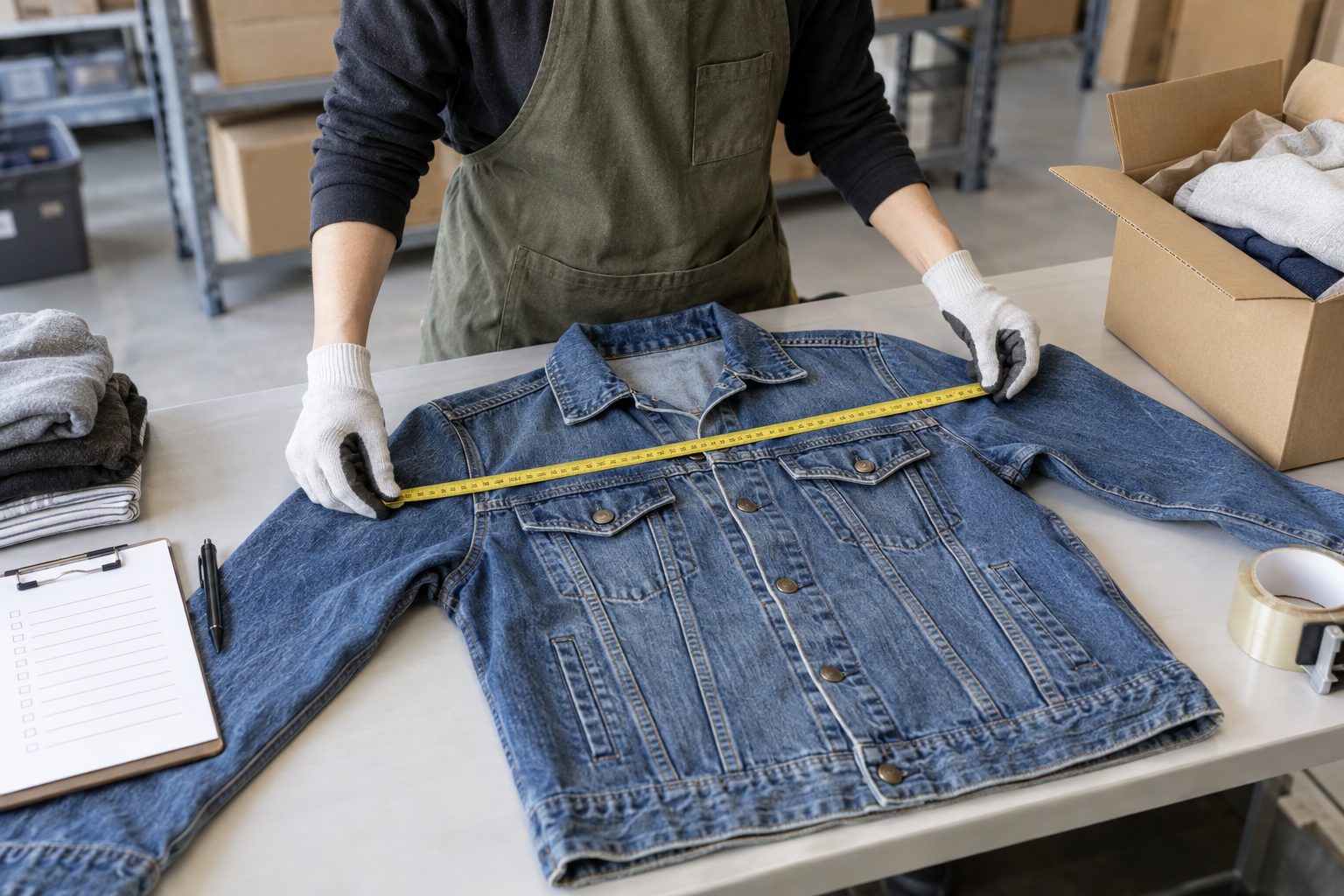
Used garments may have been altered, washed, stretched or shrunk. Ask for the actual chest or pit-to-pit width, shoulder width, sleeve length, garment length and waist or rise where relevant. Specify whether a measurement should be taken flat and whether it is a half measurement or full circumference.
Compare those numbers with a garment you already wear comfortably. Do not convert a Chinese label directly into a US size. If the seller will not provide a needed measurement, decide whether the uncertainty is acceptable before paying.
Save the listing, selected variation and seller’s written answers. The broader Xianyu overseas buying guide explains the purchasing routes; this article focuses only on used apparel evidence and approval.
Ask for condition evidence that matches your decision
“Good condition” is subjective. Request recent photos of the exact item, not catalog images. Useful views include:
- front and back under neutral light;
- collar, cuffs, underarms, hem and pocket edges;
- fasteners, lining and interior labels;
- stains, holes, pilling, fading, repairs or alterations;
- any area already identified by the seller as damaged.
Ask whether the item has odors, missing parts or replaced hardware. Photos cannot reliably prove odor, fabric composition, authenticity or how the garment will look after cleaning. If one of those points determines the purchase, treat it as unresolved unless suitable evidence is available.
Treat branded listings as an authenticity and import risk
A logo, care label, receipt photo or low price does not prove that a garment is genuine. Warehouse staff can photograph observable marks and construction details when agreed, but that is not professional authentication.
Avoid a listing when the seller refuses fresh evidence, the price is implausible, the photos appear copied or the branding is inconsistent. US Customs and Border Protection may detain or seize goods that infringe protected trademarks. The limited personal-use trademark exception described by CBP applies to qualifying articles accompanying a traveler; do not assume it covers a forwarded parcel. Review CBP’s trademark guidance before purchasing a questionable branded item.
Write the warehouse check before the parcel arrives
Give the warehouse a short, observable checklist. For example: confirm the garment color, photograph the front and back, show the size and care labels, measure the chest width and garment length, and photograph the stated flaw. Do not ask a warehouse to “check quality” without defining what evidence you need.
When the parcel arrives, match the photos and measurements to the saved listing. A visual check cannot reveal every repair, fabric weakness or hygiene issue. It also cannot guarantee fit. If the item is materially different, hold it before consolidation and use the wrong-item or missing-parts workflow while the domestic remedy may still be practical.
Decide whether to clean, return or ship
Do not remove labels, wash the garment or discard seller packaging until you have decided whether to keep it. Cleaning may affect return eligibility, and the warehouse may not provide garment-cleaning services.
If you accept the item, ask for dry protective packaging appropriate to the fabric. Vacuum compression can reduce volume for some basic clothing, but it may crease structured jackets, damage embellishments or trap moisture. Keep rigid or delicate pieces separate when compression is unsuitable.
For electronics rather than clothing, use the separate Xianyu used-phone inspection checklist; the evidence and transport risks are different.
Calculate the cost after the item is accepted
The useful comparison is not the listing price alone. Include the item, China domestic delivery, purchasing or payment assistance, requested inspection, domestic return if needed, packing, international freight and US import charges.
Ask for the packed weight and dimensions before approving dispatch. A light jacket can still create dimensional weight if it is packed in a large carton. The shipping calculator is an estimate; the final quote depends on the packed parcel, product details, destination and available route.
Use current US import rules
Rule check: 24 September 2026. CBP states that duty-free de minimis treatment for shipments valued at or below $800 was suspended for goods from all countries effective 29 August 2025. Do not use an old “under $800 is duty-free” template. Duties, taxes, fees, entry requirements and carrier handling depend on the shipment and current rules. See the CBP de minimis suspension notice.
Describe the garment and purchase value accurately. Used condition does not make a parcel exempt from customs rules. Keep the order record and payment evidence in case the carrier or customs broker requests documentation.
If you plan to resell imported apparel, check the requirements that apply to your business and product. The FTC notes that most textile and wool products require information such as fiber content, country of origin and the identity of the responsible business, and care-label rules may also apply. Start with the FTC apparel-labeling guidance rather than treating a personal-purchase guide as business compliance advice.
A practical approval checklist
Before paying, confirm the exact garment, measurements, visible flaws, included parts, seller evidence and international-route eligibility. Before dispatch, compare the warehouse evidence with the listing, resolve any mismatch, approve suitable packing and review the final quote and import arrangement.
If you need help communicating with the seller or purchasing the item, send the listing, US ZIP code and your exact inspection checklist through the shopping-agent service. If you can manage the transaction yourself, request only the forwarding and warehouse checks you actually need.
📲 Download the YDA Express App
Use the YDA Express App to place China purchasing orders, view product check photos, manage packages, and arrange consolidation and international forwarding.