Review new adult apparel labels by SKU before a bulk order: composition evidence, origin, business name or RN, care instructions and batch consistency.
Before buying 1688 clothing for US resale, approve the labels for the exact garment you will sell. A size tag, attractive hangtag or supplier’s “export quality” claim does not establish that its fiber, origin, business identity and care information are suitable for the US market.
This review is for new, ordinary adult textile apparel, such as a basic shirt. Children’s clothing, protective garments, fur, wool-specific questions and other specialist products need a separate review. Personal secondhand purchases follow a different decision path; use the Xianyu used-clothing checklist for condition and fit. Official sources checked: 17 October 2026.
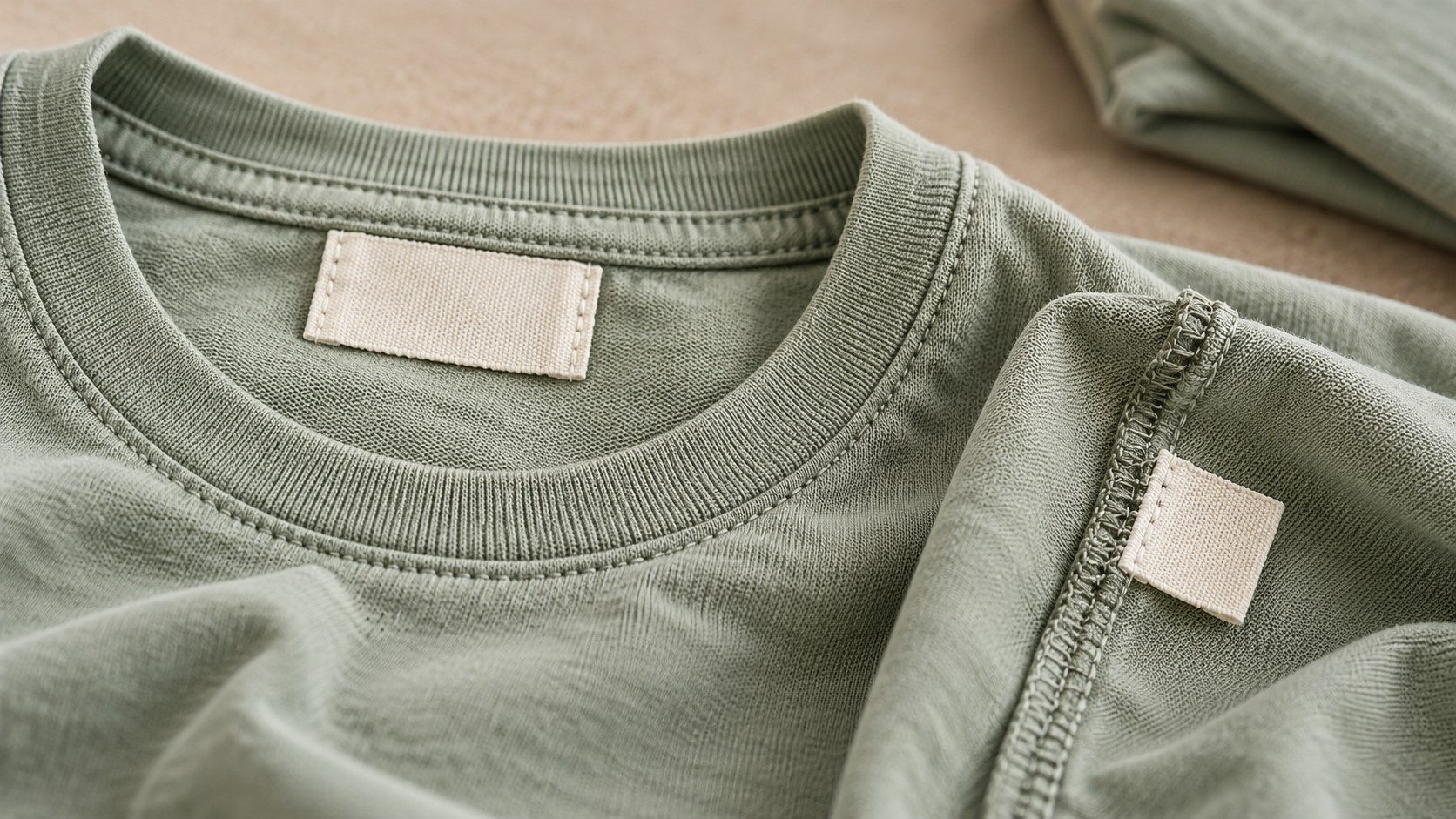
Cover: AI-generated illustration, not a customer shipment or product-test photograph.
Inspect a garment, not just a label mock-up
Ask for clear photographs of every label, both sides where accessible, and a wider view showing where each is attached. Match them to the product link, SKU, colour, size and sample. An artwork file shows intended wording; a garment photograph shows what was attached. Neither by itself proves the stated fiber composition.
For a repeat order, do not approve a whole product family from one photograph. Ask whether different colours, linings, trims or factories change the material or care requirements. Keep unresolved SKUs out of the approved batch until the specific discrepancy is resolved.
The worksheet below is an editorial example of a review method, not a tested product, legal certificate or ready-to-print label.
Read the label as four separate claims
Fiber: what is the garment actually made of?
Request the supplier’s composition specification for the exact item and compare it with the proposed English wording. Under 16 CFR Part 303, required fiber disclosures use recognised generic names and applicable percentage rules. Required information must be in English; Chinese can appear in addition.
A description such as “ice silk,” “premium fabric” or “bamboo feel” is not enough to identify the actual fiber. Do not translate a marketing phrase into a composition claim. If the supplier cannot support the composition, place that SKU on hold and obtain reliable evidence or appropriate testing advice. A warehouse photo cannot determine percentages.
Origin: where was the product manufactured?
Ask for the manufacturing origin and supporting production information. Do not use the supplier’s office address, the China warehouse address or the location from which the parcel ships as proof of origin. CBP origin rules determine the origin of imported textiles; routing through another country does not by itself change it.
Check placement as well as wording. FTC guidance specifies an inside-centre-neck origin label for a garment with a neck. A country statement hidden inside an inaccessible fold or appearing only on an outer shipping carton is not the same review outcome as an attached, accessible garment label.
Identity: whose business stands behind the label?
The FTC’s textile-label guidance allows the relevant company name or an eligible registered identification number, known as an RN. An RN is an alternative to the business name, not a universal prerequisite for selling clothing. FTC does not issue RNs to businesses outside the US.
Agree which permitted company will be identified. A brand logo alone may not meet the business-name requirement. If using an RN, verify the holder in the FTC RN database and its connection to this distribution chain. Do not copy an unrelated number from a similar garment. An RN is not a customs EIN and does not identify the importer for customs entry.
Care: will these instructions work for the whole garment?
The Care Labeling Rule, 16 CFR Part 423 requires a reasonable basis for the care instructions. A generic instruction chosen because it fits a small tag is not a product assessment. Ask what supports the proposed washing or drycleaning method, including effects on trim, prints, dyes and lining.
FTC’s care-label guide distinguishes care-label timing from entry: importers must attach care labels before US sale, although they need not be attached when entering the US. Care labels generally must be permanently attached and remain legible for the garment’s useful life. This does not waive separate origin or textile-label obligations. Approving complete labels before dispatch is a purchasing control, not a claim that all label rules have identical deadlines.
Turn the review into a SKU decision
Use one record for each materially different SKU:
| Approval field | Evidence to retain | Hold if unresolved |
|---|---|---|
| Product identity | Link, SKU and matching sample photos | Photo belongs to another version |
| Fiber wording | Composition evidence and English artwork | Marketing term replaces composition |
| Origin and location | Origin support and attached-label photo | Shipping location used as origin |
| Business identity | Permitted company name or verified RN | Unrelated RN or logo-only claim |
| Care | Supported instructions and attachment photo | Unsupported method or temporary care tag |
| Batch match | Approved revision and batch-photo reference | Supplier changes fabric or label wording |
For example, if a supplier changes a shirt’s fabric but reuses the original artwork, record HOLD — revised composition and care evidence needed. Do not mark the new batch approved merely because the sewing and size look unchanged.
Before paying for bulk production, ask the supplier to confirm the final artwork, label location, responsible business and replacement procedure for a mismatch. Retain the agreed revision and compare the received sample and later batch with it. Do not remove required information to make space for a private-label logo.
Labels do not replace safety, customs or marketplace checks
A compliant-looking label is not a CPSC certificate, a laboratory report or permission to sell a restricted product. Determine the applicable safety rules separately; the US CPSC SKU-document guide covers that document task. A marketplace may also ask for evidence beyond an attached label. Check the actual seller category and listing requirements before purchase; a 1688 product page does not promise US marketplace acceptance.
This guide does not offer one clothing duty rate. Classification, fiber, construction, origin and current trade measures affect the entry calculation. Do not budget using an automatic $800 duty-free assumption; CBP’s 2026 guidance continues the general de minimis suspension. Use the separate US import-duty guide as the starting point for a current product-specific check.
YDA can discuss supplier coordination and whether label photographs or a pre-dispatch comparison are available for your order. It cannot certify composition, design a legal label on the importer’s behalf or guarantee US admission or marketplace approval. Before dispatch, reconfirm the actual batch, current rules and available service. For a purchase enquiry, send the product link, intended adult use, SKU list and label photos, and identify which field is unresolved.
📲 Download the YDA Express App
Use the YDA Express App to place China purchasing orders, view product check photos, manage packages, and arrange consolidation and international forwarding.