
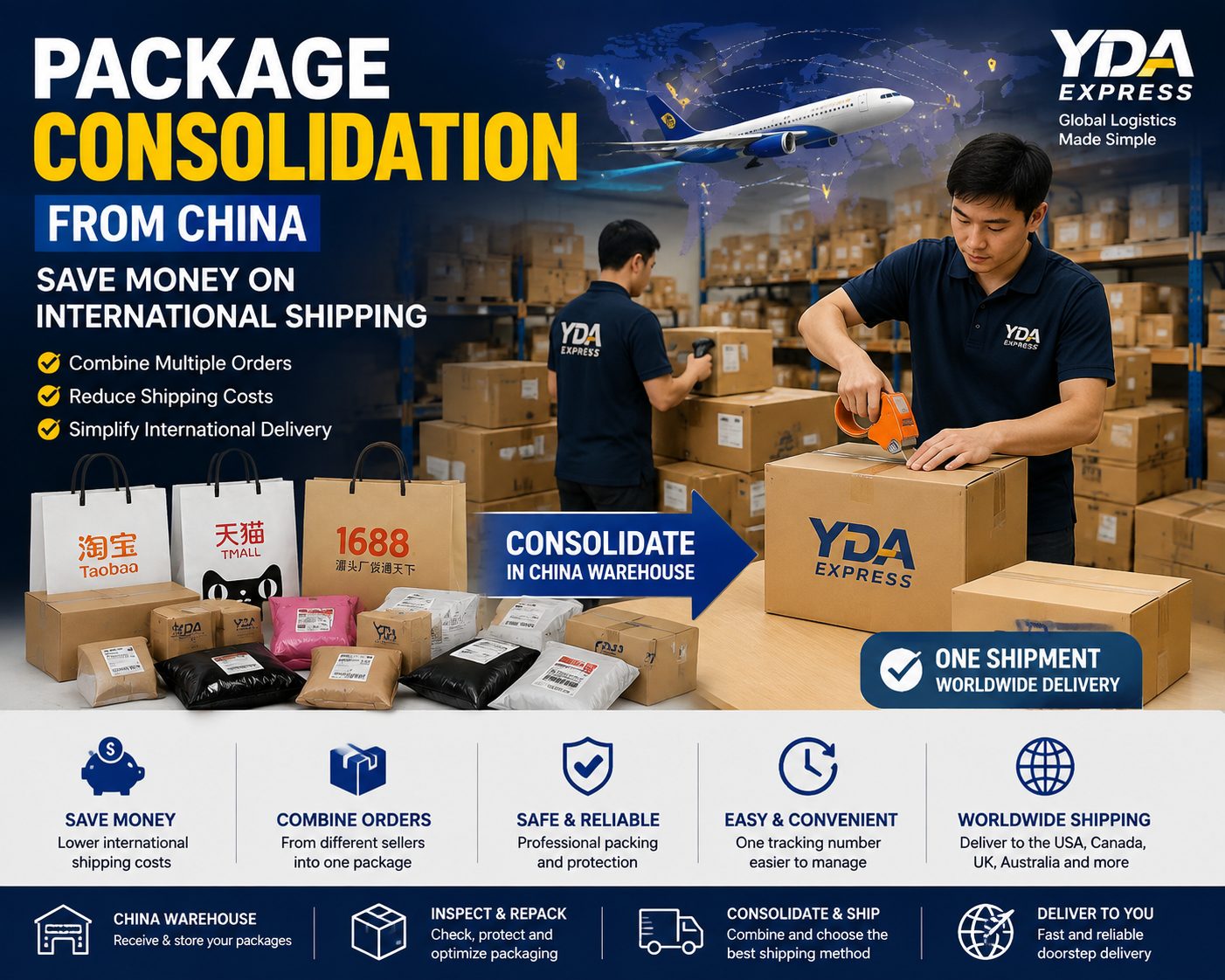
Learn everything about international shipping from China in 2026. Discover air freight, sea freight, express shipping, customs clearance, package consolidation, shipping costs, and practical tips to reduce logistics expenses for global buyers.
# Understanding International Shipping From China
International shipping from China has become one of the most important components of global trade. Every day, millions of parcels, pallets, and shipping containers leave Chinese factories, warehouses, and fulfillment centers, supplying products to consumers and businesses across North America, Europe, Oceania, the Middle East, Africa, and many other regions. From small online purchases made through Taobao to bulk orders sourced directly from manufacturers, China's logistics network supports almost every type of international commerce.
For overseas buyers, international shipping is much more than simply moving products from one country to another. It is a complete logistics chain involving suppliers, domestic transportation, warehouses, export customs, airlines or shipping companies, import customs, local delivery providers, and finally the recipient. Every step affects delivery speed, transportation costs, customs clearance efficiency, and the overall shopping experience.
As international e-commerce continues to expand, more consumers are choosing to purchase directly from Chinese shopping platforms rather than buying through local retailers. Chinese marketplaces such as Taobao, 1688, JD.com, and Pinduoduo offer an enormous range of products, competitive prices, and access to manufacturers that are often unavailable elsewhere. However, buying directly from China also introduces new challenges, especially for first-time international shoppers.
One of the most common misconceptions is that shipping is simply a matter of selecting a courier. In reality, successful international shipping requires careful planning. Buyers must consider shipping costs, parcel dimensions, customs regulations, prohibited items, insurance, delivery time, and the most appropriate transportation method. Choosing the wrong shipping solution can increase costs dramatically, while selecting the right strategy can significantly improve efficiency and reduce overall expenses.
Why China Is the World's Largest Export Hub
China has spent decades building one of the world's most advanced manufacturing and logistics ecosystems. Thousands of industrial clusters produce everything from clothing and electronics to furniture, automotive parts, machinery, beauty products, toys, and consumer goods.
These manufacturing centers are connected by extensive highway networks, high-speed rail systems, international airports, and some of the world's busiest seaports. This infrastructure allows products to move quickly from factories to warehouses and then to international transportation hubs.
Major ports such as Shanghai, Shenzhen, Ningbo, Guangzhou, and Qingdao handle millions of containers every year, while international airports in cities including Guangzhou, Shenzhen, Shanghai, Beijing, and Hong Kong support large volumes of global air cargo.
Because of this mature logistics infrastructure, buyers around the world can purchase products directly from China with greater convenience than ever before.
Why More Buyers Purchase Directly From China
There are several reasons why international buyers increasingly choose to source products directly from China.
The first is price. Purchasing directly from manufacturers or domestic marketplaces often eliminates several layers of distribution, allowing buyers to obtain products at considerably lower prices than local retail markets.
The second is product selection. Chinese online marketplaces offer millions of products across virtually every category. Whether customers are searching for fashion accessories, home décor, industrial equipment, electronic components, robot parts, or commercial inventory, they can usually find multiple suppliers offering different price points and specifications.
The third advantage is access to new products. Chinese manufacturers frequently release new products before they become available in overseas markets, allowing businesses and consumers to stay ahead of local trends.
Finally, direct purchasing provides greater flexibility. Buyers can compare suppliers, negotiate prices for larger orders, and customize products when working directly with manufacturers or wholesalers.
The Complete International Shipping Process
Although every shipment is different, international shipping from China generally follows the same workflow.
The process begins when a buyer places an order through a Chinese marketplace or directly with a supplier. After production or order processing is completed, the seller ships the products to a warehouse or freight forwarding facility inside China.
At the warehouse, parcels are received, registered, inspected, and prepared for export. If multiple orders have been placed with different sellers, they can be consolidated into one shipment to reduce international freight costs. Excess packaging may be removed, fragile items reinforced, and parcels repacked into stronger export cartons before shipping.
Once the shipment is ready, export documentation is prepared and the goods are transferred to the selected transportation provider. Depending on the shipping method, parcels may travel by air freight, sea freight, railway, or international courier.
After arriving in the destination country, the shipment passes through import customs clearance before being transferred to a local delivery company for final delivery to the buyer's address.
Understanding each stage helps buyers make better decisions and avoid many of the common problems associated with international shipping.
Common Challenges for First-Time International Buyers
Despite significant improvements in global logistics, first-time buyers often encounter avoidable difficulties.
Many underestimate shipping costs by focusing only on product prices. Others choose inappropriate transportation methods, resulting in unnecessary delays or higher freight charges. Incorrect customs declarations, prohibited items, insufficient packaging, and lack of shipment planning can also create unexpected complications.
Language barriers and unfamiliar purchasing platforms may further increase the complexity of buying directly from China.
Fortunately, professional logistics providers, China warehouse services, and package consolidation solutions have simplified this process considerably. By using experienced shipping partners, international buyers can reduce risks, improve shipping efficiency, and enjoy a smoother purchasing experience.
Understanding how international shipping works is the first step toward building a cost-effective and reliable global purchasing strategy. Whether you are ordering a single parcel for personal use or importing inventory for your business, the right logistics solution can save time, reduce costs, and ensure your products arrive safely anywhere in the world.# Major Shipping Methods From China
Choosing the right shipping method is one of the most important decisions when purchasing products from China. Every transportation option has its own advantages, costs, delivery times, and suitable product categories. Rather than asking which method is the "best," experienced importers ask a different question: Which shipping method is best for this specific shipment?
The answer depends on several factors, including parcel weight, dimensions, product value, delivery urgency, destination country, customs requirements, and overall logistics budget.
Understanding the strengths and limitations of each shipping solution allows buyers to reduce unnecessary expenses while improving delivery reliability.
Air Freight
Air freight is one of the fastest international shipping methods available for goods leaving China.
Cargo is transported through international airports before entering the destination country's customs system and being transferred to local delivery networks. For urgent shipments, air freight offers an excellent balance between speed and reliability.
It is particularly suitable for:
- Electronics
- Mobile phone accessories
- Robot components
- Fashion products
- Medical equipment
- Business samples
- High-value products
- Time-sensitive orders
The biggest advantage of air freight is speed. Most international air shipments arrive much faster than ocean freight, making it ideal for businesses with urgent inventory requirements or customers who need products quickly.
However, faster transportation usually comes with higher shipping costs. Airlines also calculate charges based on either actual weight or volumetric weight, whichever is greater. Large but lightweight parcels can therefore become more expensive than expected.
Sea Freight
Sea freight remains the most economical solution for transporting large quantities of cargo internationally.
Instead of paying for speed, businesses benefit from significantly lower transportation costs, especially for heavy shipments.
Sea freight is commonly used for:
- Furniture
- Home appliances
- Commercial inventory
- Industrial machinery
- Building materials
- Wholesale purchases
- Large e-commerce replenishment orders
For companies importing products regularly, sea freight often provides the lowest cost per kilogram.
Although transit times are considerably longer than air freight, the savings become substantial when shipping hundreds or thousands of kilograms.
Many successful import businesses combine sea freight with careful inventory planning, allowing them to minimize logistics expenses while maintaining stable stock levels.
International Express Courier
International courier companies provide door-to-door delivery services with highly developed global logistics networks.
Express services are often chosen when buyers require reliable tracking, customs handling, and fast final delivery.
Typical characteristics include:
- Online shipment tracking
- Professional customs processing
- Reliable delivery schedules
- Signature confirmation
- Worldwide coverage
International courier services are particularly suitable for business documents, valuable products, urgent replacement parts, and premium customer orders where delivery speed is a priority.
While courier services are generally more expensive than other shipping methods, they offer excellent visibility throughout the transportation process.
Dedicated Shipping Lines
Dedicated shipping lines have become increasingly popular in cross-border e-commerce.
Unlike traditional international courier services, dedicated lines focus on specific countries or regions, allowing logistics providers to optimize transportation routes, customs clearance procedures, and delivery efficiency.
Dedicated shipping lines are widely used for destinations such as:
- United States
- United Kingdom
- Canada
- Australia
- European countries
- Southeast Asia
For many e-commerce sellers, dedicated shipping lines provide an attractive balance between shipping cost and delivery speed.
Because these services are designed specifically for certain markets, they often offer more competitive pricing than traditional express carriers while maintaining stable transit times.
Rail Freight
Rail freight has become an important transportation option between China and many European destinations.
The development of international railway networks has created a solution positioned between air freight and sea freight.
Compared with air freight, rail transportation offers lower shipping costs.
Compared with sea freight, rail services generally provide shorter transit times.
For certain European importers, rail freight has become an efficient alternative for medium-sized commercial shipments where both delivery time and transportation budget must be carefully balanced.
Although railway routes are geographically limited compared with air and sea transportation, they continue to play an increasingly important role in international logistics.
How to Choose the Best Shipping Method
There is no universal shipping solution suitable for every order.
Professional logistics planning considers multiple factors before selecting transportation.
These include:
- Destination country
- Total shipment weight
- Parcel dimensions
- Product category
- Delivery deadline
- Customs requirements
- Overall logistics budget
For example, a small parcel containing electronic accessories may benefit from air freight or express delivery, while several hundred kilograms of commercial inventory are usually far more economical when transported by sea.
Experienced international buyers rarely choose shipping based solely on price. Instead, they evaluate the total logistics cost, delivery reliability, customs efficiency, and customer expectations before making a decision.
Selecting the appropriate transportation method not only reduces shipping expenses but also improves delivery performance, minimizes operational risks, and creates a more efficient international supply chain.# How to Reduce International Shipping Costs
Reducing international shipping costs is one of the primary goals for both individual buyers and businesses importing products from China. While many people focus only on finding lower shipping rates, experienced importers understand that the biggest savings often come from improving the entire shipping process rather than simply choosing the cheapest carrier.
Shipping costs are influenced by many factors, including parcel weight, dimensions, packaging, shipping method, destination country, customs procedures, and warehouse operations. By optimizing these factors before a shipment leaves China, buyers can significantly reduce their overall logistics expenses.
Consolidate Multiple Orders Into One Shipment
One of the most effective ways to lower shipping costs is package consolidation.
Many overseas buyers purchase products from multiple sellers on platforms such as Taobao, 1688, JD.com, and Pinduoduo. If every seller ships internationally separately, buyers pay international shipping fees multiple times.
Instead, all purchases can first be delivered to a China warehouse.
Once every parcel arrives, warehouse staff combine the shipments into one carefully organized package before international dispatch.
This approach offers several important benefits:
- Only one international shipment instead of several.
- Lower total shipping costs.
- Fewer customs declarations.
- Easier shipment tracking.
- Reduced packaging waste.
- Better parcel organization.
For regular international buyers, package consolidation often produces the largest long-term shipping savings.
Remove Unnecessary Packaging
Many Chinese sellers use oversized cartons and excessive protective materials to prevent damage during domestic transportation.
While this is useful inside China, it often increases international shipping costs because carriers charge according to either actual weight or volumetric weight.
Professional warehouses can safely remove:
- Large outer cartons
- Duplicate packaging
- Excess plastic fillers
- Unnecessary foam materials
- Oversized shipping boxes
Products are then repacked into export cartons that provide sufficient protection while minimizing unused space.
Reducing parcel dimensions can lower freight charges without compromising product safety.
Select the Right Shipping Method
Different products require different transportation solutions.
Choosing the wrong shipping method can increase costs unnecessarily.
For example:
- Small, valuable electronics usually benefit from air freight.
- Heavy furniture is generally better suited for sea freight.
- Commercial inventory may require container shipping.
- Urgent replacement parts often justify express courier services.
Rather than using the same shipping option for every order, experienced logistics providers evaluate each shipment individually to recommend the most suitable transportation method.
Balancing speed, cost, and reliability often produces the best overall value.
Plan Purchases Instead of Shipping Immediately
Many first-time buyers ship every order as soon as it arrives.
Although convenient, this approach usually increases total shipping costs.
Professional buyers often plan their purchases in advance.
Instead of shipping immediately, they continue placing orders until all products arrive at the warehouse.
Once everything has been received, parcels are consolidated and shipped together.
This strategy reduces repeated international freight charges while making customs processing more efficient.
Planning purchases also allows buyers to compare different shipping options before making a final decision.
Work With a Professional China Warehouse
A modern China warehouse offers far more than temporary storage.
Professional warehouse services help optimize every stage of the shipping process.
Typical services include:
- Parcel receiving
- Secure storage
- Product inspection
- Package consolidation
- Repacking
- Protective reinforcement
- Shipping label verification
- Weight optimization
- International shipping arrangements
Instead of managing dozens of suppliers individually, buyers work with one centralized logistics partner responsible for preparing shipments professionally.
This not only reduces costs but also minimizes shipping errors and improves delivery reliability.
Understand Customs Before Shipping
Unexpected customs issues can increase both shipping costs and delivery time.
Different countries apply different import regulations, tax thresholds, documentation requirements, and restricted product lists.
Before arranging international transportation, buyers should confirm:
- Whether import duties may apply.
- Whether special documentation is required.
- Whether products are restricted or prohibited.
- Whether additional inspections may occur.
Preparing shipments correctly before export helps avoid customs delays, additional storage fees, and unnecessary complications after arrival.
Think About Total Cost Instead of Shipping Price Alone
The cheapest shipping option is not always the most economical choice.
A low-priced service that results in damaged goods, customs delays, poor tracking, or unreliable delivery can ultimately cost far more than choosing a professional logistics provider.
Experienced international buyers evaluate the total logistics cost, including transportation, packaging, customs efficiency, delivery reliability, and after-sales support.
By focusing on the complete shipping process rather than only the freight price, buyers can build a more efficient supply chain while reducing long-term logistics expenses.# Choosing the Right International Shipping Partner
Selecting the right international shipping partner is just as important as choosing the right products. Even if you purchase high-quality goods at competitive prices, poor logistics can result in delays, damaged parcels, unexpected costs, and dissatisfied customers.
A reliable shipping provider does much more than transport parcels from China to another country. It helps buyers optimize the entire logistics process, from warehouse operations and packaging to customs clearance and final delivery.
Whether you are an individual shopper, an e-commerce seller, or a business importing products regularly, working with an experienced logistics partner can significantly improve shipping efficiency while reducing long-term costs.
Evaluate Experience and Industry Expertise
International shipping involves many moving parts.
A professional logistics provider should understand:
- International transportation regulations
- Customs procedures
- Country-specific import requirements
- Product restrictions
- Packaging standards
- Freight optimization
Experience becomes especially important when shipping electronics, batteries, robot components, automotive accessories, commercial inventory, or oversized cargo.
An experienced logistics company can identify potential issues before they become expensive problems.
Look for Comprehensive Warehouse Services
A modern logistics company should provide much more than parcel forwarding.
Professional warehouse services typically include:
- Parcel receiving
- Secure warehouse storage
- Product inspection
- Photo verification
- Package consolidation
- Protective repacking
- Weight and volume optimization
- International shipment preparation
Having all these services managed in one warehouse creates a smoother shipping process while reducing communication between multiple suppliers.
For buyers placing frequent orders, centralized warehouse management becomes a major advantage.
Multiple Shipping Solutions Matter
Every shipment is different.
Some buyers prioritize speed, while others focus on minimizing transportation costs.
A professional logistics company should offer several shipping solutions, including:
- Air freight
- Sea freight
- International express courier
- Dedicated shipping lines
- Commercial freight services
Providing multiple transportation options allows buyers to select the most appropriate solution based on product type, delivery schedule, and available budget.
Instead of forcing every shipment through a single carrier, experienced logistics providers recommend the shipping method that offers the best overall value.
Transparent Pricing Builds Trust
Unexpected fees are one of the most common concerns among international buyers.
A trustworthy shipping company clearly explains:
- Shipping charges
- Warehouse fees
- Storage policies
- Package consolidation costs
- Additional service fees
- Customs-related expenses
Transparent pricing allows customers to calculate total logistics costs before shipping rather than discovering unexpected charges after their parcels have already left China.
Reliable communication is equally important.
Buyers should receive timely updates regarding parcel arrival, warehouse processing, shipment preparation, tracking information, and delivery progress.
Technology Improves the Customer Experience
Modern international logistics increasingly relies on digital management systems.
Professional shipping companies often provide customers with online platforms where they can:
- Track parcel arrivals
- View warehouse inventory
- Upload shipping instructions
- Request package consolidation
- Monitor shipment status
- Access tracking numbers
These tools simplify the shipping process while giving buyers greater visibility throughout the logistics journey.
For businesses managing frequent imports, digital warehouse management significantly improves operational efficiency.
Build a Long-Term Logistics Partnership
Many first-time buyers choose a shipping provider based solely on price.
Experienced importers take a different approach.
Instead of changing logistics companies for every shipment, they build long-term partnerships with providers that consistently deliver reliable service, competitive pricing, professional warehouse management, and responsive customer support.
A trusted logistics partner becomes an extension of your supply chain.
Over time, this relationship creates smoother purchasing processes, better shipment planning, lower transportation costs, and greater confidence when buying products from China.
Successful international shipping is not only about moving parcels across borders. It is about creating a reliable logistics system that supports long-term growth, protects your products, and ensures every shipment reaches its destination safely and efficiently.# Conclusion
International shipping from China has never been more accessible. Thanks to the rapid development of global logistics networks, buyers from around the world can now purchase products directly from Chinese manufacturers, wholesalers, and online marketplaces with greater convenience than ever before.
However, successful international shipping is not determined by transportation alone. It depends on every stage of the logistics process, including supplier selection, warehouse management, package consolidation, shipping method, customs clearance, and final delivery.
Understanding these factors allows buyers to reduce unnecessary costs, improve shipping efficiency, and minimize the risks that often affect first-time international purchases.
Whether you are importing products for your business or simply buying items for personal use, selecting the right shipping strategy is one of the best investments you can make. Working with a professional logistics provider ensures your products are handled correctly from the moment they leave the seller until they arrive safely at your door.
As global e-commerce continues to expand, international shipping will remain one of the most important links connecting buyers with Chinese suppliers. Learning how the system works today will help you make smarter purchasing decisions for years to come.
Frequently Asked Questions (FAQ)
1. What is international shipping from China?
International shipping from China refers to transporting goods from Chinese suppliers, manufacturers, or online marketplaces to customers in other countries using air freight, sea freight, rail freight, express couriers, or dedicated shipping lines.
2. Which shipping method is the fastest?
Air freight and international express courier services are generally the fastest options for most destinations. They are ideal for urgent orders, high-value products, and business shipments that require short delivery times.
3. Which shipping method is the most economical?
Sea freight is usually the most cost-effective solution for heavy cargo, commercial inventory, furniture, machinery, and large-volume shipments where delivery speed is less important.
4. How can I reduce international shipping costs?
You can lower shipping costs by:
- Consolidating multiple orders into one shipment.
- Removing unnecessary packaging.
- Choosing the most suitable shipping method.
- Planning purchases in advance.
- Using a professional China warehouse.
- Optimizing parcel size and weight before export.
5. Do I need a China warehouse?
A China warehouse is highly recommended if you purchase from multiple Chinese sellers. It allows parcels to be received, inspected, stored, consolidated, and professionally prepared before international shipping, making the entire process more efficient and cost-effective.
6. How are shipping costs calculated?
Shipping charges are usually determined by factors such as actual weight, volumetric weight, parcel dimensions, destination country, transportation method, and additional logistics services. Different carriers may use different pricing models.
7. Can I buy directly from Taobao or 1688 and ship internationally?
Yes. Many overseas buyers purchase directly from Chinese platforms such as Taobao and 1688. If sellers do not provide international delivery, a professional shopping agent or China warehouse can receive the parcels and arrange worldwide shipping.
8. What items can be shipped internationally?
Most consumer products, including clothing, electronics, home goods, robot components, automotive accessories, sporting equipment, beauty products, and business inventory, can be shipped internationally. However, each destination country has its own customs regulations and restricted item policies.
Recommended Reading
Explore more buying guides, shipping guides, warehouse tips, and logistics articles: