
Shipping 100 kg to the USA? See how carton dimensions, consolidation, packing fees and delivery terms change the real cost—and what to send for a useful quote.
Shipping 100 kg from China to the USA does not have one useful “lowest price.” For a merchant, the better starting point is the total price for the safely packed shipment, delivered to the actual US address within a workable delivery window. Carton dimensions, product type and what the quote includes can change the bill even when the scale weight stays the same.
A merchant recently asked YDA Express for the minimum price for 100 kg. That is a reasonable question: freight affects the margin on every item. Our approach is to examine how the goods can be combined and packed, then compare suitable transport options. A discount can help, but so can avoiding unnecessary billable volume in the first place.
Here is how to make that comparison before authorizing shipment.
First, establish what “100 kg” means
Ask whether the weight is goods only, supplier-packed weight or the final gross weight after consolidation. International packing materials add weight; removing redundant outer packaging may reduce it.
You also need the number of cartons and each carton’s outer length, width, height and gross weight. A 100 kg shipment might be five manageable cartons. It does not mean one 100 kg box.
For a service using dimensional pricing, a bulky carton can be billed above its scale weight. FedEx’s dimensional-weight explanation illustrates a calculation using centimeters divided by 5,000, applied per package. Use the divisor, rounding and billing rules of the actual quoted service; that formula is not universal across parcel, air freight and sea freight products.
Worked example: a higher rate can produce a lower bill
Illustrative calculation only. The dimensions, dollar rates and packing fee below are invented to explain the comparison. They are not a YDA Express quote, a current market rate or a customer’s savings result.
Assume five cartons, each weighing 20 kg after packing. In this example, suitable goods can be repacked more compactly while preserving protection and retail packaging. Final gross weight remains 100 kg in both plans.
The assumed service bills each carton at the greater of actual weight or dimensional weight, using a divisor of 5,000. There are no additional rounding adjustments or minimum charges in this simplified example.
| Measurement | Original packing | Revised packing |
|---|---|---|
| Cartons | 5 | 5 |
| Size of each carton | 60 × 50 × 50 cm | 50 × 40 × 50 cm |
| Gross weight per carton | 20 kg | 20 kg |
| Dimensional weight per carton | 30 kg | 20 kg |
| Total chargeable weight | 150 kg | 100 kg |
The calculation for one original carton is 60 × 50 × 50 ÷ 5,000 = 30 kg. The revised carton is 50 × 40 × 50 ÷ 5,000 = 20 kg.
Now compare two hypothetical proposals:
- Plan A: $5 per chargeable kg × 150 kg = $750 in freight.
- Plan B: $6 per chargeable kg × 100 kg + $30 repacking = $630 in freight and repacking.
Plan B has the higher rate per kilogram but costs $120 less in this example. This is a freight-and-repacking comparison only: taxes, clearance, insurance and other charges are excluded. To compare final delivered totals, those items and the delivery scope must also be checked.
If the goods already fit compactly and actual weight determines the bill, reducing carton volume may produce no freight saving. Recalculate after packing; do not apply the example’s reduction to every order.
Build the packing plan around inventory that remains sellable
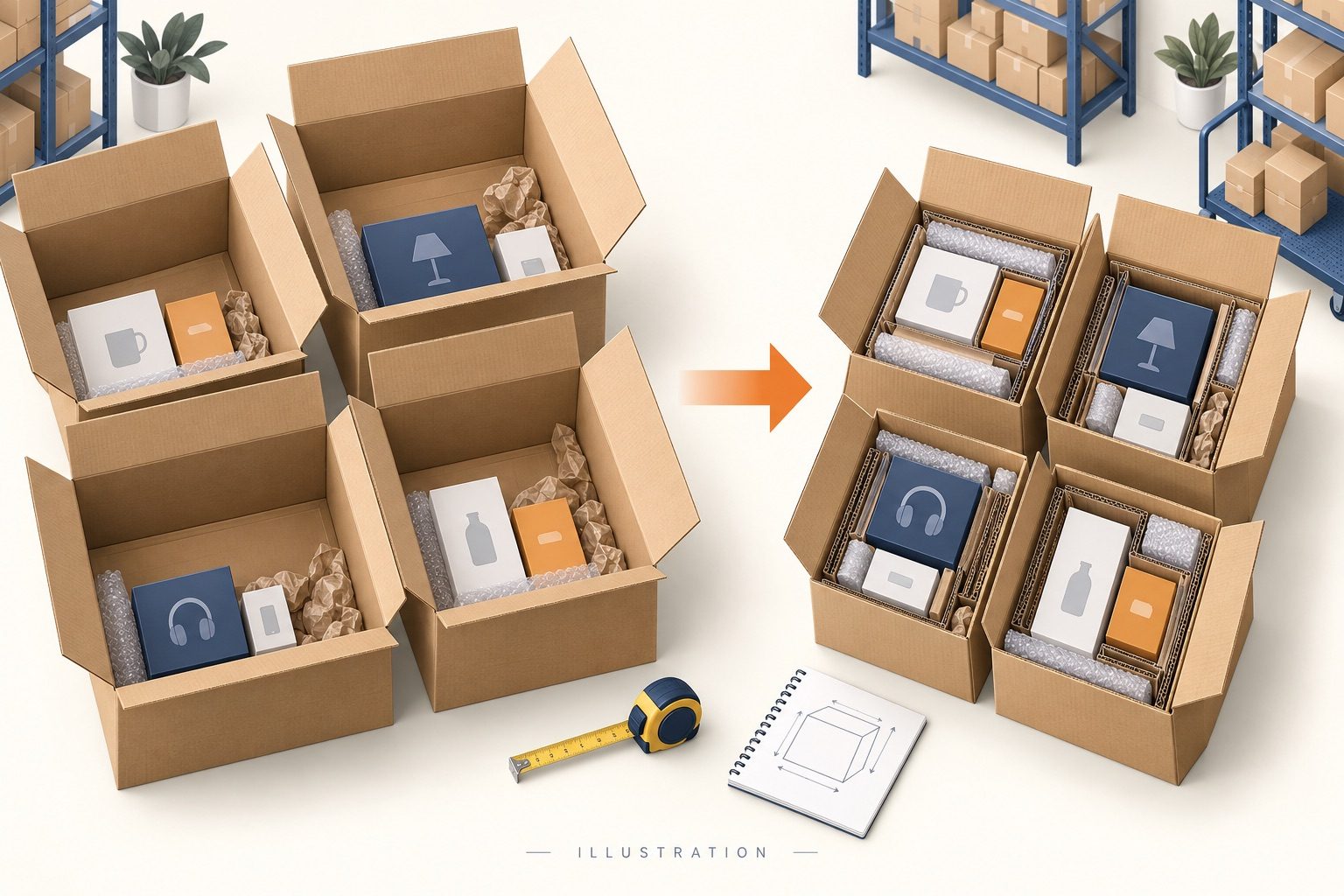
Conceptual illustration: reduce unnecessary outer space while retaining suitable protection. This is not a photograph of a customer shipment or a scale drawing of the calculation above.
A lower shipping invoice is useful only if the goods arrive fit for their intended sale or use. For a merchant, retail presentation, identifiable stock and intact packaging may be part of the product’s value.
Ask the warehouse to assess these decisions:
Remove redundant outer packaging selectively. Large domestic shipping cartons may have room to spare. Keep sealed retail packs, required labels, barcodes and protective inserts where they matter. Agree on changes before packaging is discarded.
Group compatible goods. Products with similar protection needs may pack efficiently together. Heavy components and delicate retail goods may need separate cartons even when empty space remains. Share the full product list so route eligibility can be checked before packing.
Preserve stock identification. Request a carton contents list showing item or SKU, quantity and carton number. Mixing suppliers’ products without an inventory record can create unnecessary work when receiving stock in the USA.
Compare manageable cartons with larger cartons. One oversized box is not automatically cheaper than several smaller ones. UPS explains that package size, weight and packaging can trigger additional handling charges. Have the selected service’s limits checked before approving the carton plan.
For item-by-item wording, use our guide to giving a China warehouse clear packing instructions.
Compare complete delivery proposals on the same basis
Send competing providers the same product list, final carton measurements and destination. A preliminary estimate based on “about 100 kg” should be identified as an estimate, with the conditions that could change it.
A useful written proposal should answer:
- What is being charged? Actual and dimensional weights, the billing method, rate tier, minimum charge and how remeasurement is handled.
- What does packing cost? Repacking labor, replacement cartons, reinforcement and any separately charged materials or warehouse services.
- Where does the price end? The exact US ZIP code and address type, with residential, remote-area or other delivery charges identified where applicable. For freight delivery, confirm unloading equipment and appointment requirements.
- Who handles clearance and import charges? Request written inclusions, exclusions, required documents and the responsible parties. “Door delivery” alone does not explain which charges are included.
- What happens if something goes wrong? Tracking availability, the contact handling delays, and applicable loss or damage claim terms. Check any optional insurance coverage and exclusions.
- How long is the quote valid? Confirm validity and when the delivery estimate begins.
Use the USA consolidation checklist to confirm arrivals, contents and declarations before finalizing the shipment. Packing changes should not alter the accurate description or value of the goods.
Choose transport around the stock deadline
For a business, “stable shipping” should mean a clear service plan: a realistic dispatch estimate, a defined delivery scope, trackable handoffs where available and someone responsible for following up on exceptions.
Stock needed soon: compare eligible express or air options against the date inventory must be available for sale. Include receiving, packing and clearance time in the discussion. A flight transit estimate alone does not answer when stock reaches your premises.
Routine replenishment with time available: ask whether a slower service produces a lower complete delivered total. Do not select a sea option solely from a low headline freight rate; ask for its minimums, origin and destination charges and final delivery scope.
A mixed-priority order: price an urgent subset separately from the remaining stock. This is a planning option, not an automatic saving: two shipments can add packing, minimum and processing charges. Compare both totals and decide whether earlier access to the urgent goods is worth the difference.
For example, a shop might need one product line for a launch while the rest replenishes existing inventory. That hypothetical situation deserves a different transport plan from an order in which every item is needed next week.
When repacking—or waiting for more goods—is not worth it
Keep an efficient supplier carton when the expected freight reduction does not cover the repacking cost. Preserve packaging needed for resale, protection or agreed coverage terms. Ask for selective improvement rather than stripping every product down.
Waiting for another supplier can make consolidation worthwhile, but set a latest dispatch date. Saving on freight loses its purpose if the stock arrives too late for its intended use.
If a single supplier already offers suitable export packing and a competitive delivery proposal, buying directly may be the simpler choice. When purchasing from several suppliers, a warehouse can be useful for coordinating arrival, packing and dispatch; our 1688-to-USA shipping guide explains that wider process.
You can also ask whether a volume or repeat-order discount is available. Confirm it in the written quote—100 kg by itself does not establish eligibility. Negotiate after the packing plan and service scope are clear.
Send these details for a useful 100 kg quote
You can use this request when contacting YDA Express:
I am preparing approximately 100 kg of goods for delivery to the USA. Please compare the current packing with a suitable consolidation or repacking plan, including the packing fee.
Products, materials and quantities: [details]
Supplier locations or warehouse parcel numbers: [details]
Current carton count, outer dimensions and gross weights: [details, or state if unknown]
Retail packaging, labels and protection that must stay: [details]
US ZIP code and delivery address type: [details]
Date the stock is needed, and any urgent items: [details]
Goods needing special route review: [details]Please show the chargeable weight, total quoted cost, inclusions and exclusions, delivery estimate and quote validity for each suitable option.
Start with the information you have. If the cartons have not reached the warehouse, request a provisional estimate and identify what still needs measuring.
Ask YDA Express to review the packing plan alongside the shipping quote through our purchasing and forwarding services. The aim is a shipment that uses space sensibly, protects your stock and fits your delivery needs at a clear total cost.
📲 Download the YDA Express App
Use the YDA Express App to place China purchasing orders, view product check photos, manage packages, and arrange consolidation and international forwarding.