
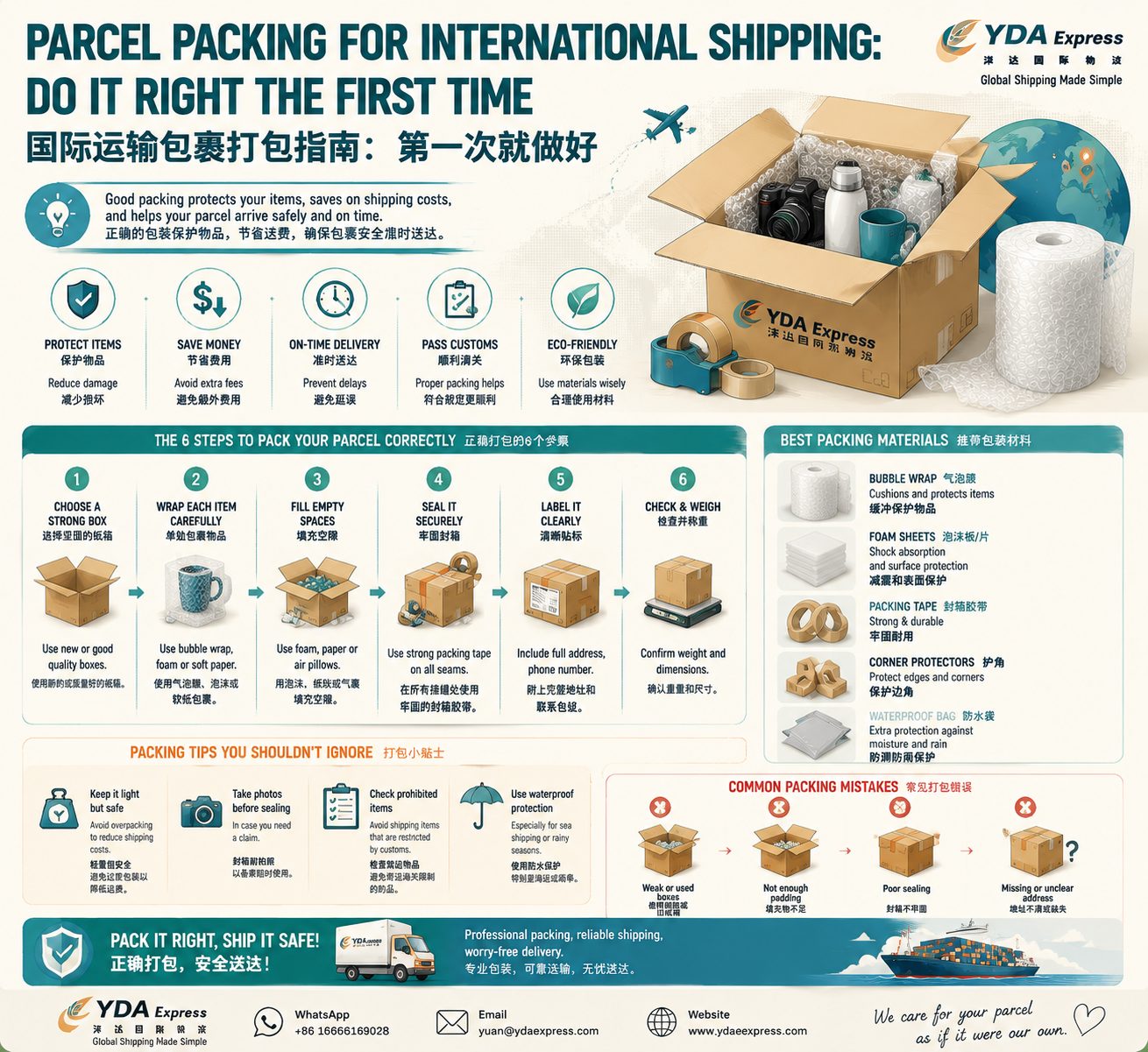
Learn how to write clear packing instructions for a China warehouse. Decide what packaging to keep or remove, how to protect fragile, heavy and liquid items, when to consolidate or split parcels, and what to approve before international dispatch.
When several Taobao, 1688, JD.com or Pinduoduo orders arrive at a China warehouse, writing “pack everything safely” is not enough.
The warehouse does not automatically know whether you want to keep retail boxes, compress clothing, separate liquids, protect a collector’s package or divide heavy and fragile products. Vague instructions force warehouse staff to make decisions that may not match your priorities.
Clear packing instructions help protect the goods, control volumetric weight and create a record of what you authorised before international dispatch. This guide shows what to inspect, what decisions to make and how to write instructions that a warehouse can follow without guessing.
Wait until the expected parcels are identified
Before requesting packing, confirm that every parcel intended for the shipment has arrived and is registered under the correct account.
Match each parcel with:
- seller name;
- domestic tracking number;
- order number;
- product name;
- quantity;
- selected colour, size or model;
- expected accessories;
- return deadline.
If an order is missing, do not assume it has been combined with another seller’s delivery. Check the domestic tracking record and ask the warehouse to confirm which parcel numbers have been received.
YDA Express provides eligible registered customers with up to 180 days of free storage at its warehouse in Yangjiang, China. This gives buyers time to wait for planned orders from different sellers. Review the conditions in the free warehouse storage policy.
Storage should not delay inspection. A seller’s return period may expire long before the warehouse storage allowance ends.
Review the products before changing the packaging
Once retail boxes, seals or seller cartons have been removed, returning the product may become more difficult. Review the order before authorising irreversible packaging changes.
Useful arrival photographs may show:
- seller’s outer parcel;
- product and quantity;
- visible colour or model;
- retail packaging;
- fragile areas;
- labels or serial information;
- visible damage;
- leakage or moisture;
- included accessories.
Ask for specific views instead of requesting a general quality check. For example:
- photograph all four corners of the retail box;
- show the product label and model number;
- confirm whether the bottle seal is intact;
- measure the width and length;
- photograph the screen before packing.
A basic warehouse inspection can identify visible differences and obvious damage. It does not replace professional authentication, laboratory analysis, safety certification or complete functional testing.
The warehouse inspection checklist explains how to request useful evidence before the parcel is repacked.
Classify every item by its packaging priority
Before writing instructions, place each product into a practical category.
Compressible items
Clothing, bedding and other soft goods may allow volume reduction. However, compression may crease formal clothing, damage padded products or affect items intended for resale.
State whether the warehouse may:
- remove hangers;
- remove shoe or retail boxes;
- fold the product;
- use a compression bag;
- retain tags;
- retain branded packaging.
Fragile items
Glass, ceramics, screens, figurines and delicate parts need movement control and impact protection. Identify handles, corners, protruding parts and other weak areas.
Do not rely on clothing in the same carton as the only cushioning. Each fragile item should have its own protective layer and should not touch another hard product.
Heavy items
Tools, metal components, cookware and dense machinery parts can crush lighter goods or break through a weak carton. They may need reinforced packaging or a separate box.
State whether heavy products may share a carton and what must be separated from them.
Liquids and leak-prone goods
Liquids, oils, creams and similar products may need secondary containment, absorbent material and separation from textiles or paper goods. Confirm route eligibility before packing.
Structured or presentation-sensitive items
Shoes, handbags, gift sets and collectables may lose value if their retail boxes are removed or compressed. Clearly state which original packaging must remain.
Sensitive goods
Batteries, electronics, powders, magnets, food, cosmetics and branded goods may require route-specific preparation. Packaging should only begin after the route has been checked.
Specify what packaging may be removed
“Remove unnecessary packaging” is too broad. Divide packaging into three groups.
Packaging that may be removable
Depending on the product, this may include:
- oversized domestic courier cartons;
- extra plastic mailers;
- advertising leaflets;
- empty filler;
- duplicate outer boxes.
Packaging that should normally remain
This may include:
- manufacturer protection;
- moulded inserts;
- sealed product packaging;
- labels needed to identify the item;
- instruction manuals;
- retail packaging needed for resale;
- collector or gift boxes.
Packaging that may need replacement
A seller carton may need replacement if it is:
- wet;
- punctured;
- badly creased;
- too weak for the total weight;
- bulging;
- missing a secure bottom;
- covered with obsolete labels.
Photograph packaging that matters before removing or replacing it. This provides a record of its condition and helps the customer approve the change.
Describe the required protection, not only the material
Requesting “more bubble wrap” does not explain what problem needs to be solved. State the protection objective.
Examples of clearer instructions include:
- prevent the ceramic handles from touching the box;
- protect the screen from direct pressure;
- secure the metal strap so it cannot scratch the handbag;
- keep the retail box free from tape;
- separate the liquid bottle from all clothing;
- prevent the heavy component from moving;
- reinforce the bottom for the combined weight;
- keep the sealed package unopened.
Packaging should control movement in multiple directions. If an item can move freely inside the carton, adding a warning label will not solve the problem.
The international packaging materials guide explains the roles of cartons, cushioning, dividers, sealing materials and moisture protection.
Decide whether to consolidate or divide the shipment
Consolidation may reduce unnecessary packaging and repeated shipment charges, but one large carton is not always safer or cheaper.
Consider consolidation when:
- products have similar handling needs;
- the same route accepts all items;
- goods cannot damage one another;
- one carton remains within practical size and weight limits;
- the delivery deadline is the same;
- all products belong to the same recipient.
Consider separate cartons when:
- heavy and fragile items conflict;
- liquids could contaminate other goods;
- one product needs a different route;
- a presentation box must remain uncrushed;
- the combined carton becomes oversized;
- some products are urgent;
- customs or commercial records should remain separate.
Ask for a comparison of the proposed package count, weight and dimensions before confirming the final option.
The package consolidation guide explains why the best result may be one carton, several cartons or a combination of both.
Include a simple packing table
For mixed orders, use a table instead of writing one long message.
| Item | Keep retail box | Compression allowed | Extra protection | Pack separately | Special instruction |
|---|---|---|---|---|---|
| Cotton shirts | No | Yes | Moisture protection | No | Keep product tags |
| Ceramic cups | Yes | No | Individual cushioning and dividers | Yes | Protect handles |
| Handbag | Yes | No | Fill interior and cover hardware | No | Do not tape gift box |
| Bottled sauce | Yes | No | Sealed secondary bag and absorbent layer | Yes | Keep away from textiles |
| Electronic device | Yes | No | Protect screen and connectors | Depends on route | Confirm battery details |
Replace the example items with your actual order. If a decision depends on cost, state that the warehouse should request approval before proceeding.
Request final measurements before paying for shipping
Do not approve the freight charge using the seller’s original estimate. After consolidation and protective packing, request:
- number of cartons;
- actual weight of each carton;
- outer dimensions;
- volumetric-weight formula;
- chargeable weight;
- photographs of the closed cartons;
- route name and service scope;
- relevant surcharges;
- insurance or compensation terms.
Packaging can reduce empty space, but protective materials can also increase dimensions. The correct balance depends on product value, fragility and the selected transport method.
The shipping cost calculation guide explains how actual weight, volumetric weight, dimensions and route conditions affect the final charge.
Check labels and documents before sealing
The outer label should be clear, complete and attached to a flat surface. Remove or cover obsolete barcodes from reused cartons.
Confirm:
- recipient’s full name;
- complete street address;
- city, region and postal code;
- destination country;
- reachable telephone number;
- carton count where applicable;
- correct shipping label;
- required handling or battery labels.
The packing list and customs information should match the physical contents. Product descriptions must be specific, and quantities and values should be supportable with purchasing records.
Do not ask the warehouse to describe goods as “gifts,” “samples” or “accessories” without identifying the actual products.
Ask for approval photographs at the right stages
A useful photo record may include:
- items before repacking;
- fragile protection before the carton is closed;
- item arrangement inside the carton;
- sealed carton;
- shipping label;
- weight and measurement record.
Not every shipment requires all these photographs. Request them when the value, fragility, presentation or claim risk justifies the additional work.
Photographs do not prove that concealed damage cannot exist, but they help confirm whether the agreed instructions were followed before dispatch.
Use a clear instruction template
You can submit packing instructions in this format:
Shipment objective: Protect fragile products while controlling unnecessary volume.
Parcels included: List the relevant warehouse parcel numbers.
Remove: Identify seller cartons, mailers or retail packaging that may be discarded.
Keep: Identify product boxes, labels, manuals, accessories and seals that must remain.
Protect: State which items need cushioning, dividers, moisture protection, secondary sealing or bottom reinforcement.
Separate: Identify products that must not share a carton.
Compression: List the items that may or may not be compressed.
Photographs required: State the views needed before final approval.
Final quotation: Request actual weight, dimensions and chargeable weight before shipment.
No substitution without approval: Ask the warehouse to contact you if the requested method cannot be completed.
This format makes the customer’s priorities clear and reduces decisions based on assumptions.
Final checklist before authorising dispatch
Confirm that:
- all expected parcels have arrived;
- visible product checks are complete;
- seller return deadlines were reviewed;
- removable packaging is identified;
- retail packaging that matters will remain;
- fragile areas have specific protection instructions;
- heavy products cannot crush lighter goods;
- liquids have secondary containment;
- sensitive items match the selected route;
- consolidation and division were compared;
- the final carton count is confirmed;
- actual and volumetric weight are available;
- shipping labels and recipient details are correct;
- customs information matches the contents;
- final packaging photographs were reviewed.
Effective packing instructions describe the required result, not merely the amount of material to use. The warehouse should know what can be removed, what must be protected and which decisions still require customer approval.
YDA Express can assist with parcel receiving, inspection photographs, eligible free warehouse storage, package consolidation, repacking and international shipment preparation. Customers can approve the product condition, packing plan and final chargeable weight before the shipment leaves China.
📲 Download the YDA Express App
Use the YDA Express App to shop from China, place purchasing orders, receive product inspection photos, manage packages, consolidate shipments, and arrange worldwide delivery—all in one place.
🎁 New customers pay no purchasing service fee on their first order.