A practical guide explaining how international buyers can purchase goods from 1688.com using Chinese purchasing agents and consolidation services, covering the process, shipping options, costs, and tips for a smooth experience.
Last week, a friend in Texas found the perfect custom-branded yoga mats on 1688.com. They were half the price of anything on Alibaba, but when he tried to check out, the site asked for a Chinese business license and a local bank account. Sound familiar? This is where 1688 purchasing agents and international consolidation services come in.
For the broader differences between shopping, purchasing, sourcing and forwarding services, review this China shopping agent guide.
1688.com is Alibaba Group’s wholesale marketplace aimed at the domestic Chinese market. It's where factories sell directly to businesses inside China. Compared to Alibaba International, prices are often lower, MOQs can be smaller, and you’ll find products that never make it to export channels. But the platform is entirely in Chinese, supports only Chinese payment methods, and does not offer international shipping. That’s the wall overseas buyers hit.
But there’s a well-trodden path: use a China-based purchasing agent—often called a 1688 daigou or procurement service. These agents act as your local buyer. You give them the product links, they communicate with suppliers, pay in yuan, receive the goods at their Chinese warehouse, and then forward them to you using international logistics. Alternatively, you can use a freight forwarder that provides a Chinese mailing address, but you’d still have to navigate 1688’s ordering and payment system yourself. For most, the agent route is far simpler.
In this guide, I’ll walk you through exactly how it works, what to expect, and how to get your goods from a factory in Shenzhen to your doorstep in London or Los Angeles without headaches.
Why Go Through the Trouble of 1688?
If you’re already buying from Alibaba or AliExpress, you might wonder why bother with 1688 at all. The answer usually comes down to two things: price and access.
1688 is the upstream source for many Alibaba sellers. A product listed for $15 on Alibaba might be $9 on 1688—same factory, different listing. When you’re importing 500 units, that margin matters. Beyond cost, 1688 gives you a front-row seat to China’s domestic supply chain. You’ll find electronics components, packaging materials, unbranded apparel, and niche manufacturing services that simply aren’t marketed overseas. For small ecommerce brands, 1688 is a goldmine for product development.
Of course, the platform wasn’t built for foreigners. It assumes you have a Chinese ID, a business license, and an Alipay account tied to a Chinese bank. This is where an overseas purchasing agent steps in.
The Two Main Ways to Buy from 1688 Abroad
Option 1: Full-Service Purchasing Agent
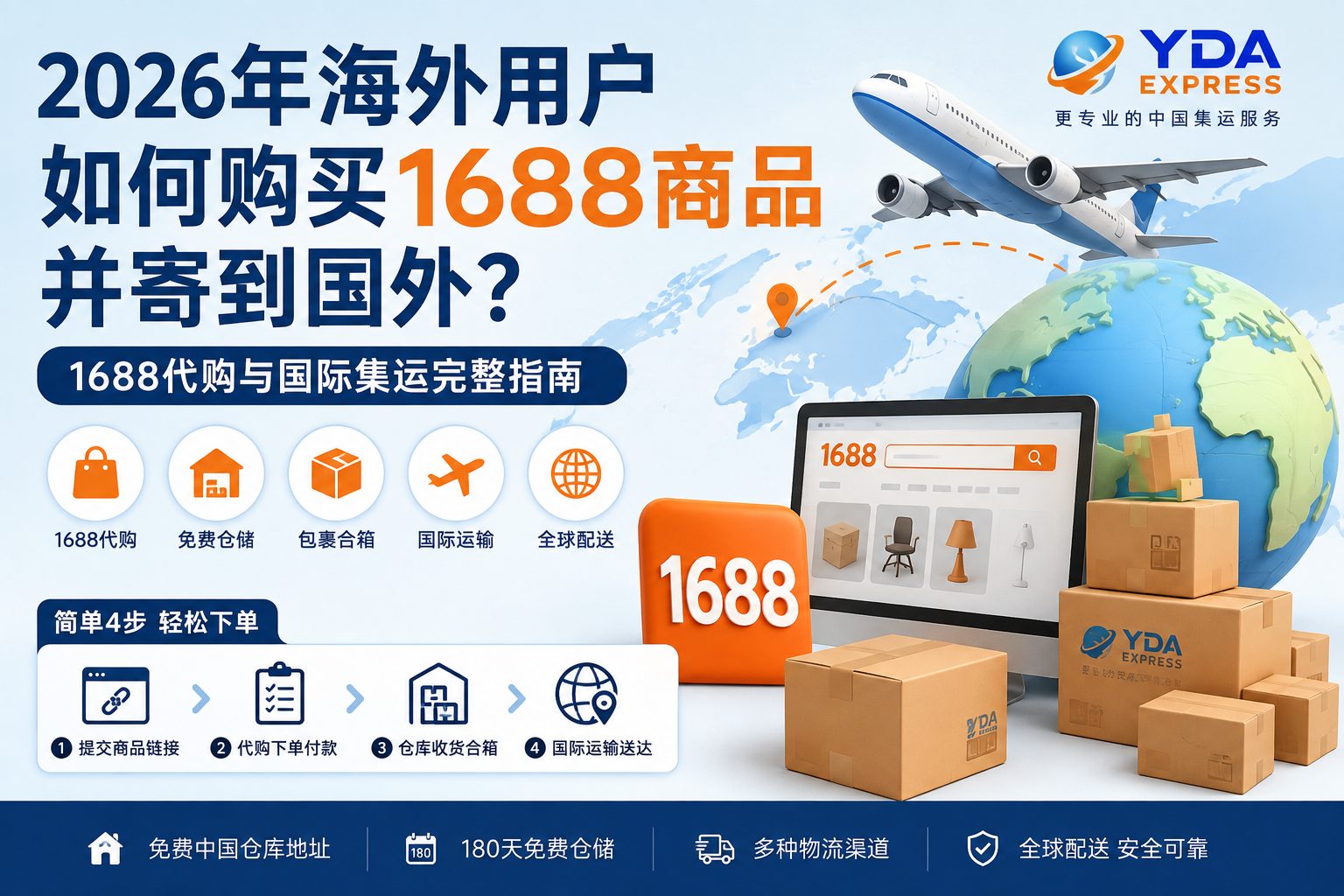
A China purchasing agent does it all. You provide the 1688 product links, specify quantities, and the agent handles everything down to final delivery. The typical flow:
- You share links via email, WhatsApp, or WeChat.
- The agent confirms pricing and any custom requirements with the supplier.
- You pay the agent (PayPal, bank transfer, Wise—most agents accept multiple methods).
- The agent buys the goods using their local account and warehouse address.
- Items arrive at the agent’s warehouse; they can take photos for quality inspection.
- If you’re ordering from multiple suppliers, the agent consolidates everything into one shipment.
- You pick a shipping method—international express, air freight, or sea freight—and pay the freight cost.
- The package clears customs and lands at your address.
Good agents live and breathe this workflow. They know which suppliers are reliable, how to pack fragile items, and how to handle the paperwork so you don’t get stuck. At YDA Express, we’ve processed thousands of 1688 procurement orders, from single cartons of phone cases to pallets of fitness equipment. The advantage of a logistics-first agent is they can be brutally honest about what will and won’t save you money on shipping.
Option 2: DIY with a Freight Forwarder’s Address
Some buyers prefer to keep control. You can register a 1688 account using your passport (yes, it’s possible, though clunky) and add a China freight forwarding address as your delivery location. Then you pay suppliers directly through Alipay—which may or may not accept your foreign card. Once the goods reach the forwarder, they’ll store, consolidate, and ship.
Honestly, this path only makes sense if you speak Chinese, have a trusted payment method inside China, and are comfortable handling disputes solo. For the other 99% of overseas buyers, an all-in-one agent removes the friction.
How to Find a Reliable 1688 Purchasing Agent
Not every “agent” on Facebook groups is legitimate. Here’s what to look for:
- A real company behind the service. Check their business registration, website, and years in operation.
- Physical warehouse photos or videos. A legitimate operation has nothing to hide.
- Transparent fees. Most agents charge a small percentage (usually 3–10%) of the product cost or a flat fee. Shipping should be priced transparently based on weight and dimensions.
- Carrier relationships. A good agent works with international courier services like DHL, FedEx, UPS, and SF International, as well as air and sea freight consolidators. If they only offer one obscure shipping line, be cautious.
- Communication in English. You don’t want to guess what’s happening with your €2,000 order.
Start with a small test order—a few units of a low-cost item. Evaluate how long it takes, the packaging, and the agent’s communication before scaling up.
The Hidden Savings: Consolidation and Repacking
Package consolidation is the unsung hero of China purchasing. When you buy from five different 1688 suppliers, you’ll get five separate domestic packages. If you ship each one individually, you pay a base courier charge five times over—plus your shipments might arrive days or weeks apart. Consolidation combines everything into one master parcel, and you pay for only one international shipment.
But smart agents go further: they repack to reduce volumetric weight. International couriers charge by whichever is greater—actual weight or dimensional weight (length × width × height in cm ÷ 5000 for kg). Imagine you ordered pillows. Their actual weight might be 2kg, but the factory box measures 60×50×40 cm, giving a volumetric weight of 24kg. The shipping bill would be wild. By squeezing those pillows into a vacuum bag or a custom-sized carton, a good agent can drop the volume dramatically.
Repacking also protects your goods. Factory packaging is often designed for palletized trucking, not cross-continent courier abuse. An experienced agent reinforces cartons, adds waterproofing, and removes unnecessary clutter like heavy plastic handles. This is where international logistics experience really pays off.
Shipping Methods: Which One to Choose?
The right shipping method depends on weight, urgency, and destination. Let’s break it down.
International Express (Door-to-Door)
Carriers like DHL, FedEx, and UPS are the standard for shipments under 100 kg. They pick up from the agent’s warehouse and deliver to your door in 3–7 business days. Customs clearance is typically handled within the service, so you just pay any applicable duties before delivery. DHL tends to be strong in Europe and the Middle East; FedEx and UPS dominate the US lanes. SF International (the courier arm of SF Express) has become a competitive alternative to many Western countries, often at lower rates.
Expect to pay around $5–$10 per kg for small parcels (1–10 kg) to the US or UK, though volume weight can bump that up. For reference, a 10 kg box of clothing in a 50×40×30 cm carton (volumetric weight 12 kg) might run $60–$80 via DHL to the UK, customs duties not included.
Air Freight
When your consolidated shipment crosses the 45 kg mark, air freight starts making sense. You’re not booking a whole plane—just pallet or crate space on a commercial cargo flight. Transit time is typically 7–15 days airport-to-airport, and you’ll need a customs broker (or your agent’s partner) to clear the goods and arrange final delivery. Per-kg rates drop to $3–$6 depending on origin/destination pair and fuel surcharges. It’s a popular choice for seasonal inventory where you can’t wait weeks for a ship.
Sea Freight
For bulk shipments of 200 kg or more, sea freight is the cheapest option. You can book less-than-container-load (LCL) or a full container (FCL). Transit takes 30–45 days port-to-port, plus a week for customs and inland trucking. Rates fluctuate wildly, but you might pay under $1 per kg for LCL to major US or European ports after all fees. The trade-off is time and complexity—you’ll deal with a bill of lading, arrival notices, and possibly storage charges if you don’t clear quickly. A good agent will manage this, but it pays to understand the process.
A small business in Manchester importing 500 canvas backpacks might choose LCL sea freight and wait five weeks to save hundreds over express. The same client might pay for DHL express to get 20 samples quickly. That mix—sea for bulk, express for rush—is common.
Customs, Duties, and the Tax Elephant in the Room
Your goods will go through customs. Always. How much you pay depends on the destination country’s de minimis threshold (the value below which no duty or tax is charged).
- United States: Section 321 de minimis is $800 per person per day. If your consolidated shipment’s declared value is under $800, it typically enters duty-free. Over $800, duties kick in based on the Harmonized Tariff Schedule.
- United Kingdom: After Brexit, the £135 threshold was eliminated for most goods. Now, VAT (20%) is collected at the point of sale or on import. Duties apply over £135.
- European Union: The €150 customs duty exemption remains, but VAT is charged from the first euro, and since 2021 the Import One-Stop Shop (IOSS) means your agent should ideally handle VAT upfront to avoid delays.
- Canada: CAD $20 for duties, CAD $60 for taxes—anything above is subject to assessment.
- Australia: GST applies to imports under AUD $1,000 via the seller/platform; over, duties and GST payable at border.
These rules change. In 2026, watch for evolving ecommerce import policies. Your agent will prepare a commercial invoice with declared values. Under-declaring to dodge tax is a gamble—customs can seize goods if values look fake. Declare honestly, in line with the actual transaction, and budget for duties as part of your landed cost.
Real Talk: Common Mistakes First-Time Buyers Make
Over a decade in international logistics, I’ve seen the same slip-ups cost people time and money.
- Ignoring domestic shipping inside China. Just because the supplier offers “free shipping” doesn’t mean it’s fast. Some use economy couriers that take a week or more just to reach the agent’s warehouse in Shenzhen. Ask your agent to press for a reliable carrier if you’re in a hurry.
- Not checking packaging before shipping. You approved the product photos, but did you check how it’s packed? A beautiful ceramic vase in a thin cardboard sleeve won’t survive 8,000 miles. Pay the extra few dollars for bubble wrap, double-boxing, or a wooden crate.
- Forgetting about volumetric weight on bulky but light items. That pack of 50 yoga blocks might weigh 10 kg but measure out to 40 kg for billing. Your agent can advise, but always ask: “Is the chargeable weight the same as the actual weight?”
- Timing around Chinese holidays. Chinese New Year (usually late January or February) shuts down factories and logistics for two weeks. If you order in early January expecting a February delivery, you’ll be disappointed. Plan 60 days ahead of any major holiday, including Golden Week in October.
- Assuming the cheapest agent is the best. When an agent’s fee is suspiciously low, they’re probably making it up on shipping markups or not providing any quality checks. Pay a fair rate for a professional service.
How YDA Express Fits Into Your 1688 Workflow
We built YDA Express to connect global buyers with China’s supply chain without the guesswork. Unlike standalone China purchasing agents, we’re a licensed freight forwarder first. That means our warehouse rates, repacking, and carrier discounts directly benefit you. We don’t farm out your shipping to a third party—we control the whole chain.
Here’s the process if you work with us:
- You send us your 1688 links or product descriptions.
- We source, verify suppliers, and give you a total cost (product + our flat service fee).
- You pay via bank transfer, PayPal, or Wise.
- We order, inspect, photograph, and store your items.
- When you’re ready, we consolidate, repack, and ship using DHL, FedEx, UPS, SF International, or sea/air freight.
- We handle export declarations and provide all tracking.
We ship to over 200 countries. Most small parcels arrive within a week via express. Larger sea freight shipments take time but slash your per-unit cost. And if something goes sideways—a damaged item, a delayed flight—you talk to one team, not a chain of subcontractors.
Your Next Steps
Overseas shopping from 1688 doesn’t have to feel like a leap of faith. With the right partner, you can source unique products at factory prices and have them delivered to your door almost anywhere on the planet.
Start small. Pick one product, find a reliable agent, and run a trial. Once you see the quality and the landed cost, you’ll wonder why you didn’t do it sooner. If you’re ready to explore 1688 international consolidation and need a partner who speaks both logistics and procurement, get in touch with YDA Express for a free quote. We’re here to make China’s biggest wholesale marketplace feel like your local supplier.