
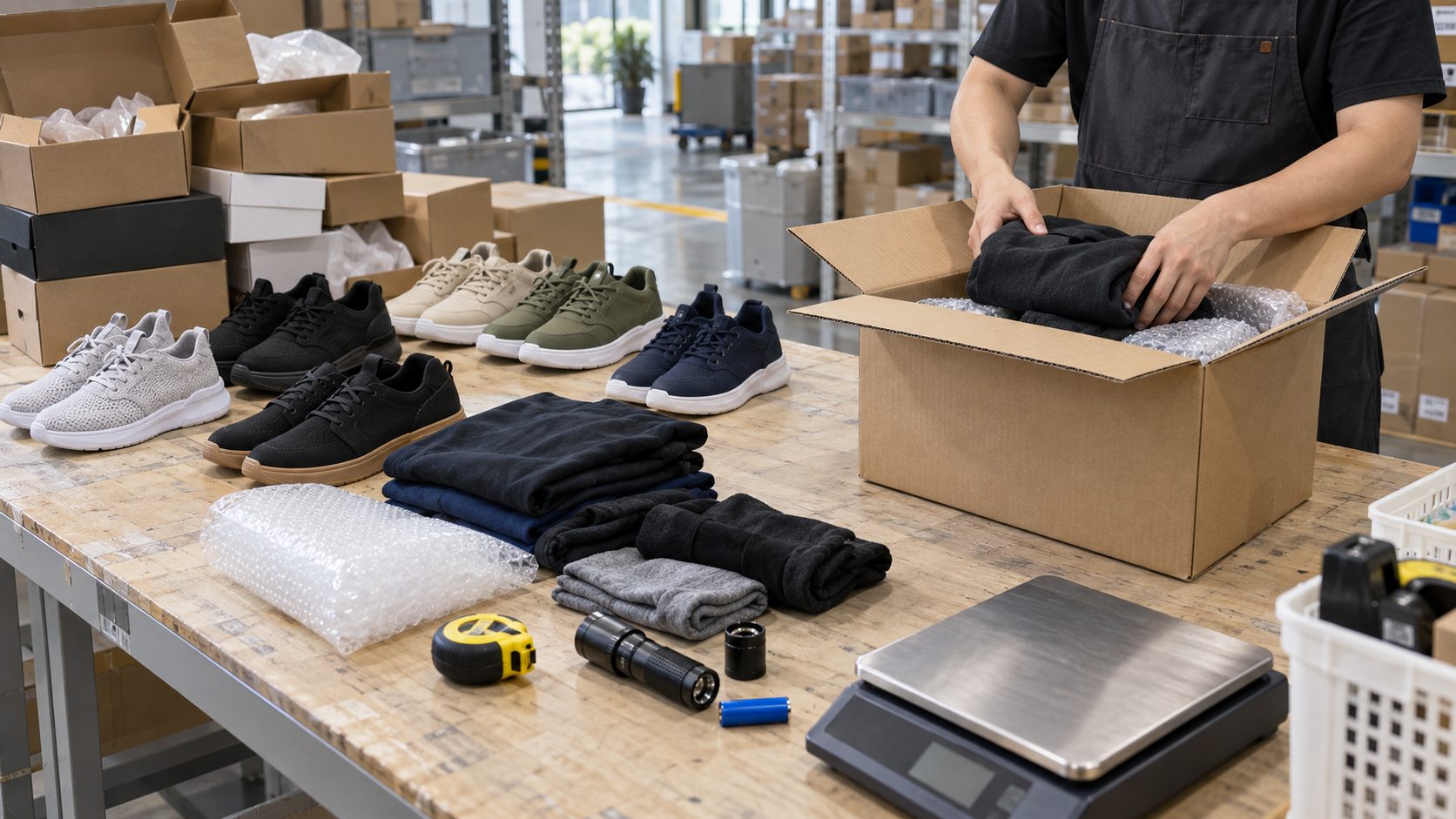
An anonymized warehouse case showing how 11 China parcels were checked, photographed, repacked, reviewed for a removable battery, remeasured and compared with a valid non-remote pickup option.
From 11 China Parcels to One Shipment: A Warehouse Repacking Case
When several purchases arrive at a China warehouse separately, the cheapest shipping decision is rarely “send everything immediately.” The useful sequence is: match every parcel, inspect the contents, remove only unnecessary packaging, check restricted items, repack the goods, measure the final carton, and then compare routes using the exact destination postcode.
This anonymized warehouse case follows that process. It is based on documented customer-service and packing records, with all names, addresses, phone numbers, order numbers, tracking numbers and account details removed. The records show the warehouse work through repacking and measurement; they do not prove final customs clearance, delivery or a guaranteed amount saved.
The starting point: 7 parcels, then 4 more
The customer first had seven parcels in the warehouse. Their combined inbound actual weight was 3.52 kg, while the preliminary combined quote showed 7.00 kg of chargeable weight. That difference was a warning that packaging volume—not only product weight—could affect the shipping bill.
Four more parcels arrived later, bringing the total to eleven. Instead of shipping the first group immediately, the customer waited and asked the warehouse to consolidate all eleven parcels into one shipment.
If you are new to this process, our China warehouse parcel receiving guide explains how domestic tracking numbers, inbound photos and warehouse records are matched before international dispatch.
Step 1: confirm every parcel before repacking
The warehouse checked each inbound parcel against the customer account and provided arrival photos. This matters because consolidation should begin only after the customer confirms that the expected parcels are present.
The customer also reported difficulty viewing one set of photos in the app. The practical fix was not to guess: the team checked the warehouse record, confirmed that photos existed, and asked the customer to update the app or use the browser view. A packing request should not move forward until both sides are referring to the same parcels.
Step 2: remove bulk, not necessary protection
The shipment contained shoes, clothing and small accessories. The customer asked the warehouse to remove shoeboxes, outer cartons and redundant retail bags, then use the smallest reasonable carton.
That instruction can reduce empty space, but “remove all packaging” should not mean “ship with no protection.” Shoes can be nested or packed closely, small parts can be placed inside available product space, and light cushioning can protect surfaces and prevent movement. Fragile or easily deformed goods may still need a rigid box.
For a reusable instruction format, see how to give packing instructions to a China warehouse. A good request identifies what may be removed, what must stay, and what level of protection is acceptable.
Step 3: handle the flashlight battery before choosing a route
One parcel contained a flashlight with a removable lithium battery. The customer wanted the battery removed so the remaining flashlight body could be considered for a general-cargo route.
The warehouse removed the cell at the customer’s request and recorded the result. However, battery removal does not automatically guarantee that every carrier will accept the remaining product as general cargo. The product description must remain accurate, the warehouse must confirm that no battery remains, and the selected carrier must recheck route eligibility.
Lithium batteries are regulated air cargo. The IATA battery guidance explains that classification, packing and documentation depend on the battery and how it is shipped. Never hide a battery or declare a battery-powered item as something else.
Step 4: wait for the final carton before comparing prices
After the unnecessary retail packaging was removed, the goods were arranged in one carton with limited protective material. The warehouse record showed a final packed result of about 4.04 kg and approximately 24 × 33 × 27 cm.
Those figures are useful because an international shipment may be billed by actual weight or volumetric weight, depending on the route. A preliminary estimate made before repacking can change after the final carton is weighed and measured. Our guide to why a China shipping quote changes after packing explains this difference.
The correct comparison is therefore not “3.52 kg inbound versus 4.04 kg packed.” It is the final actual weight versus the route-specific volumetric weight, together with any minimum charge, rounding rule and surcharge.
Step 5: compare a valid non-remote pickup point
The customer’s home destination was flagged as remote for at least one service. A remote-area surcharge is normally determined by the carrier’s service map and the exact postcode or locality—not simply by the country or city name. DHL, for example, describes remote-area service as collection or delivery outside its standard service areas and applies a surcharge according to the current service guide.
One possible way to reduce that cost is to use a legitimate staffed pickup location in a non-remote area, such as a supported carrier service point, post office, commercial address or trusted family address. This is not the same as entering a random postcode.
Before using a pickup address, confirm all of the following:
- The selected carrier and service actually deliver to that location and allow recipient pickup.
- The exact postcode is not classed as remote for that specific route.
- The location accepts international parcels of the planned size and weight.
- The recipient name and phone number match the person collecting the parcel.
- The customer knows the identification, authorization and collection-time requirements.
- The cost of travelling to the pickup point does not cancel the shipping saving.
Then request two quotes using the same final packed weight and dimensions: one for the home address and one for the confirmed pickup address. Our guide to calculating international shipping costs shows why the final carton, destination postcode, goods type and route must be compared together.
What this case demonstrates
This case does not show that consolidation always saves money. It shows where a warehouse can create a better decision:
- Eleven parcels were matched before packing.
- Arrival photos and parcel records were checked.
- Shoeboxes and redundant outer packaging were removed.
- Necessary protection was kept.
- A removable battery was separated and the route needed to be rechecked.
- The final carton was weighed and measured before the shipping comparison.
- A valid non-remote pickup option was considered instead of assuming the home address was the only choice.
The result is a clearer quote based on the shipment that will actually travel. Final acceptance, customs treatment, transit time and delivery still depend on the carrier, destination and declared goods.
📲 Download the YDA Express App
Use the YDA Express App to place China purchasing orders, view product check photos, manage packages, and arrange consolidation and international forwarding.