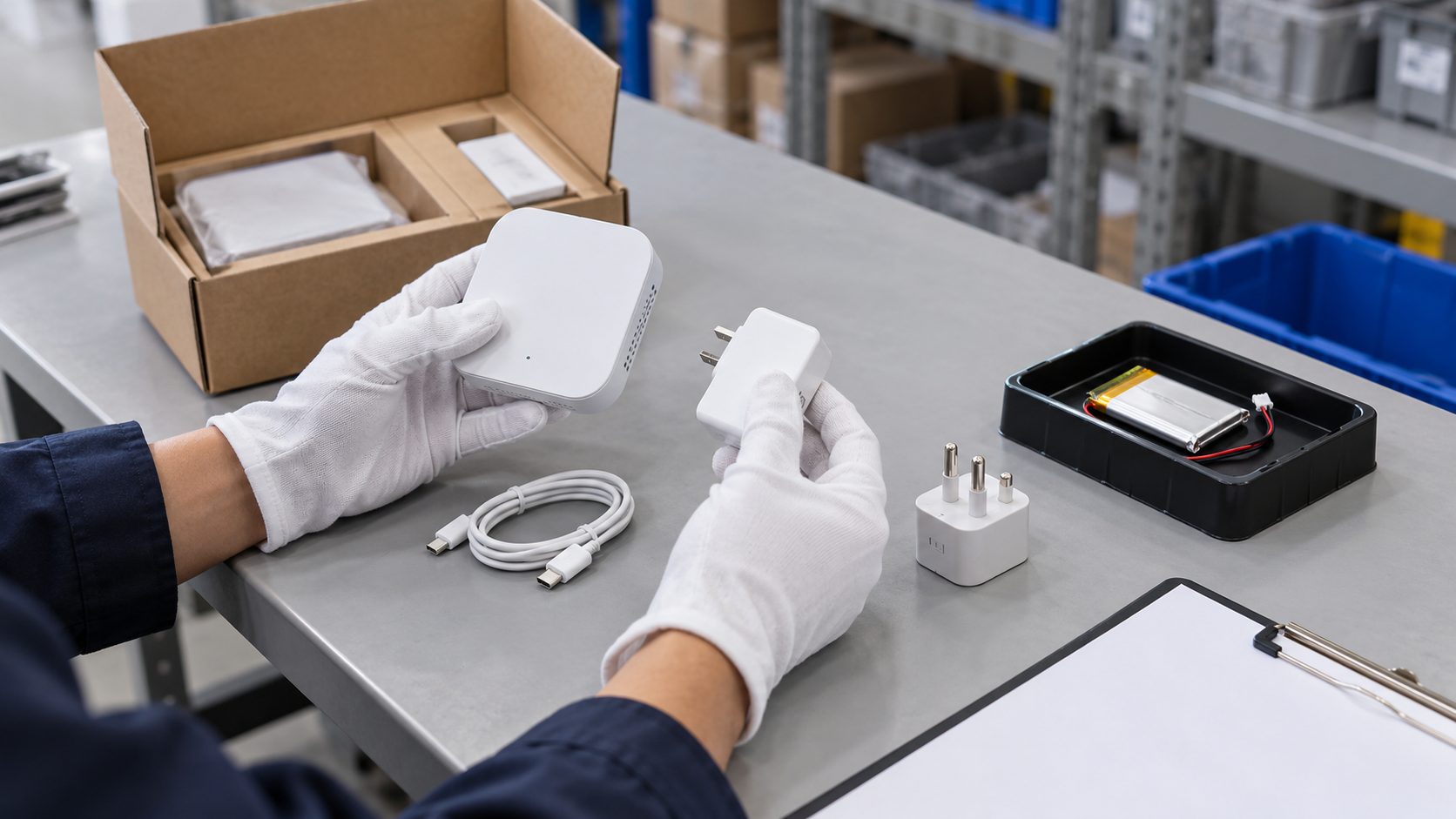
Before paying a 1688 supplier, check the Swiss plug, electrical documents, OFCOM radio frequency and power, lithium-battery route, 8.1% import VAT basis and importer responsibilities.
Policy checked: 5 October 2026. Swiss rules and carrier acceptance can change. Recheck the exact product, route and current official guidance before paying the balance or dispatching.
Buying a charger, smart device, wireless sensor or battery-powered product on 1688 is not just a price-and-freight decision. For Switzerland, the practical question is whether the exact model can be imported, connected, operated and—if applicable—resold lawfully. A China warehouse can verify visible items and packaging, but it cannot turn missing conformity evidence into approval.
Use this guide before paying a supplier deposit. If you are still deciding between retail shopping and supplier sourcing, first read our Taobao Switzerland vs 1688 comparison.
First classify the order: personal test or Swiss market supply
A one-piece sample for your own evaluation and a commercial batch for resale do not create the same business risk. Record the intended use before asking for a quote:
- exact product, model, voltage, rated power and plug;
- whether it transmits by Wi-Fi, Bluetooth, cellular, RFID or another radio system;
- radio frequency band and maximum output power;
- whether a lithium cell is installed, packed with the device or shipped separately;
- personal testing, company equipment, demonstration or resale;
- quantity, unit value, Swiss delivery postcode and importer name.
The supplier listing is only a sales page. It is not evidence that the model complies with Swiss electrical or radio rules. For commercial supply, the Swiss importer carries responsibilities that cannot be delegated to a forwarding warehouse.
Do not pay the deposit until the evidence pack is usable
Ask the 1688 supplier for documents tied to the exact model, not a generic certificate for another product:
- commercial invoice or pro-forma invoice with clear product description and model;
- rated voltage, frequency, power and plug type;
- product and rating-label photos;
- declaration of conformity and the standards applied;
- radio frequency band and maximum output power for wireless equipment;
- battery chemistry, capacity in Wh, packing condition and transport test information requested by the carrier;
- user instructions and safety information in the languages required for the intended Swiss market;
- manufacturer and responsible economic-operator details where applicable.
If the seller refuses to identify the model, supplies inconsistent labels or sends an unrelated certificate, pause the order. The 1688 purchasing guide explains the broader supplier-order workflow, but compliance evidence must still be assessed for the actual product.
Electrical gate: Swiss plug, voltage and safety documents
Switzerland uses its own plug and socket system under SN 441011. A device that merely includes an EU plug plus a loose travel adapter may not be an appropriate commercial solution. Confirm whether the power supply is designed for the Swiss market, whether the voltage and frequency are compatible, and whether the supplied plug, cord and adapter are permitted for the intended use.
For low-voltage electrical products, ask for a model-specific declaration of conformity, safety information, traceable manufacturer/importer details and readable markings. A CE mark photo alone does not prove that the paperwork matches the model or that Swiss requirements are satisfied. ESTI is the competent Swiss authority for electrical safety matters; its published information should be checked again for the actual product category.
Hold the order if the supplier says “European standard” without giving the plug drawing, rated input, model number and conformity documents.
Radio gate: OFCOM conformity, frequency and power
Wireless products need an additional decision. Switzerland’s Federal Office of Communications (OFCOM) states that radio equipment placed on the Swiss market must meet essential requirements, undergo conformity assessment, have technical documentation and a declaration of conformity, include required user information, and carry the necessary marking.
Before purchase, obtain the declaration of conformity plus the operating frequency and maximum transmission power. Compare these with the applicable Swiss radio interface regulations. Equipment can appear compliant with a foreign regime yet use a frequency or power level that is unavailable or restricted in Switzerland. OFCOM specifically warns importers not to buy when the supplier cannot provide the information needed for this check.
Examples needing this gate include Wi-Fi/Bluetooth devices, wireless cameras, remote controls, radio modules, tracking devices, smart-home hubs and some children’s electronics. YDA can ask the seller for visible documents; it cannot determine regulatory conformity or issue an OFCOM approval.
Battery gate: legal import and route acceptance are separate
A product can be legal to own but still be refused by an airline, courier or consolidation route because of its battery configuration. Tell the warehouse whether the battery is built in, packed with the equipment or separate. Provide chemistry, capacity in watt-hours, quantity and condition.
The international carrier may request test summaries, safety data, compliant labels or specific packaging. Damaged, swollen, recalled, unmarked or loose cells should not be dispatched. Power banks are generally treated as batteries rather than ordinary accessories and often have stricter routing limits.
Never hide a battery in the declaration. A route quotation is valid only for the goods described. Acceptance at a China warehouse is not a guarantee that a particular carrier, transit country or Swiss customs authority will accept the shipment.
Swiss VAT, customs treatment and the real landed-cost basis
The Swiss Federal Office for Customs and Border Security (FOCBS) applies import tax to imported goods. The standard VAT rate is 8.1%; a 2.6% reduced rate applies to specified categories. For electronics, the standard rate is normally the relevant planning rate. The taxable basis can include the goods value plus costs incurred up to the destination, including transport, insurance and customs-clearance elements where applicable.
Switzerland abolished import tariffs on industrial products in HS Chapters 25–97 from 1 January 2024. Many electronics therefore have zero customs duty, but that does not remove the customs declaration, import VAT, product controls, carrier clearance fees or accurate tariff classification.
Worked estimate, not a tax quotation
Assume the converted goods value is CHF 100 and transport/insurance to the destination adds CHF 35. A simplified planning basis is CHF 135. At 8.1%, import VAT would be about CHF 10.94, before any carrier clearance or inspection fee. The customs exchange rate, final invoice, tariff classification, other charges and platform tax treatment can change the result.
Import tax of CHF 5 or less is generally not collected, but this is not a universal “CHF 63 duty-free allowance.” Mail-order and platform-tax rules can make a registered seller or platform liable for Swiss domestic VAT on certain low-value supplies. Also, the CHF 150 traveler allowance applies to people carrying goods across the border—not to postal or courier orders from 1688.
FOCBS simplified e-dec Easy treatment is available only when all conditions are met, including gross mass up to 1,000 kg, VAT value up to CHF 1,000, no permit or non-customs restriction, and customs duty excluding VAT no more than CHF 5. Regulated radio or electrical goods may fall outside that simplified path.
Restricted goods and importer responsibilities
Do not treat customs clearance as the same as permission to sell. Depending on the product, the importer may need conformity evidence, labeling, instructions, registrations or permits. Goods that use restricted radio parameters, unsafe electrical components or non-compliant batteries may be stopped or refused.
Other prohibited or restricted categories—such as narcotics, weapons, pyrotechnics, counterfeit goods and protected species products—must not be hidden inside an electronics order. Carrier restrictions can be stricter than customs law. When a product has a laser, liquid, magnet, chemical, medical claim, surveillance function or encryption/radio feature, disclose it before the route is selected.
What the China warehouse can verify
After the sample reaches the warehouse, request only observable checks:
- model and quantity against the order;
- exterior, plug shape, rating label and included accessories;
- visible damage and retail packaging;
- battery marking visible without dismantling;
- photographs of supplied documents.
Use warehouse receiving and inspection as a decision point before export. For several suppliers, agree on battery separation, cushioning and final dimensions before parcel consolidation.
Warehouse photos are not laboratory tests. They do not verify electrical safety, radio performance, authenticity, intellectual-property rights or Swiss market authorization.
Go, hold or stop
| Decision | Minimum condition |
|---|---|
| Go to sample | Exact model, plug/input, radio data, battery data and basic documents are consistent; a suitable route is provisionally available. |
| Hold | A document is missing, the certificate model differs, the radio frequency/power is unclear, or the carrier has not accepted the battery configuration. |
| Stop | Supplier refuses essential evidence, markings conflict, the product uses prohibited/restricted parameters, or the declared goods would conceal a battery or regulated function. |
For a commercial batch, approve one sample first and keep the final balance conditional on the same bill of materials, model, labels, firmware/radio settings and documents. A passed sample does not guarantee that later production is identical.
What YDA Express can and cannot do
Within an agreed scope, YDA Express can assist with 1688 purchasing, Chinese supplier communication, warehouse receiving, visible check photos, consolidation, packing coordination and international-forwarding options. Send the seller link, model, quantity, intended use, plug/voltage, radio details, battery details, declared value and Swiss postcode before requesting a route.
YDA cannot certify product safety, issue a declaration of conformity, act as OFCOM or ESTI, guarantee customs release, decide whether you may place a product on the Swiss market, or promise a final tax amount before customs assessment. The Swiss importer remains responsible for truthful declarations and applicable product obligations.
Recheck the current FOCBS import VAT rules, SECO industrial tariff guidance and OFCOM radio-equipment conditions before dispatch. If the exact product facts are incomplete, do not ship first and investigate later.
📲 Download the YDA Express App
Use the YDA Express App to place China purchasing orders, view product check photos, manage packages, and arrange consolidation and international forwarding.