
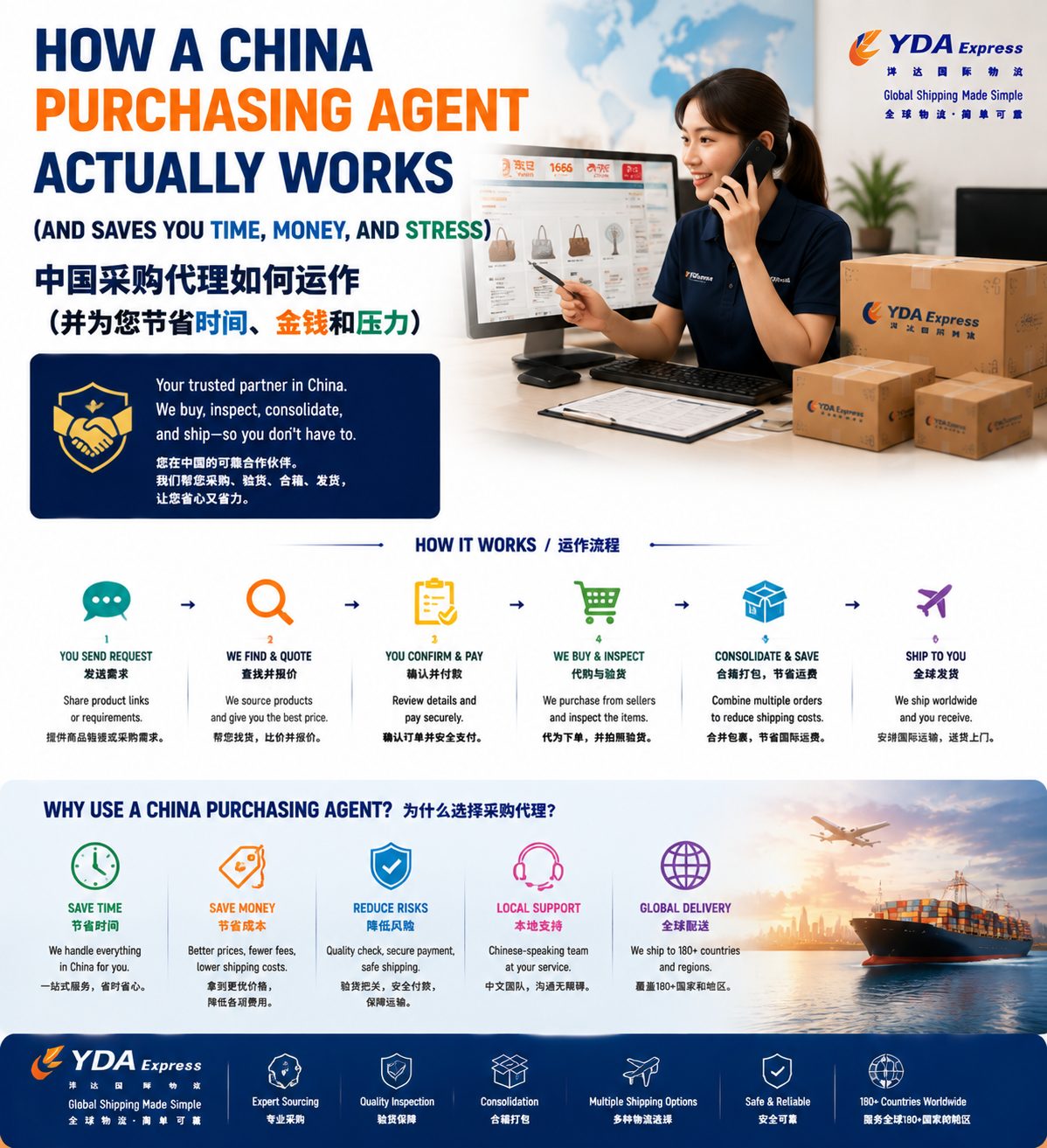
Follow the seven-step China purchasing-agent process from product-link confirmation and seller payment to warehouse checks, consolidation, international shipping and delivery.

A China purchasing agent turns a product link into a managed order inside China. The process usually has two approval points: first, the buyer approves the purchase; later, after the goods arrive and the packed size is known, the buyer approves international shipping.
This page follows an approved order from product request to delivery, with the decision owner and evidence at each handoff. If you have not yet decided what to delegate, use the proxy-purchase authorization guide before payment. For the definition and responsibilities of a shopping agent, sourcing agent and parcel forwarder, read what a China shopping agent is.
The seven-step process at a glance
| Step | Buyer provides or decides | Agent performs | Evidence to expect |
|---|---|---|---|
| 1. Submit request | Link, variation, quantity and destination | Reviews the request and identifies missing details | Itemized request or quotation |
| 2. Confirm order | Approves price, service scope and substitutions | Confirms seller details and prepares payment | Approved order record |
| 3. Purchase | Funds the approved amount | Pays the seller and records domestic shipment | Payment or order status |
| 4. Warehouse receipt | Waits for all selected orders or requests urgent action | Receives, identifies and records parcels | Arrival status, tracking, weight or photos where available |
| 5. Check and resolve | Reviews evidence and chooses return, replacement or acceptance | Performs agreed checks and contacts the seller when required | Photos, notes and problem status |
| 6. Consolidate and pack | Selects parcels and packaging preferences | Combines compatible goods and prepares the package | Final packed weight and dimensions |
| 7. Ship and track | Approves an eligible route and declaration details | Dispatches the shipment and provides tracking | International tracking number |
The exact service varies by provider and product. The useful question at every step is: what must the buyer approve, what must the agent record and what happens if the result differs from the order?
Step 1: Submit an exact product request
The buyer starts with a product link or seller quotation. A complete request should include:
- Marketplace or seller URL
- Selected color, size, model or specification
- Quantity
- Maximum acceptable price, if relevant
- Whether substitutions are allowed
- Customization or packaging instructions
- Destination country
- Known batteries, liquids, powders, magnets, brands or oversized characteristics
For clothing, use measurements rather than a size label alone. For electronics, identify the exact model, voltage, plug and included accessories. For 1688 or customized goods, include the agreed specification, sample requirement, MOQ and production time.
The agent should identify missing or contradictory information before payment. A screenshot without the selected option is not a complete order instruction.
Checkpoint: The buyer and agent should be looking at the same product, variation and quantity.
Step 2: Confirm the quotation and service scope
The quotation should separate the product price from services and costs that occur later.
At the purchase stage, confirm:
- Product price and quantity
- China domestic delivery
- Purchasing or payment-service fee
- Exchange-rate method, where applicable
- Seller dispatch or production estimate
- Optional inspection or photo request
- Domestic return conditions
- Non-refundable customization or setup charges
International freight may remain an estimate because the final packed weight and dimensions are not yet known. A large lightweight parcel can be charged by dimensional weight, while a dense parcel may be charged by actual weight.
If the seller changes the price, says a variation is unavailable or proposes a substitute, the agent should return to the buyer for approval rather than make a material change without permission.
Checkpoint: The buyer approves the exact purchase and understands which later charges are still unknown.
Step 3: The agent purchases from the seller
After the buyer approves and funds the order, the agent places the order using an available payment method in China. The agent should record the marketplace order, seller, paid amount and domestic tracking status.
An agent may make payment easier, but it does not change the seller’s product quality or return policy. Seller due diligence still matters, particularly for high-value, customized or wholesale orders.
For several product links, keep each order line separate. This makes it easier to match incoming parcels and identify which seller is responsible if something is missing.
Checkpoint: The order record should show what was purchased and whether the seller has dispatched it.
Step 4: Parcels arrive at the China warehouse
The seller sends the goods to the agent’s China warehouse. The warehouse identifies the customer and matches the parcel to an order using the domestic tracking number, customer code or order reference.
A useful receiving record may include:
- Arrival date
- Domestic tracking number
- Related purchase order
- Parcel count
- Received weight
- Outer-package condition
- Available receiving photos
Several sellers may dispatch on different days. The buyer can decide whether to wait for all selected orders or process an urgent parcel separately. Storage terms and included periods should be checked against the provider’s current policy rather than assumed from an old article or quotation.
If a courier shows delivered but the parcel is not identified, or a seller splits one order across several packages, use the warehouse receiving and parcel-ID checklist before moving to consolidation.
Checkpoint: Every received parcel should be matched to the correct order before consolidation.
Step 5: Check the goods and resolve domestic problems
Warehouse checking must be defined. A basic visible check may confirm quantity, color, size label, model marking, obvious damage or included accessories. It does not automatically verify authenticity, hidden function, material composition, certification or long-term performance.
The buyer should request the checks that matter for the product. Examples include:
- Clothing label and selected measurements
- Product model and visible markings
- Plug, voltage label and listed accessories
- Number of units or components
- Visible cracks, dents or stains
- Custom logo or packaging appearance
If the goods differ from the order, the buyer decides whether to request a return, replacement, partial refund or acceptance. The agent can communicate with the seller and follow the available marketplace process, but the seller’s decision and return deadline still apply.
This stage is time-sensitive. It is easier to address an incorrect product while the goods remain in China than after international delivery.
Checkpoint: The buyer reviews available evidence and accepts the goods or opens a domestic problem case.
Step 6: Consolidate, repack and approve the final package
When the selected parcels are ready, the buyer chooses which goods to ship together. Consolidation can reduce repeated base charges and unnecessary outer packaging, but combining everything is not always appropriate.
Consider separate packages when goods are:
- Fragile or easily compressed
- Restricted to different shipping routes
- Urgent while other orders are delayed
- Very heavy, oversized or unusually shaped
- Sensitive to moisture, pressure or movement
- Required to keep original retail packaging
The buyer should state which packaging can be removed and which must remain. Repacking can reduce volume, but protection should not be sacrificed only to produce a smaller number.
Before dispatch, review the final actual weight, dimensions, packaging method and eligible route options. For a more detailed provider comparison, use the China shopping agent platform evaluation checklist.
Checkpoint: The buyer approves the packed shipment rather than relying only on the weight of the original seller parcels.
Step 7: Approve shipping, declaration details and tracking
The available shipping route depends on the destination, goods, actual weight, dimensional weight, urgency and carrier restrictions. Ordinary products may qualify for several options, while batteries, liquids, cosmetics, food, powders, magnets, branded goods or oversized items may require advance review.
The declaration should accurately describe the contents and use supportable values. Avoid vague descriptions or requests to declare goods falsely. The buyer or importer remains responsible for destination-country rules, permits, taxes and other import obligations.
After the shipment is accepted by the carrier, the agent provides the international tracking number. Early tracking may show only that shipment information was created; movement appears after carrier pickup or the next network scan.
No agent can guarantee an exact delivery date or customs outcome. The practical service is to provide accurate shipment information, an eligible route and traceable handover records.
For a U.S.-bound order, the warehouse-to-USA release checklist brings the selected goods, packed quotation, import records and delivery details into one final review. It does not replace the actual route or customs check.
Checkpoint: The shipment has an accepted route, accurate information and a working tracking reference.
Where costs become final
Purchasing-agent orders normally have two financial checkpoints.
Purchase-stage cost
This can include the product, China domestic delivery, purchasing service, payment cost and any requested pre-shipment work.
Shipping-stage cost
This can include consolidation, packing materials, special handling and international freight. Destination duty, tax, brokerage or delivery charges may remain separate depending on the route and import terms.
Separating the two checkpoints helps buyers understand why a product quotation is not the same as a delivered-cost quotation.
A practical multi-seller example
Suppose a buyer selects clothing from two Taobao shops and packaging accessories from an 1688 supplier.
The agent records three separate purchases. Each seller dispatches domestically, and the warehouse matches the three incoming parcels to the buyer. The buyer reviews the clothing variations and accessory quantity, resolves any visible problem while domestic action is still possible, and then chooses whether all three parcels are compatible for consolidation.
Only after packing can the final weight and dimensions be used for an international freight quotation. The buyer approves the route, declaration information and dispatch. This sequence creates more control than treating the entire transaction as one unexplained payment.
Buyer responsibility vs agent responsibility
| Area | Buyer normally decides | Agent normally performs when agreed |
|---|---|---|
| Product suitability | Whether the item meets the intended use | Records the selected product |
| Order approval | Variation, quantity, price and substitution rules | Places the approved order |
| Inspection request | Which visible facts must be checked | Provides the agreed check or evidence |
| Problem outcome | Return, replace, accept or escalate | Communicates and processes the available domestic action |
| Packaging | What to keep, remove or protect | Packs according to approved instructions |
| Shipping | Route, speed and cost preference | Offers eligible options and dispatches |
| Import compliance | Destination rules and importer obligations | Provides available shipping documents and parcel data |
The clearest agent relationship is one where every decision has an owner and every completed step leaves a record.
Common mistakes that disrupt the process
Sending only a product picture. The agent needs a working link or a complete seller quotation.
Leaving the variation unclear. Color, model, set and size can change the price and the product received.
Assuming inspection means full quality control. State the required checks and understand their limits.
Waiting too long to review warehouse evidence. Domestic return windows may expire.
Approving freight before final packing data exists. Estimates can change after consolidation and dimensional-weight calculation.
Buying restricted goods before checking a route. Product eligibility should be reviewed before payment whenever possible.
Treating the agent as the importer of record automatically. Destination legal responsibilities must be confirmed separately.
Using the process with YDA Express
YDA Express can provide purchasing assistance and China warehouse forwarding for suitable orders. Buyers submit product links and exact requirements, approve the purchase, review available warehouse evidence and then approve packing and an eligible international route.
The service scope depends on the goods and destination. Review the China shopping agent service guide and send the product links, quantities, destination country and inspection requirements before payment.
Frequently asked questions
Does the agent buy before I approve the quotation?
A controlled process should require the buyer to approve the product details and purchase-stage cost before payment to the seller.
When is international shipping calculated?
An estimate may be available earlier, but the most useful quotation comes after the final package weight and dimensions are known.
Will the warehouse open every parcel?
Policies vary. Confirm whether receiving photos, opening, counting, measurements or function checks are included or separately requested.
What happens if the seller sends the wrong item?
The buyer reviews the evidence and decides the preferred outcome. The agent can contact the seller and use the available domestic return or dispute process, subject to seller and marketplace rules.
Can the agent guarantee customs clearance?
No. Clearance depends on the goods, documents, value, destination requirements and customs authority. A responsible agent can help prepare accurate shipment information but should not promise a guaranteed result.
Can several marketplace orders be shipped together?
Compatible parcels can often be consolidated after they arrive at the warehouse. Fragile, urgent, restricted or route-incompatible goods may be better shipped separately.