
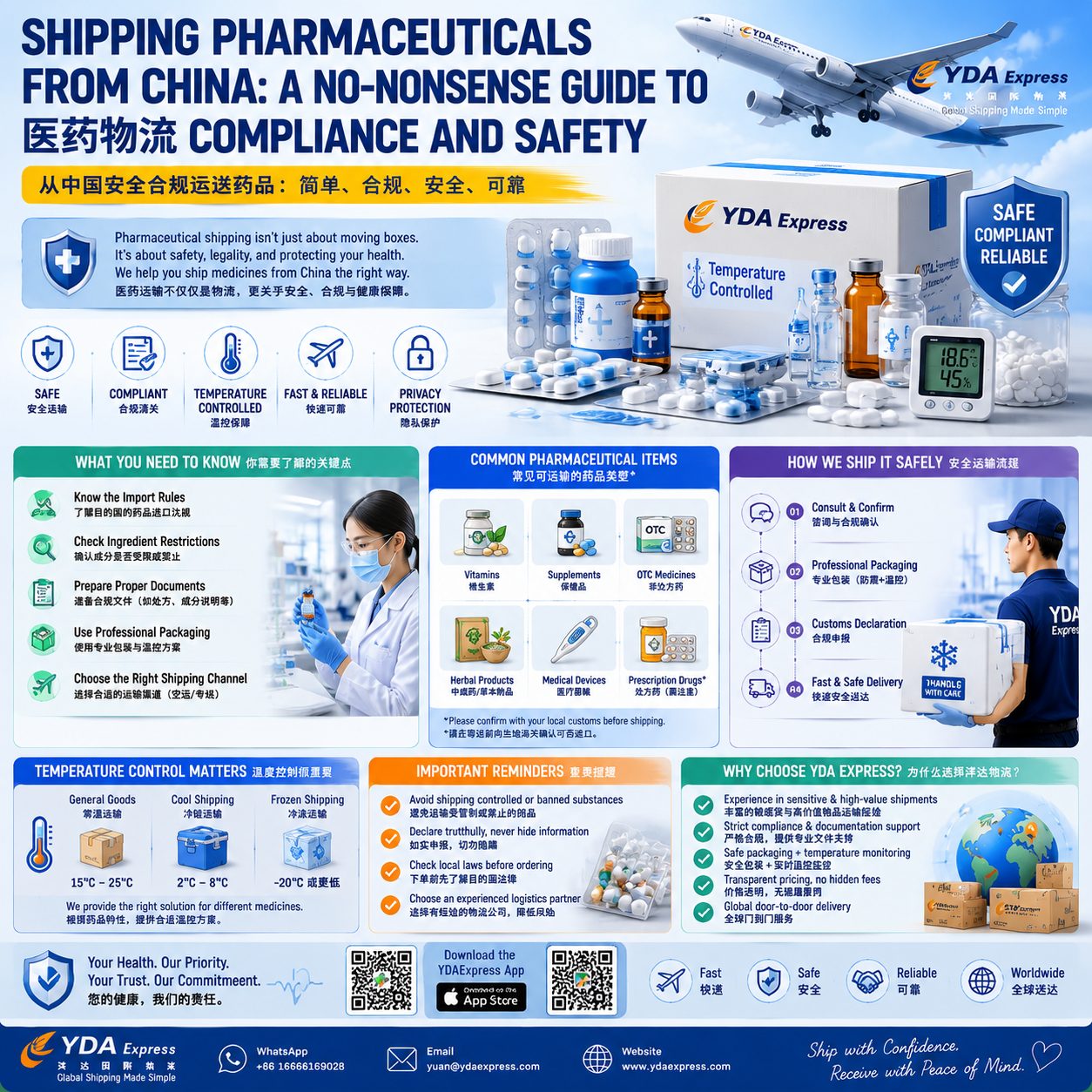
A practical guide to shipping medicine, supplements and traditional Chinese health products from China. Learn how to check import eligibility, prepare documents, inspect products, consolidate parcels and reduce customs risks.
Ordering medicine, vitamins or traditional Chinese health products from China may seem straightforward until the parcel reaches an export checkpoint or destination customs office. A product sold as a supplement in China may be regulated as a medicine elsewhere. A familiar herbal ingredient may require additional documentation, while an unlabeled bottle can be refused even when the contents are legal.
The safest approach is to treat every shipment as a compliance question before it becomes a logistics order. You need to confirm what the product is, whether the destination allows it, which documents are required and whether the packaging can withstand inspection and transit.
First identify how the destination country classifies the product
Product names used by Chinese sellers do not always match the categories used by foreign regulators. A product described as a vitamin, health food or traditional remedy may be treated as a dietary supplement, medicine, controlled substance or medical device after import.
Start by collecting the exact product information:
- Full product name and active ingredients
- Strength, dosage and quantity
- Manufacturer and country of origin
- Original retail packaging and expiry date
- Intended use and whether it is for personal use or resale
Common categories require different levels of care:
- Vitamins and general supplements: Usually easier to assess when factory-sealed and clearly labeled, but ingredient limits still vary by country.
- Over-the-counter medicines: May require dosage information, ingredient details and restrictions on quantity.
- Prescription medicines: Often require a valid prescription, medical documentation or an import authorization. Resale shipments usually involve stricter licensing.
- Traditional Chinese medicine and herbal products: Powders, granules, raw herbs and animal-derived ingredients can create additional customs or conservation concerns.
- Medical devices: Items such as diagnostic kits, monitoring equipment or therapy devices may follow medical-device rules rather than ordinary parcel rules.
Do not rely on the product page alone. Ask the seller for a clear label photo and ingredient list before purchasing. For supplier checks, you can also review this guide on verifying an 1688 supplier before payment.
Check import eligibility before paying the seller
A logistics company can help prepare a shipment, but it cannot make a prohibited product legal. Before placing an order, check the official customs or health authority website of the destination country. Look for rules covering personal imports, prescription medicines, supplements, herbal products, quantities and labeling.
Pay special attention to:
- Ingredients that are controlled, restricted or not approved locally
- Products containing animal parts, hormones, narcotics or sedatives
- Liquids, aerosols, alcohol-based formulas and temperature-sensitive goods
- Maximum quantities for personal use
- Prescription or doctor-letter requirements
- Import permits for commercial shipments
If the information is unclear, send the product link, label photos and destination country to the logistics provider before payment. A responsible provider should explain whether the item is accepted, conditionally accepted or unsuitable for the proposed route.
Prepare documents that match the actual contents
Accurate paperwork reduces questions during export and import clearance. A vague description such as “health product” or “medicine” is rarely useful. The commercial invoice or customs declaration should identify the product clearly, including quantity, form and declared value.
Depending on the product and destination, customs or the carrier may request:
- Commercial or pro forma invoice
- Packing list
- Ingredient list and label photographs
- Prescription or doctor’s letter
- Certificate of Analysis
- Manufacturer or quality certificates
- Import permit or other product-specific authorization
Never underdeclare the value or describe medicine as cosmetics, gifts or ordinary goods. Misdeclaration can cause delays, seizure, penalties or return costs. The recipient’s phone number and email address should also be correct, because customs or the carrier may request clarification directly.
For a broader explanation of document preparation and clearance stages, see this guide to import customs clearance when shipping from China.
Use a China warehouse for inspection and controlled handling
When products are purchased from several Chinese sellers, send them to one warehouse before international dispatch. This creates an opportunity to check the parcel while domestic returns are still practical.
At the warehouse, request checks such as:
- Whether the correct product and quantity arrived
- Whether seals, labels and expiry dates are visible
- Whether bottles, boxes or blister packs are damaged
- Whether different products have been mixed together
- Whether the packaging matches the declaration
Photos can help you compare the received goods with the seller’s listing. However, visual inspection cannot replace laboratory testing, authentication or a medical professional’s advice. If the product is unsuitable, contact the seller before international shipping whenever possible.
YDA Express provides up to 180 days of free storage in its China warehouse, allowing you to wait for orders from different sellers and organize them before dispatch. Read the warehouse storage policy to understand the applicable conditions.
Decide whether to consolidate or separate the parcels
Consolidation can reduce repeated domestic and international handling, but combining every item into one box is not always safe. Separate shipments may be more appropriate when products have different restrictions, temperature requirements, fragility or documentation.
Before requesting consolidation:
- List every product and quantity.
- Separate liquids, powders, batteries and temperature-sensitive items.
- Confirm that all products are allowed on the same route.
- Compare actual weight with dimensional weight.
- Check whether the outer packaging protects each item.
- Approve the final invoice and recipient details.
A well-managed package consolidation service should show which parcels are included and explain any repacking or handling charges.
Choose packaging and transport based on product risk
Non-temperature-sensitive tablets and sealed supplements should remain in their original packaging, inside a waterproof inner bag and a rigid outer carton. Loose pills in unmarked bags are difficult to identify and may attract additional inspection.
For liquids, use leak-resistant sealing, absorbent material and separation from other goods. Temperature-sensitive products require validated packaging and a route capable of maintaining the required conditions. Ordinary ice packs in a standard carton are not a reliable cold-chain solution.
Packaging should also allow customs officers to inspect and reseal the parcel without destroying the contents. This international packaging guide explains how cushioning, sealing and box selection affect transport risk.
What YDA Express can and cannot do
YDA Express can receive parcels, photograph visible details, identify apparent packaging issues, help organize documents, consolidate eligible orders and arrange an appropriate international route. New customers can request a waiver of the purchasing service fee for their first order by contacting support before placing the order. Existing customers may contact support to ask about available discounts or coupons.
No logistics provider can guarantee customs approval. The final decision belongs to the authorities in the origin and destination countries. If a product is prohibited, undocumented or medically unsuitable, the safest decision may be not to ship it.
Final checklist before dispatch
Confirm the product classification, destination rules, ingredients, quantity, expiry date, documents, declared value, packaging, route and recipient contact details. Keep invoices and prescriptions available until delivery is complete. Use tracking and insurance when offered, and respond quickly if the carrier or customs office requests information.
Cross-border medicine shipping becomes more manageable when you assess eligibility before purchase, inspect products in China and declare every item accurately. If you are unsure about a specific medicine, supplement or herbal product, send the product link and destination to YDA Express for a route review before paying the seller.
📲 Download the YDA Express App
Use the YDA Express App to shop from China, place purchasing orders, receive product inspection photos, manage packages, consolidate shipments, and arrange worldwide delivery—all in one place.
🎁 New customers pay no purchasing service fee on their first order.