
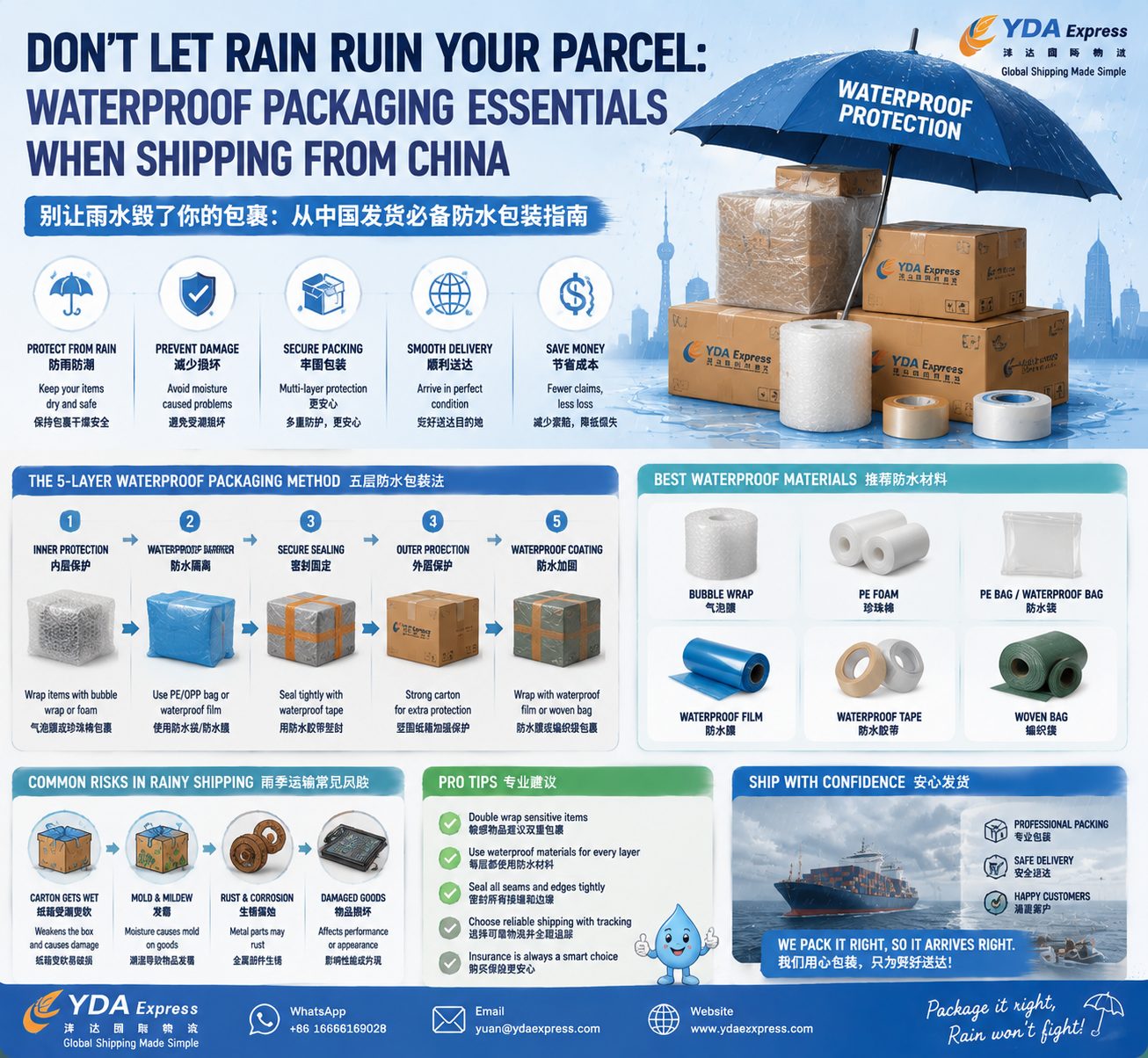
Water damage is one of the most common pitfalls in international shipping. This guide explains why waterproof packaging matters, how to do it right, and where YDA Express can help.
You spent weeks picking out the perfect ceramic tea set from a seller on Taobao. The photos looked gorgeous, the price was right, and the seller promised careful packaging. Three weeks later, the box arrives — and it’s a soggy mess. The cardboard has collapsed, the packing peanuts are a mushy pulp, and half the teacups are chipped or shattered. The culprit? A single encounter with rain during the 5,000-mile journey from China to your doorstep.
This isn’t a rare horror story. Water damage is one of the most frequent and costly problems in international shipping, and it’s almost entirely preventable. Whether you’re importing a few items for personal use or running a small ecommerce business that relies on consistent product quality, waterproof packaging — or waterproof packaging, as it’s called in Chinese logistics — should be a non-negotiable part of your shipping checklist with every order.
The journey from a Chinese warehouse to an overseas address is full of moisture risks. Packages move through humid coastal ports, get loaded onto planes or ships in rain-soaked loading docks, and sit in outdoor staging areas where a sudden downpour can turn a cardboard box into a liability. Even inside a cargo hold, condensation can form as temperatures fluctuate. Without proper waterproofing, your goods are at the mercy of the weather.
Why Waterproof Packaging Is So Critical for Cross-Border Packages
Most shippers rely on standard corrugated cardboard boxes because they’re cheap and recyclable. But cardboard acts like a sponge once it gets wet. A box that encounters even a few minutes of rain loses structural strength immediately. Corners buckle, seams split, and the contents shift and bang against each other. Electronics get short-circuited, fabric items develop mildew, paper documents become illegible. And if the box completely breaks open, the carrier might repack it — often poorly — or worse, return it to sender or discard it as undeliverable.
Customs officers have no patience for falling-apart parcels. If a package arrives at a border inspection point with water damage, the inspector might flag it for additional scrutiny, delay clearance, or even reject entry because the contents are no longer in “good condition” as declared. That’s extra fees, storage charges, and a furious recipient on the other end.
I’ve personally seen a shipment of custom-printed t-shirts arrive at our Shenzhen consolidation center with the box completely soaked from a single afternoon thunderstorm. The carton was sitting on a pallet outdoors for maybe 20 minutes. It didn’t just wet the outer layer; moisture wicked through to the shirts, leaving permanent water stains. That entire batch had to be reordered, setting the client back two weeks and hundreds of dollars. A simple waterproofing step would have prevented it.
Common Scenarios Where Water Sneaks In
Understanding the actual points of vulnerability helps you plan better. Here’s where water typically gets into international parcels:
Ground transportation within China. Before your package even reaches an international hub, it travels by truck. Warehouses in southern cities like Guangzhou or Shenzhen see frequent rain, and during the monsoon season (May to September), torrential downpours are a daily occurrence. If the truck’s tarpaulin isn’t secured tightly or the package is handled briefly on an uncovered loading bay, it gets wet.
At the port or airport. Container ports in Shanghai, Ningbo, or Yantian are massive, open-air facilities. Stacks of containers sit for hours or days waiting for vessel loading. A leaky container seal or a poorly covered pallet can expose dozens of boxes to seawater spray, rain, or condensation. Air freight has its own risks: parcels might sit on the tarmac during loading or unloading, and a sudden rain shower can drench cargo before it’s moved into the plane’s hold.
International transit by sea. Sea freight containers are not completely waterproof. Container doors have seals that can degrade over time, allowing moisture to creep in. Temperature swings between day and night cause “container rain,” where water vapor condenses on the ceiling and drips onto the cargo below. That’s why many importers use desiccants and plastic liners inside the container — but for LCL (less-than-container-load) shipments, your box might be stacked with others that aren’t so well protected.
Last-mile delivery at the destination. It’s not just on the China side. Your local postal service or courier might leave a package on a front porch in rainy London or a snowy doorstep in Toronto. If the outer packaging isn’t at least water-resistant, the final mile can be the final straw.
How to Waterproof Your Shipment: Practical Steps That Actually Work
The type of waterproofing you need depends on what you’re shipping and how tolerant it is to moisture. But there are some universal methods that add minimal weight and cost while providing a big safety net.
1. Poly bagging individual items. Every item inside the box should be sealed in its own polyethylene bag. This is standard for electronics, clothing, and anything with a fabric or paper surface. Even if the outer box gets soaked, the contents stay dry. For small items like jewelry, accessories, or components, heat-seal the bag to make it completely airtight. This also prevents tiny parts from scattering if the box is crushed.
2. Waterproof liner for the outer box. Before you pack anything, line the entire box with a large, heavy-duty plastic bag or sheet. Place the goods inside the liner, then twist the opening and tape it shut before closing the carton flaps. This creates a secondary barrier that catches any water that penetrates the cardboard. I prefer using 2-mil or thicker polyethylene sheeting, cut to size. You can also buy pre-made plastic box liners from packaging suppliers.
3. Use water-activated tape (and the right way to tape). Regular packing tape might peel off when wet, but water-activated kraft tape (also called gummed tape) actually bonds with the cardboard fibers and becomes part of the box. It provides a stronger seal that resists moisture better. When taping the box, cover all seams completely, especially the bottom and top center seams. I see many shippers only tape the top flap joint, leaving moisture an easy entry point through the edge seams. Don’t skimp on tape — a fully taped box is far more resilient.
4. Avoid overpacking with paper or cardboard fillers. Crumpled newspaper or corrugated dividers inside the box will soak up water and hold it against your items, accelerating damage. Instead, use closed-cell foam, air pillows, or plastic bubble wrap as void fill. Bubble wrap has the added benefit of providing some moisture resistance. If you must use paper fill, enclose it in a plastic bag first.
5. Shrink wrap the entire box. A quick pass of industrial stretch or shrink wrap around the outside of your sealed carton adds a final layer of protection. It’s not 100% waterproof but it deflects most splashes and light rain. Many shippers at YDA Express opt for this extra step, especially during the rainy season. It also keeps the box cleaner and makes labels less likely to peel off.
6. Desiccants are your friend. Toss a few silica gel packets inside the liner, especially if you're shipping electronics, leather goods, or anything that can corrode or mildew. Desiccants absorb ambient moisture inside the box during transit. For large cartons, consider using bentonite clay desiccants that have higher absorption capacity. They’re cheap and can save you from a condensation-related headache.
7. Choose double-wall boxes if possible. Single-wall corrugated boxes turn to mush quickly. Double-wall or heavy-duty boxes have an extra layer of corrugation that adds rigidity and takes longer to saturate. It’s a small upfront cost that pays for itself when the package survives a storm.
What About Different Types of Goods?
Electronics. Double bagging is mandatory. Original packaging is often not waterproof, so add a sealed poly bag around the product box. Include silica gel. For high-value items like laptops or phones, consider using a waterproof hard case inside the carton.
Clothing and textiles. Individual poly bags prevent mildew and water stains. If you’re shipping garments on hangers, use garment bags and fold them carefully into a plastic-lined box. Adding scented or moisture-absorbing sachets is a nice touch for customer experience.
Paper products (books, documents). These are the most vulnerable. In addition to a sealed plastic sleeve, you can wrap the item in wax paper or a waterproof, breathable membrane like Tyvek. Place the wrapped book inside a rigid box, then put that box in a poly-lined shipping carton. Yes, it’s extra layers, but water won’t forgive.
Food or health supplements. Many countries require airtight packaging anyway to prevent contamination. Use heat-sealed aluminum foil bags or vacuum-sealed plastic pouches. Make sure any inner packaging is food-safe.
When It's Worth Getting Professional Help
If you’re shipping a few items occasionally, you can manage waterproofing yourself with a trip to the local hardware store for heavy-duty bags and tape. But if you’re running a small business and importing regularly, the time and risk aren’t worth it. A single water-damaged shipment can cost you more in refunds and reputation than months of proper packaging.
That’s where a China-based freight forwarder or consolidation service becomes invaluable. At YDA Express, for example, we handle waterproofing as a standard part of our consolidation process. When your orders from different online stores arrive at our warehouse, we inspect each one, repackage if needed, and then consolidate them into one water-resistant package before forwarding it internationally. Our team knows which carriers are more prone to moisture issues (hint: the cheaper ones often cut corners on handling) and we can recommend the right level of protection for your specific route and product type.
We’ve shipped everything from sensitive medical devices to delicate silk scarves, and we’ve learned through trial and error what works. For high-volume clients, we can even incorporate waterproofing into their standard operating procedure so every outgoing carton gets the same treatment without them having to think about it. It’s the kind of behind-the-scenes detail that makes a difference between a happy customer and a disastrous unboxing.
The Costs Are Minimal — The Consequences Are Not
Some shippers balk at spending an extra $0.50 or $1.00 on waterproofing materials. But compare that to the cost of replacing an entire order or dealing with a chargeback. Even if the damage is covered by shipping insurance, the claims process is time-consuming and often requires extensive documentation. Many carriers have exemptions for “improper packaging,” meaning they won’t pay out if you skimped on protection. So the real cost of poor waterproofing isn’t just the product; it’s the lost trust, the negative reviews, and the operational headache.
Waterproof packaging doesn’t need to be complicated. A roll of polyethylene sheeting, some poly bags, good tape, and maybe a desiccant or two — that’s 95% of what you need. Get into the habit of asking your supplier in China: “Is the package waterproofed waterproof packaging?” before they ship it out. If they look at you blankly, you know it’s time to step in or switch fulfillment methods.
Ready to Ship from China Without the Water Worries?
Whether you’re a first-time importer or a seasoned ecommerce seller, protecting your goods from moisture is one of the simplest ways to ensure a professional delivery experience. If you’d rather leave it to the experts, we’re here to help. YDA Express specializes in parcel forwarding, consolidation, and purchasing assistance from China, and we’ll make sure your packages are sealed tight against rain, humidity, and whatever the journey throws at them.
Got a shipment coming up? Reach out to our team on WhatsApp at +86 16666169028 or email yuan@ydaexpress.com. Or visit our website https://www.ydaexpress.com to see how we can make international shipping from China simple, reliable, and — of course — bone-dry.
📦 China Parcel Forwarding & International Shipping Already placed your order? Send your purchases to our China warehouse for parcel receiving, photo inspection, up to 180 days of free storage, package consolidation, international shipping, and real-time tracking.
📲 Download the YDA Express App One app for shopping, purchasing assistance, package management, consolidation, international shipping, and worldwide delivery.
🌍 More Helpful Guides Explore practical guides on shopping from China, parcel forwarding, shipping costs, and customs clearance.