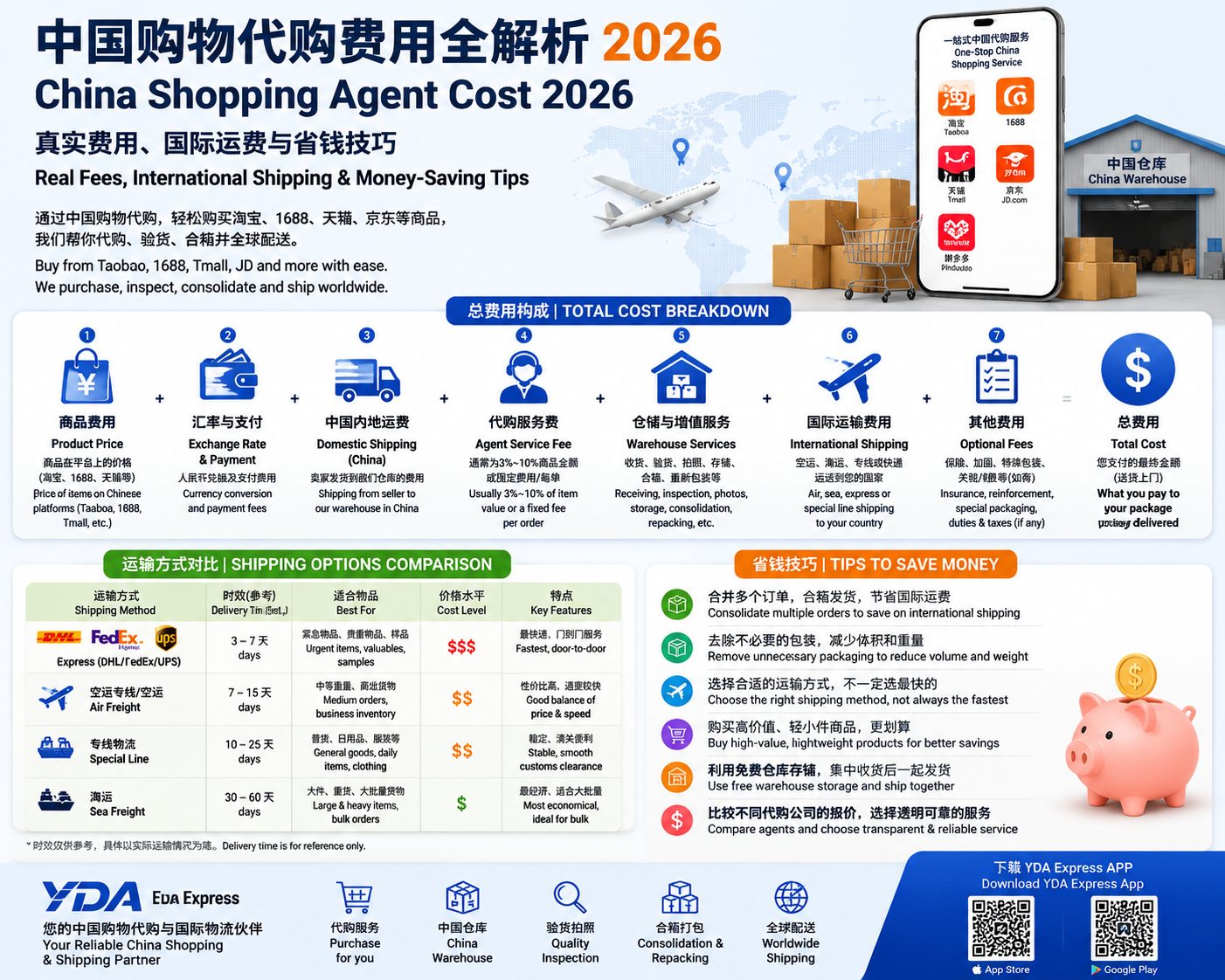
Understand the complete China shopping agent cost: service fees, payment charges, warehouse services, consolidation, international shipping and destination costs.
The total China shopping agent cost is not one fee. It is normally the sum of the product price, domestic delivery in China, the agent’s purchasing or payment charges, optional warehouse services, international shipping, insurance and any destination taxes.
A low advertised service fee does not necessarily produce the lowest delivered cost. To compare providers correctly, request a complete quotation for the same product, quantity, destination and shipping conditions.
China shopping agent cost: quick breakdown
| Cost component | What it covers | What to confirm |
|---|---|---|
| Product price | Amount charged by the seller | Variant, quantity and current price |
| Domestic shipping | Seller-to-warehouse delivery in China | Per order, per seller or included |
| Service fee | Purchasing and order management | Percentage, fixed fee or minimum fee |
| Payment and exchange | Card, transfer, gateway or currency conversion | Exchange rate and processing charge |
| Warehouse services | Receiving, photos, inspection, storage and handling | What is free and what is optional |
| Consolidation and packing | Combining parcels and preparing the shipment | Repacking, materials and handling |
| International shipping | Transport from China to the destination | Chargeable weight, route and surcharges |
| Insurance | Coverage for loss or damage | Insured value, exclusions and claim rules |
| Import charges | Duties, taxes and customs-related fees | Prepaid or collected at destination |
The basic calculation is:
Total landed cost = products + China domestic delivery + agent and payment fees + warehouse services + international shipping + insurance + destination charges
Not every order includes every component. The purpose of the formula is to identify the charges before payment rather than discover them after the goods reach the warehouse.
1. Product price
The product price is the amount charged by the Taobao, 1688, Tmall or other seller. Confirm:
- Selected colour, size, model and quantity.
- Whether the displayed price requires a minimum quantity.
- Whether discounts depend on membership, coupons or domestic promotions.
- Whether customization, samples or packaging cost extra.
- Whether the seller may change the price before the agent places the order.
For 1688 orders, a listing may show several price tiers. The applicable price can depend on quantity and product specification, so the lowest number on the listing is not always the price for your order.
2. Domestic shipping within China
Most products first travel from the seller to the agent’s warehouse. If you buy from five sellers, you may receive five separate domestic delivery charges.
Ask whether domestic shipping is:
- Included in the product price.
- Charged by each seller.
- Recalculated when the seller confirms the order.
- Refundable if an order is cancelled.
- Increased for remote warehouse locations or oversized goods.
Domestic delivery is often smaller than international shipping, but multiple suppliers can make it a meaningful part of the total.
3. China shopping agent service fees
A provider may charge for purchasing, seller communication and order management in different ways:
Percentage-based fee
The service fee is calculated as a percentage of the product value. Confirm which value is used: product price only, product plus domestic shipping, or another subtotal.
Fixed fee
The provider charges a set amount per order, seller, item or purchasing request. Fixed fees can affect small orders more heavily than large ones.
Minimum fee
A percentage may be advertised, but a minimum charge applies when the calculated amount is too low. Always ask whether there is a minimum per order or per seller.
Service included elsewhere
Some providers advertise a low or zero purchasing commission but earn revenue through the exchange rate, payment processing, warehouse services or shipping. This is not automatically a problem, but the full cost must be visible.
When comparing China shopping agent fees, do not compare the commission alone. Compare the amount required to get the same parcel delivered under the same conditions.
4. Payment processing and exchange rates
If you pay in a currency other than RMB, the transaction may involve:
- Currency conversion.
- Card or payment-gateway fees.
- Bank-transfer charges.
- Deposit or wallet top-up charges.
- Refund conversion differences.
- Withdrawal or balance-return fees.
Request the exchange rate used for the quotation and ask whether it can change before the order is purchased. A small difference in the effective rate can matter on a large product order.
To compare quotations, calculate:
Effective RMB received ÷ amount paid in your currency
Also check whether refunds return to the original payment method or remain as account credit.
5. Warehouse receiving, photos and inspection
A warehouse may include basic receiving and parcel registration, while other tasks are charged separately. Possible services include:
- Arrival photographs.
- Additional detailed photographs.
- Quantity checking.
- Measurement or weighing.
- Visible-damage checking.
- Size or model confirmation.
- Functional testing when available.
- Return handling.
- Long-term storage.
- Disposal or removal of unwanted items.
Ask for the exact definition of a “basic inspection.” A warehouse photo does not prove authenticity, materials, performance or regulatory compliance. More detailed inspection should have written criteria and a stated fee before work begins.
6. Storage charges
Many agents provide a free storage period, followed by a daily or periodic charge. Confirm:
- When the storage period starts.
- Whether each parcel has its own start date.
- How many days are included.
- The rate after the free period.
- Whether returned, disputed or restricted goods continue accumulating charges.
- What happens when the maximum storage period expires.
Storage becomes important when products arrive from several sellers at different times.
7. Consolidation and packing fees
Consolidation combines eligible parcels into a smaller number of international shipments. It can reduce duplicate outer packaging and repeated base shipping charges, but it may also involve:
- Handling fees.
- New cartons or protective materials.
- Removal of seller packaging.
- Vacuum packing.
- Reinforcement for fragile goods.
- Wooden packaging or pallets.
- Splitting restricted items into separate parcels.
Ask whether the provider charges per parcel, per final carton, by labour time or by materials used. Removing retail packaging can lower volume, but it may reduce product protection or remove information needed for resale.
8. International shipping cost
International transport is often the largest variable. The price depends on:
- Destination country and postcode.
- Shipping route.
- Actual and volumetric weight.
- Parcel dimensions.
- Product category.
- Batteries, liquids, magnets or other restricted characteristics.
- Declared value.
- Fuel, remote-area or oversized surcharges.
- Customs terms.
- Seasonal capacity.
Actual weight vs. volumetric weight
Carriers commonly compare actual weight with a volume-based calculation and charge the greater value. The divisor and rounding rules differ by route.
Volumetric weight = length × width × height ÷ route divisor
Do not assume one universal divisor. Ask for the route’s formula, unit of measurement and rounding method.
Estimated vs. final shipping charge
A quote made before warehouse arrival may use estimated weight and dimensions. The final amount can change after packing. Request the packed weight, dimensions and any surcharge before authorizing dispatch.
9. Insurance and claims
Insurance may be optional, included up to a limited amount or unavailable for certain goods and routes. Confirm:
- What events are covered.
- Whether coverage is based on purchase value, declared value or another amount.
- Product and route exclusions.
- Required purchase evidence.
- Claim deadline.
- Compensation limit.
- Whether shipping charges are covered.
Insurance is not the same as a delivery guarantee, and poor packaging or prohibited goods may affect a claim.
10. Duties, taxes and customs-related costs
Destination charges depend on the product, declared value, origin, destination and shipping terms. They may include duties, import tax, brokerage, handling or inspection fees.
Before shipping, ask whether the route is:
- Delivered with applicable import charges prepaid.
- Delivered with charges collected from the recipient.
- Subject to separate carrier brokerage or handling.
The agent can explain the available shipping terms, but the importer should verify product restrictions and tax responsibility for the destination country.
Example of a complete quotation
The table below is an illustration, not a YDA price quote:
| Item | Example amount |
|---|---|
| Products | 200 |
| Domestic delivery | 12 |
| Purchasing and payment charges | 15 |
| Optional photos or checking | 5 |
| Packing and consolidation | 8 |
| International shipping | 70 |
| Insurance | 4 |
| Destination charges | Not included in the example |
| Subtotal before destination charges | 314 |
The important lesson is not the example amount. It is that a quotation showing only “products + shipping” may omit several components.
How to compare two agents fairly
Send both providers the same information:
- Product links and exact variants.
- Quantity from each seller.
- Destination country and postcode.
- Expected parcel contents.
- Required inspection level.
- Consolidation and packing requirements.
- Preferred delivery speed.
- Insurance requirement.
- Whether destination charges should be prepaid.
Then compare:
| Comparison point | Agent A | Agent B |
|---|---|---|
| Product subtotal | ||
| Effective exchange rate | ||
| Domestic delivery | ||
| Purchasing fee | ||
| Payment fee | ||
| Inspection and photos | ||
| Storage allowance | ||
| Packing and consolidation | ||
| Shipping route | ||
| Chargeable weight formula | ||
| Insurance | ||
| Destination charges | ||
| Final estimated total |
A fair comparison requires the same scope. A cheaper quotation may simply exclude services or taxes included in another quotation.
Fees that are easy to overlook
Before paying, check for:
- Minimum service charges.
- Fees charged per seller or order.
- Payment-gateway charges.
- Exchange-rate margins.
- Additional photo or inspection fees.
- Domestic return shipping.
- Return-handling charges.
- Storage after the free period.
- Repacking materials.
- Oversized or remote-area surcharges.
- Restricted-product route surcharges.
- Parcel splitting.
- Insurance.
- Customs brokerage or destination handling.
- Refund and balance-withdrawal charges.
Ask the agent to mark each item as included, optional, estimated or payable later.
How to reduce the total cost
Compare landed cost, not product price
A cheaper product can become more expensive after domestic delivery, poor packing or a higher chargeable weight.
Consolidate compatible orders
Combining eligible parcels may reduce repeated packaging and shipment base charges. Do not combine goods when restrictions, fragility or customs treatment make separation safer.
Control parcel volume
Ask for final dimensions and whether unnecessary packaging can be removed without damaging the goods.
Choose the route after warehouse measurement
Select international transport after the parcel has been measured whenever possible. Estimated dimensions can produce an inaccurate comparison.
Define inspection before purchase
A clear checklist helps avoid paying for unnecessary tasks while ensuring important details are checked.
Avoid unnecessary storage
Coordinate seller delivery times and monitor the free-storage period.
Test with a smaller order
A trial order reveals the actual payment, warehouse and shipping charges before you commit to a larger purchase.
Frequently asked questions
How much does a China shopping agent charge?
There is no single universal rate. Providers may use a percentage, a fixed charge, a minimum fee or a combination of purchasing, payment, warehouse and shipping charges. Request a complete written breakdown.
Is a zero-commission agent free?
Not necessarily. The provider may charge through currency conversion, payment processing, warehouse services or shipping. Compare the final delivered-cost estimate.
Is international shipping included in the agent fee?
Usually it is quoted separately, but pricing structures differ. Confirm whether the advertised fee covers purchasing only or includes any warehouse and transport services.
Why did the shipping estimate change?
The estimate may have been based on approximate product information. The final charge can change after the warehouse measures the packed parcel, applies the route’s volumetric formula or identifies a product surcharge.
Are customs duties included?
That depends on the route and shipping terms. Ask whether import charges are prepaid or collected from the recipient and whether carrier brokerage is separate.
Can consolidation always save money?
No. It often reduces duplicate packaging, but a larger carton can increase volumetric weight or trigger oversize rules. Compare the packed measurements and route conditions.
Get a quotation for your order
This page explains China shopping agent cost and fees. If you are ready to buy, use the China shopping agent service and provide the product links, quantities and destination so the order can be assessed.
If you are still learning the terminology, read what a China shopping agent is. For the operational sequence, see how China purchasing agents work.