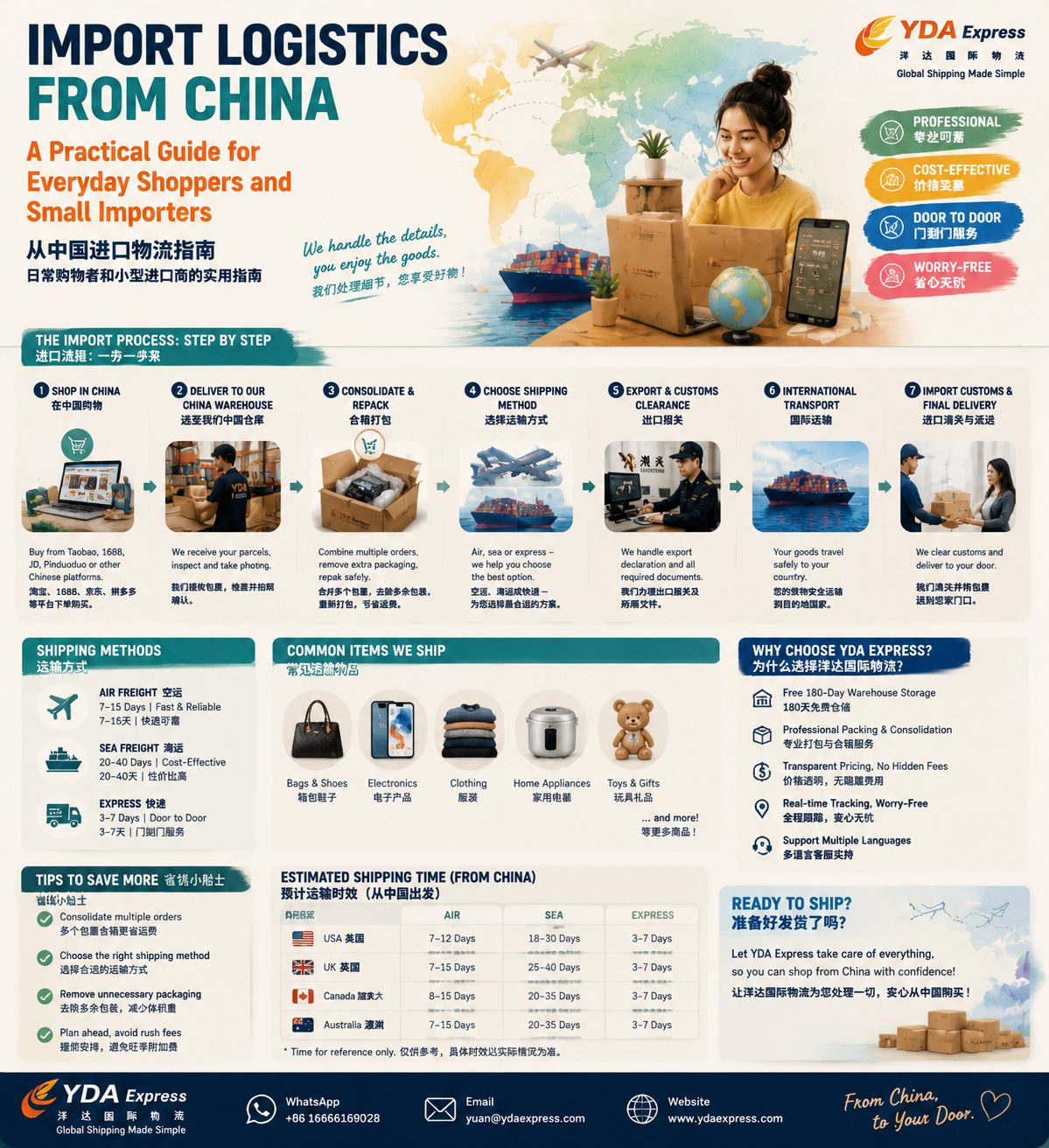
Learn how to plan an import shipment from China before suppliers dispatch the goods. Confirm product restrictions, carton data, delivery terms, warehouse receiving, inspection, consolidation, customs documents, landed cost and delivery timelines.
You have confirmed the product, quantity and price with a Chinese supplier. Then the supplier asks: “Which shipping method do you want?”
Choosing immediately between express, air or sea freight is tempting, but the transport method should not be the first decision. Before requesting a reliable quote, you need the finished quantity, carton dimensions, product specifications, destination requirements and delivery deadline.
A shipping plan prepared before the supplier dispatches can prevent incompatible products from reaching the wrong warehouse, reduce packaging changes, clarify customs responsibilities and make freight quotations easier to compare.
This guide explains what to confirm from the moment an order is placed until the shipment is ready to leave China.
Start with a complete shipment profile
A freight quotation is only as accurate as the information supplied. “Fifty kilograms of products to the United States” is not enough.
Prepare a shipment profile containing:
- exact product name;
- material and intended use;
- quantity;
- unit value and total value;
- country of origin;
- number of cartons;
- gross weight of each carton;
- outer dimensions of each carton;
- pickup location in China;
- destination country, city and postal code;
- delivery deadline;
- personal or commercial purpose;
- battery, liquid, powder, magnet or other sensitive characteristics;
- required insurance or compensation level.
If the goods are not yet packed, mark the figures as estimates. Ask the supplier when final carton data will become available and request photographs of the packed order.
Do not compare shipping prices based on different assumptions. One provider may quote port-to-port sea freight while another quotes door-to-door delivery. The lower number may cover far less of the journey.
Confirm whether the product can use the proposed route
A product that moves normally within China may still face international carrier or destination-country restrictions.
Check before the supplier ships if the order includes:
- batteries or electronic devices;
- liquids, creams or oils;
- powders and granules;
- aerosols;
- magnets;
- food or supplements;
- cosmetics;
- medicine or health products;
- branded goods;
- wood, plants or animal materials;
- fragile, oversized or unusually heavy items.
Ask the logistics provider about the exact product, not only the broad category. “Electronic accessory” does not reveal whether the device contains a lithium battery. “Beauty product” does not identify whether it is a liquid, aerosol or powder.
Provide the product link, specification sheet, label photographs and destination. The pre-shipping restrictions checklist explains which details should be checked before purchasing or sending goods to a forwarding warehouse.
Route acceptance does not guarantee import approval. The destination authority makes the final admissibility decision.
Decide where the suppliers should send the goods
If you purchase from one supplier and the order is already export-ready, it may move directly to the selected carrier or cargo facility.
If you buy from several suppliers, a central China warehouse can receive the orders before international dispatch. This creates time to:
- register each delivery;
- compare received quantities with purchase records;
- photograph visible condition;
- identify missing cartons;
- handle domestic returns;
- consolidate compatible goods;
- replace weak packaging;
- measure the final shipment;
- prepare one coordinated dispatch plan.
YDA Express provides eligible registered customers with up to 180 days of free storage at its warehouse in Yangjiang, China. Review the conditions in the free warehouse storage policy.
Free storage should be used as a planning window, not as a substitute for inventory management. Supplier return deadlines, expiry dates and seasonal demand may be much shorter than the storage allowance.
Understand the supplier’s delivery terms
Before accepting a supplier quote, confirm where the supplier’s responsibility ends.
Common commercial terms can allocate transportation and risk differently. For example:
- Under an ex-works arrangement, the buyer may need to organise collection from the supplier.
- Under an FOB arrangement, the seller typically handles agreed origin responsibilities up to loading at the named port.
- Under a CIF arrangement, the seller arranges specified freight and insurance to the named destination port, but destination costs and import responsibilities may remain with the buyer.
- Under a DDP arrangement, the seller offers broader delivery and duty responsibilities, but the exact scope and lawful importer arrangement still need written confirmation.
The three-letter term alone is not enough. Record:
- named pickup or delivery location;
- who pays domestic transport;
- who handles China export formalities;
- who books international freight;
- who purchases insurance;
- who acts as importer;
- who pays destination handling;
- whether duties and taxes are included;
- where risk transfers;
- what happens if customs reassesses the shipment.
If the supplier and forwarder use different assumptions, the buyer may be charged twice for one stage or discover that an important stage was never arranged.
Compare transport methods using the same criteria
Express courier, air freight, dedicated lines and sea freight serve different requirements. There is no universal weight at which one method automatically becomes best.
Compare each option using:
- total chargeable weight;
- volume;
- destination;
- product restrictions;
- pickup coverage;
- customs arrangement;
- final delivery scope;
- tracking;
- compensation terms;
- estimated handling and transit range;
- possible destination charges.
Express services may suit smaller or urgent shipments that need detailed tracking. Air freight may be appropriate for time-sensitive commercial cargo when the buyer can manage the additional handoffs. Dedicated lines may balance cost and service for supported destinations and product types. Sea freight may suit larger, less urgent cargo, but origin consolidation, port handling, destination charges and final delivery must all be considered.
Do not compare only the line-haul rate. Compare the complete service from the agreed China pickup point to the required destination.
The door-to-door shipping guide explains which stages may be included and what should be confirmed before accepting a door-to-door quote.
Calculate actual and volumetric weight
International transport may be charged according to actual weight or volumetric weight, depending on the route.
Actual weight is measured on a scale. Volumetric weight represents the space occupied by the package. Large, lightweight cartons can therefore be more expensive than expected.
Before booking, request:
- final gross weight;
- final outer dimensions;
- volumetric formula used by the route;
- resulting chargeable weight;
- rounding rule;
- minimum charge;
- oversize or overweight surcharge.
Supplier estimates are useful for planning, but the final quote should be based on the packed shipment. Repacking or consolidation may change both weight and dimensions.
The international shipping cost guide explains how chargeable weight, destination and service conditions affect the quotation.
Plan consolidation around compatibility, not carton count
Consolidation is useful when goods from different suppliers can travel safely and legally in one shipment. It is not simply a request to place every carton inside a larger box.
Before consolidating, compare:
- recipients;
- delivery deadlines;
- product restrictions;
- weight distribution;
- fragility;
- contamination risk;
- customs information;
- route eligibility;
- packaging requirements.
Clothing and flexible goods may allow unnecessary domestic packaging to be removed. Fragile products, retail boxes for resale and structured items may need their original protection. Liquids should not be placed where leakage could damage textiles or documents. Heavy components should not be packed on top of light consumer goods.
Separate shipments may be better when products need different routes, customs documents or delivery times.
The package consolidation guide explains how to decide what should travel together and what should remain separate.
Inspect and document the goods before export
The shipment should not leave China until the received goods have been compared with the purchasing instructions.
Depending on the product and inspection service, useful checks may include:
- carton count;
- visible quantity;
- colour, model or size label;
- obvious exterior damage;
- packaging condition;
- product photographs;
- carton markings;
- gross weight and dimensions.
A basic warehouse inspection cannot replace laboratory testing, technical certification, professional authentication or a complete quality-control inspection.
For commercial production, agree on acceptance criteria before manufacturing or payment. State what should be measured, tested or photographed. “Check the quality” is too vague to produce a consistent result.
If a problem is discovered, resolve it while the goods are still in China and before the seller’s return or correction period expires.
Prepare customs information from the actual goods
Customs preparation begins with accurate product information, not with a generic invoice generated at the last minute.
The final records should identify:
- shipper and consignee;
- specific product descriptions;
- material or composition;
- intended use;
- quantity;
- unit and total value;
- currency;
- country of origin;
- tariff classification when required;
- number of cartons;
- weight;
- relevant permits or supporting documents.
Avoid descriptions such as “goods,” “accessories,” “samples” or “parts” without identifying the actual items.
Keep purchase orders, supplier invoices, payment records, specification sheets and product photographs. The destination authority may request evidence of value, origin, classification or compliance.
The import customs clearance guide explains the documents and recipient responsibilities that should be confirmed before dispatch.
Build a complete landed-cost estimate
A low freight rate does not necessarily produce a low landed cost.
Your planning sheet may need to include:
- product cost;
- domestic delivery in China;
- purchasing or payment service;
- inspection;
- warehouse handling;
- consolidation;
- export packaging;
- international freight;
- fuel or route surcharges;
- insurance;
- customs brokerage;
- duties and taxes;
- destination handling;
- storage caused by delays;
- final-mile delivery.
Ask each provider to label charges as:
- included;
- excluded;
- estimated;
- payable at origin;
- payable at destination;
- conditional.
Avoid relying on the phrase “all-inclusive” without a written list. It may exclude customs inspections, remote delivery, storage, reassessment or other exceptional charges.
YDA Express can provide purchasing assistance for supported Chinese platforms. New customers pay no purchasing service fee on their first order when the offer is requested from customer service before ordering. Existing customers may contact customer service about available exclusive discounts or coupons.
Create a reverse timeline from the required delivery date
Transport time is only one part of the schedule. Work backwards from the date the goods must be available.
Include time for:
- production or supplier preparation;
- domestic transport;
- warehouse receiving;
- inspection;
- correction or replacement;
- consolidation;
- packaging;
- export processing;
- international transport;
- customs clearance;
- final delivery;
- contingency.
Do not treat the fastest published transit estimate as a delivery commitment. Seasonal congestion, weather, capacity, inspections and recipient response can all affect the schedule.
If missing the deadline would cause a serious loss, consider splitting urgent goods from the main order or holding additional inventory rather than relying on one shipment.
Final checklist before the supplier dispatches
Confirm that:
- the product details are complete;
- route restrictions were checked;
- final quantity is known;
- each carton has a weight and dimensions;
- the supplier knows the correct China delivery address;
- your customer or warehouse identifier is included;
- commercial terms and responsibilities are written down;
- all suppliers have provided tracking information;
- inspection instructions are specific;
- return deadlines are recorded;
- compatible products are marked for consolidation;
- the shipping options cover the same service scope;
- customs descriptions and values are supportable;
- the recipient can act as importer;
- excluded destination charges are understood;
- the delivery schedule includes a realistic buffer.
A reliable import plan begins before the goods leave the supplier. Once the products have entered the wrong route, reached the wrong warehouse or missed a documentation deadline, the available solutions become slower and more expensive.
YDA Express can assist with purchasing, parcel receiving, inspection photographs, up to 180 days of eligible free warehouse storage, consolidation, repacking and international shipping planning. Final route selection should be based on the actual goods, packed dimensions, destination requirements and delivery priorities.
📲 Download the YDA Express App
Use the YDA Express App to shop from China, place purchasing orders, receive product inspection photos, manage packages, consolidate shipments, and arrange worldwide delivery—all in one place.
🎁 New customers pay no purchasing service fee on their first order.