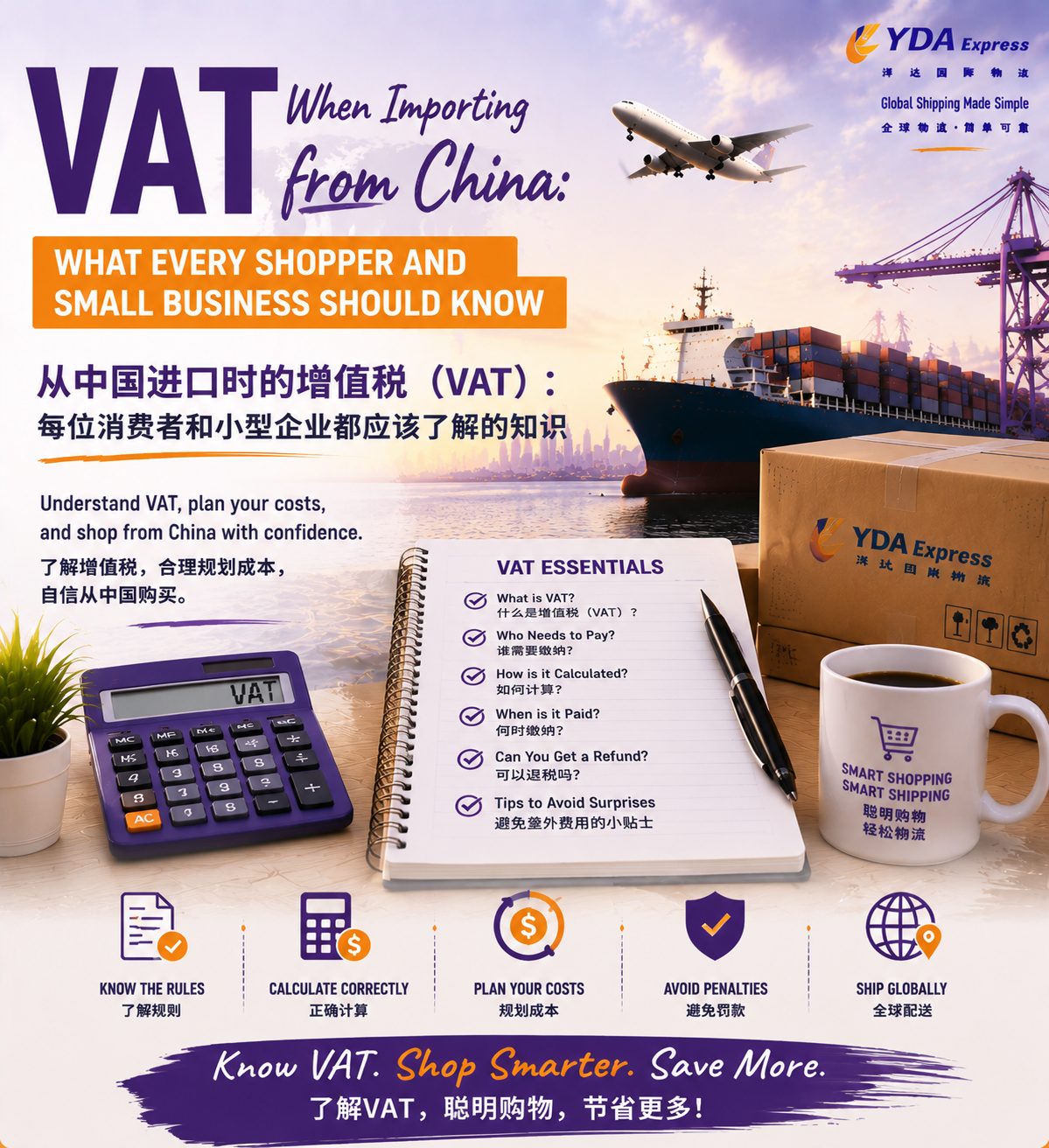
A straightforward guide to VAT on packages from China. Learn how import VAT is calculated, country-specific rules for the EU and UK, the IOSS scheme, common pitfalls, and how to avoid unexpected charges. Includes practical tips for shoppers and small businesses using parcel forwarding services.
You’ve found the perfect item on a Chinese website. Maybe it’s a unique gadget, a batch of custom-made products for your small shop, or just a great deal. You go to check out, and suddenly there’s a line about VAT or import taxes. Now you’re worried: How much extra will you pay? Will your package get held up at customs? Is it even worth it?
If you’re shipping from China to a country with a VAT system, you need to understand how it works. Not the textbook theory, but the real-world stuff that affects your wallet. I’m going to walk you through it – based on years of helping customers bring goods from China to Europe, the UK, and beyond.
VAT Basics for International Shipments
VAT – Value Added Tax – is a consumption tax added at each stage of production and distribution. When you import goods, the destination country’s government wants to collect VAT on the value of the goods as if you’d bought them locally. So if you’re in Germany and you order shoes from China, German VAT applies. It’s usually a percentage of the item’s cost, plus shipping and insurance, and sometimes customs duty.
Separate customs duty from VAT or GST when estimating import cost. In the EU, the old €22 VAT exemption ended in July 2021. IOSS can collect VAT at checkout for eligible consignments up to €150; it does not make the purchase VAT-free. From 1 July 2026, covered low-value distance sales also incur the temporary customs duty calculated by tariff classification, while normal product-specific tariff rules apply outside that scheme. For ordinary UK purchases, the £135 value generally changes the VAT collection point, with other conditions such as excise treatment to consider. Policy checked on 7 October 2026 against EU VAT, EU duty and UK guidance.
The United States does not have a federal VAT, but import duty, other applicable charges and state sales taxes are different questions. The former USD 800 de minimis exemption remains suspended, so a small US-bound purchase must not be budgeted as automatically duty-free. This article focuses mainly on destinations with VAT; for a US shipment, confirm classification, origin, value and entry requirements with the responsible clearance party. See CBP’s current de minimis guidance.
Before shipping, confirm who will be the importer of record and who must pay duties, VAT and clearance charges under the agreed service. The customs authority assesses the goods using the applicable valuation, classification and import rules. A carrier may advance charges and bill the responsible party, or require payment before delivery; its handling fees depend on the actual service and notice. YDA Express can help prepare the agreed documents, but accurate paperwork does not guarantee release without review or delay. Include the charges for which you are responsible in your budget.
How Import VAT is Actually Calculated
Here’s the formula:
Import VAT = (Goods value + shipping cost + insurance + any customs duties) × VAT rate
So VAT is charged on the total landed cost. If customs duty applies, that gets added on first. Let’s run an illustrative calculation using assumed rates and fees, not an actual tariff assessment or shipping quotation.
Example: Assume goods cost €200, international shipping costs €30, there is no insurance charge, and the applicable customs duty rate is 5.5%. The actual product classification, origin and rate must be checked separately.
- First, customs duty: (200 + 30) × 5.5% = €12.65
- Then the VAT base: 200 + 30 + 12.65 = €242.65
- If VAT rate is 21% (Belgium), the VAT = €242.65 × 0.21 = €50.96
- In this illustration, duty €12.65 + VAT €50.96 = €63.61. With an assumed €15 handling charge, the full budget is goods €200 + shipping €30 + duty/VAT €63.61 + handling €15 = €308.61. This is a teaching calculation, not a promise that those rates or fees apply to your order.
That’s why a little research upfront can save you a lot of sticker shock.
A Note on Shipping Method
Postal and commercial-courier shipments both require accurate goods and value information. Choose the service for its accepted goods, timing, tracking, price and clearance responsibilities, rather than an expectation of lower scrutiny. Deliberately under-declaring value can lead to reassessment, penalties, seizure or other action under the destination’s rules.
Country-Specific VAT Rules
European Union
Since July 2021, the EU has no general €22 VAT exemption for commercial imports. Eligible IOSS sales up to €150 collect VAT at checkout, with the required data transmitted for clearance. This is separate from customs duty: from 1 July 2026, covered distance-sale consignments up to €150 incur the temporary €3 duty calculated by tariff classification, subject to the official exceptions. Do not multiply €3 by every physical piece or assume that IOSS removes all carrier fees. Check the declaration, VAT payment record and actual carrier’s handling terms before dispatch. See EU VAT guidance and the current temporary duty rules.
If the seller doesn’t use IOSS, and you’re buying as a consumer, you’ll be asked to pay VAT (and possibly a customs clearance fee) when the package arrives. Platforms like AliExpress often handle IOSS for their sellers, but many independent Chinese online stores don’t. So before you buy, check if the seller mentions “VAT included” or “IOSS” at checkout.
For shipments over €150, both customs duty and VAT apply. The duty rate depends on the product category (HS code) and can range from 0% to 17% or more. You might also need an EORI number (Economic Operators Registration and Identification) if you import frequently or for business.
United Kingdom (Post-Brexit)
The UK left the EU’s VAT area on 1 January 2021. Now, for goods sent from outside the UK:
- If the consignment value is £135 or less, the seller is required to register for UK VAT, charge it at the point of sale, and pay it to HMRC. If they don’t, the goods may be delayed or returned. Many Chinese sellers haven’t registered, so this is a common pain point.
- If the value exceeds £135, import VAT, customs duty, and potential excise duty are collected when the goods enter the UK. The VAT rate is 20% for most goods.
There is no customs duty on goods worth less than £135. Gift shipments between individuals can be exempt up to £39, but only for genuine gifts, not commercial orders.
Do not call Great Britain’s low-value sales-VAT rules a UK version of IOSS. For ordinary non-excise goods outside the UK sold directly to consumers in Great Britain in consignments of £135 or less, the overseas seller normally accounts for VAT at sale; marketplace and business-customer rules can differ. IOSS has a separate scope for eligible distance sales to Northern Ireland and the EU. Checked on 8 October 2026 against HMRC’s overseas-sales guidance and its IOSS scheme guidance.
Other Regions
- Canada: GST/HST applies on most imports, with a de minimis of CAD 20 for postal shipments (couriers have different thresholds). Provincial taxes may apply depending on the destination.
- Australia: 10% GST on most imports; low-value goods (under AUD 1,000) may be taxed if the seller is registered for GST.
- Norway: Not in the EU but applies 25% VAT on almost everything from the first krone, with a simplified VOEC scheme for low-value ecommerce.
- Switzerland: The standard VAT rate is 8.1%, with a 2.6% reduced rate for eligible goods. The small-amount rule concerns import-tax amounts below CHF 5 under the applicable assessment rules, not a universal CHF 5 goods-value exemption or a CHF 200 courier allowance. The tax base can include transport to the Swiss destination and applicable import charges. Registered mail-order sellers or platforms may account for Swiss domestic VAT separately, so a small border-tax amount is not a promise of a tax-free purchase. Checked on 8 October 2026; see BAZG’s VAT rates and postal/courier import-tax explanation.
If you’re shipping to any of these places, treat the EU/UK logic as a baseline and then check local specifics – a few minutes on Google can save a lot of hassle.
The IOSS Scheme: A Game Changer for EU Shoppers
For an eligible IOSS purchase, VAT is collected at checkout and valid IOSS information must be supplied for the customs declaration:
- Keep the receipt and confirm that the seller or marketplace provides the required clearance data. Correct IOSS treatment avoids collecting the same VAT again at import.
- IOSS does not remove customs declarations, applicable customs duty or the carrier’s presentation and handling charges.
- Customs can still request information or inspect the goods; IOSS is not a guarantee of immediate release. Checked on 8 October 2026; Correos explains that IOSS shipments can still incur presentation and handling charges.
IOSS applies to eligible distance sales of goods in consignments up to €150 and requires the seller or marketplace to meet its registration and reporting conditions; excise goods are excluded. If a marketplace collects VAT, retain the receipt and ensure the proper clearance data is available. A purchasing or forwarding service cannot create IOSS eligibility merely by consolidating a parcel. DDP is a different contractual shipping arrangement: where offered, confirm the named importer, which duties and taxes are prepaid and any excluded fees in writing. Do not treat DDP as “mimicking IOSS” or guaranteeing that no extra bill can arise. See the EU IOSS/VAT guidance.
Common VAT Pitfalls and How to Dodge Them
Under-declaring the Value
It’s tempting. Sellers might offer to mark your package as $30 when it’s really $200. Don’t do it. Customs authorities are getting smarter; they check marketplaces, compare similar shipments, and use risk profiles. If caught, your package could be seized, you might face a fine, and future shipments could be flagged. A reputable forwarder won’t under-declare. At YdaExpress, we declare accurately based on what you provide, because the headache isn’t worth the tiny tax saving.
Wrong HS Codes
Every product has a harmonized system code that determines the duty rate. Guessing or using a generic code can lead to delays, higher duties, or reclassification penalties. You don’t need to be an expert, but give your forwarder a clear description of what’s in the box – “women’s leather handbag” is infinitely better than “bag”. We can help assign the right code.
Not Budgeting for the Full Landed Cost
This still catches people off guard. Before you hit “pay”, run the complete calculation: product cost + domestic Chinese shipping + international shipping + customs duty + VAT + any forwarder fees. If you’re a small business, factor it into your pricing. A £100 product with £40 in shipping and taxes needs a selling price above £140 just to break even.
Using Gift or Low-Value Labels
Declaring commercial goods as gifts or marking them “sample” to avoid tax is not a loophole; it’s fraud. Customs define “gift” strictly – sent from private individual to private individual, occasional, not for resale. If your package of 20 identical phone cases is marked as a gift, they’ll see right through it.
Picking the Wrong Incoterm
Incoterms define who pays what in shipping. DDU (Delivered Duty Unpaid) means you’re responsible for all import charges; DDP (Delivered Duty Paid) means the sender or forwarder covers them. If you want a fixed, all-in price, ask for DDP. YdaExpress offers DDP to many European and UK destinations, so you know exactly what you’ll pay before the package leaves China.
How YdaExpress Makes VAT Less of a Headache
We can’t make VAT disappear, but we can help you avoid nasty surprises. After years of forwarding packages from China to over 150 countries, here’s what we do that makes a difference:
- Accurate invoicing: We review your commercial invoice to ensure the description, value, and HS codes are correct. That means customs goes smoother.
- DDP options: For many EU countries, the UK, Canada, and others, we can ship DDP with all taxes and duties pre-paid. You’ll know the total cost before we ship.
- Consolidation expertise: If you buy from multiple Chinese stores (Taobao, 1688, JD, Pinduoduo), we consolidate everything into one box. We’ll give you a clear breakdown of values, so your customs declaration reflects the true consolidated total. No shady “repacking” to hide value – just honest, efficient logistics.
- Customs guidance: Whether it’s your first shipment or your hundredth, we’ll tell you what to expect at your country’s border and which paperwork you might need (EORI, Power of Attorney, etc.).
If you’re a small business importing goods to sell, we can also help you set up a regular shipping pattern that keeps VAT compliance simple and predictable.
Practical Steps Before You Ship from China
- Check the destination’s current official VAT and customs rules. Record the applicable rate, valuation basis and collection method for your actual goods.
- Confirm VAT collection at checkout. Check eligible IOSS treatment for the EU or Northern Ireland, or the applicable Great Britain sales-VAT rules. Separately confirm duties, clearance fees and other costs not included in the price.
- Ask whether DDP is available for your goods and destination. Confirm the named importer and exactly which taxes, fees and delivery services the written quotation includes.
- Budget the total landed cost. Don’t guess; calculate it. A good forwarder can help estimate the taxes.
- Get an EORI if needed. In the EU, if you import goods for business, you’ll likely need one. It’s free and usually quick to get from your national customs authority.
- Use a reliable shipping partner. The cheapest quote isn’t always the best if they cut corners on customs documentation. Look for transparency, experience, and real communication.
VAT doesn’t have to be scary. Get the basics right, work with people who know what they’re doing, and you’ll that international shipping from China can be pretty painless.
Ready to ship from China with fewer headaches? Reach out to YdaExpress. We’ll walk you through the steps, make sure your paperwork is right, and help you choose the best shipping method for your budget. Visit ydaexpress.com or message us on WhatsApp at +8616666169028. Let’s get your package moving – no VAT surprises.
Related guides
- VAT When Shipping from China: A Shipper’s Guide
- Daigou Customs Clearance: Avoid Delays & Extra Fees
- Import Taxes and Fees Explained for China Shoppers
- Shipping from China Customs Duties & Import Tax Guide 2026
📦 China Parcel Forwarding & International Shipping Already placed your order? Send your purchases to our China warehouse for parcel receiving, photo inspection, up to 180 days of free storage, package consolidation, international shipping, and real-time tracking.
📲 Download the YDA Express App One app for shopping, purchasing assistance, package management, consolidation, international shipping, and worldwide delivery.
🌍 More Helpful Guides Explore practical guides on shopping from China, parcel forwarding, shipping costs, and customs clearance.